It was ten minutes after eleven when the gobbling woke me up. The last hour and a half I had spent sleeping and soaking up the late April sunshine. It was warmer now though, and the bugs had begun to move around. My nap had freshened me and I was ready to do battle with the black-feathered monarch of the Central Illinois woods.
I first spoke with this big tom at about 9:00 a.m. I had already managed to mess-up one gobbler right at daylight. An untimely movement on my part sent the first bird of the day to another county—maybe even another state. But I learn quickly, and I would not make the same mistake twice in the same morning.
I knew my gobbler was with the hens when he answered my first call at about 8:50. I made loud excited cutting calls into his valley and he responded immediately. I also heard one or more hens call from his exact location. Patience was the key for this bird, so I made a series of yelps (which he answered), then I shut up and took my nap.
Many years chasing these big birds has taught me a lot about patience. Gobblers do not mind taking their time to do most anything they do. The only time they hurry is when they are leaving. I knew this old boy would service and then slowly lose his hens. I also knew he would come back looking for the one he never saw. He would come back looking for me.
As is their usual practice, he came back to the exact spot where we began our conversation several hours earlier. As he reached this point he began to gobble to reinstate the contact with the hen he heard that morning. As he woke me with this racket, he was about 80- yards away.
I took my time to set-up. I got comfortable. I adjusted my head net and readied my calls. I was prepared to take great care and great time if need be, to harvest this old bird. My first call was just a couple of clucks and a purr. I figured this round could take quite a while.
His gobble was so close and caught me so off-guard that the hair on the back of my neck almost knocked my cap off as it raced to attention. In less than a minute, he had cut the distance between us in half. I could not see him, but he was already within 40-yards. I eased my gun up slowly, pointing in the direction of the gobble. If my judged distance was correct, I should be able to shoot the second I see him.
The next four or five minutes seemed like a week. No movement, no sound. Then, very close to my left, I heard him. “Phtt…Phtt,woooomm.” The spitting and drumming of an adult gobbler is a sound that causes blood pressure to rise and palms to sweat. If you can hear those sounds, you know he is close, very close. I could not move. He was close enough to see me think.
He passed only a few feet from the end of my gun, but I did not shoot. This was for two reasons: first, because he arrived much closer that I had anticipated. I was holding a good foot over his head. Second, with the super-full turkey choke I had in my 12-gauge shotgun, I had no pattern whatsoever. It would be like shooting a slug at that distance. That leaves way too much room for error.
I let him spit and drum and strut and gobble for an eternity, waiting for him to get out far enough so that I could move and shoot. Having a gobbler too close is a problem I enjoy having. Finally, as he strutted, he turned his back to me at about 20-yards. I moved slowly and got on my target. He came out of a strut to gobble, but the sound of my gun was all that could be heard. He weighed 24-pounds 12-ounces, sporting an 11-inch beard and 1 1/8-inch spurs. Patience paid off.
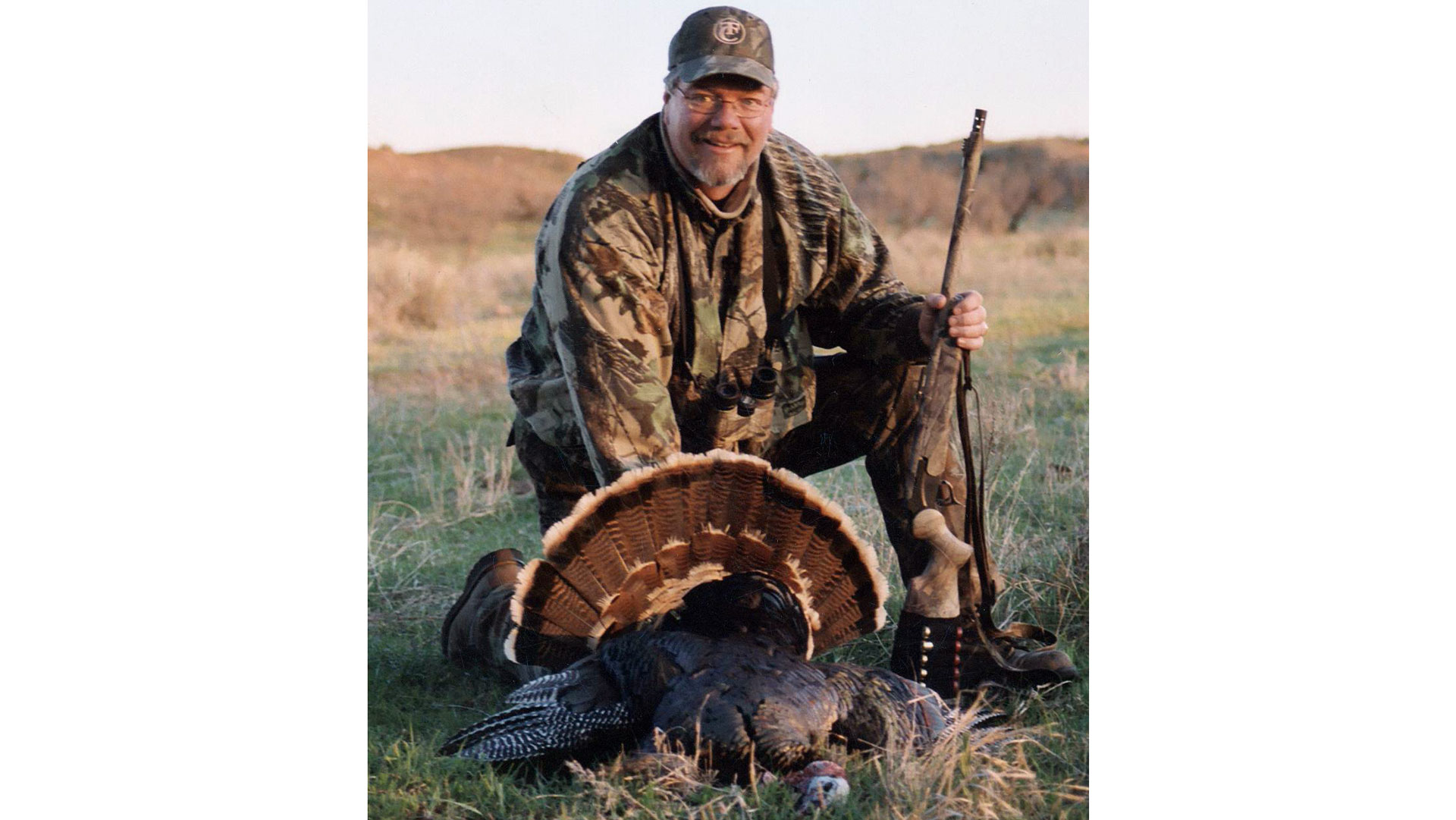
I wished several times during that hunt that I had used a different choke. Traditionally, the tighter the choke the better for turkeys. Making consistent 40-yard shots does demand tight chokes. But, as described, sometimes tighter is not better. More open chokes, especially for the experienced caller, can be very effective and very deadly.
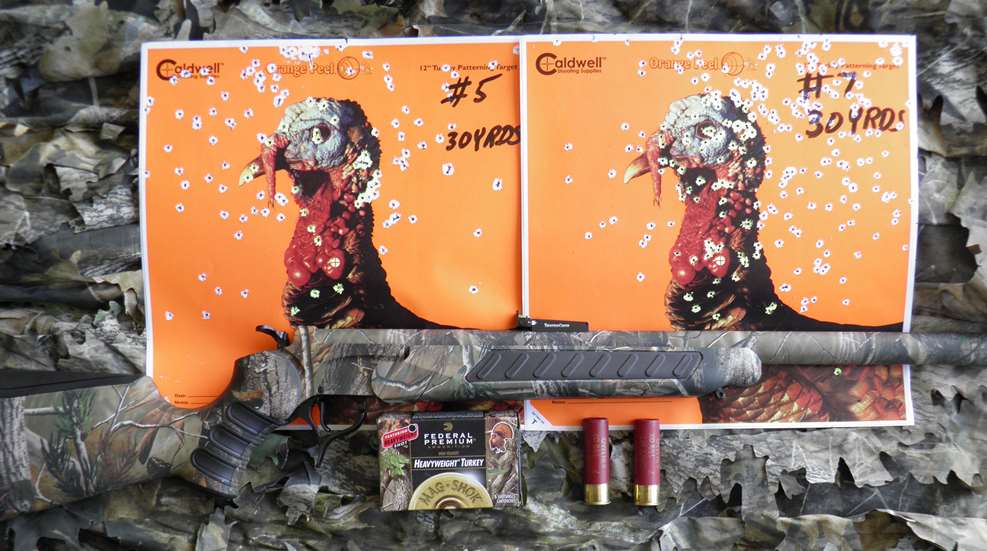
Regardless of the gun you choose, be it a pump, auto or over-under, you should pattern each of your choke tubes with several different loads to find out what works best for you. You may find that 7/8-ounces of #4 shot gives you a more uniform pattern that the same amount of #6 shot. You may find #6 shot with a modified choke gives you more lethal hits than #4 shot with a full choke.
The key is finding out well before the season what combination suits you best. Test firing and patterning your turkey gun will help you become a better hunter. Nobody wants to wound a nice big gobbler and lose him. Knowing what you and your equipment are capable of will help us all maintain this fabulous resource.
Now that we have decided to open-up our chokes for close-in gobbler shooting, we should also examine shot size. I have used #4 or #5 shot for spring turkey hunting for decades. No longer. I have found a much more deadly magnum load that delivers many more pellets to the kill zone at all distances.
Federal’s Premium #7 ½ shot turkey loads are, to my mind, the far superior turkey load on today’s market. The patterns are incredibly dense through all of my guns at all ranges, though my Thompson/Center Encore 12-gauge shoots them best.