We went up the mountain and back in time. The logging road wound through a dense pine forest and into softly melting snow and kept going up. Far below the snow was gone and the first days of June were warming green meadows in the forest. We weren’t seeing black bears down there. We were seeing plenty of British Columbia’s grizzlies. After days of glassing we decided to go up out of summer warmth to the first real thaw of spring. We stopped at a snowdrift and went on foot to an avalanche chute on a southern slope.
A young black bear ran past us at 50 yards. The bear didn’t see us. He was so happy to be out of his hole in the ground he was skipping downhill for meadow grass. There were piles of fresh bear scat along the logging road. We slipped into a shadow alongside the avalanche chute and spotted an old black bear grazing. We stalked in and my hunt was done. All it took was figuring out what black bears need.
The Big Melt
Spring moves north along the Rockies and up elevations, waking ground and sleeping bears as it goes. Much of the northern Rockies doesn’t green up until late May or even June. Contact state wildlife biologists or bear specialists in the area where you want to go—and not just months before, but also weeks and days before traveling, as snow pack and spring melts vary by year.
“The younger bears come out first,” says Mike Hawkridge of Big Country Outfitters in British Columbia. “I think this is because young bears don’t know how to pick sites on the higher north-facing slopes to prevent early thaws from flooding their dens.” Mike is one of the outfitters whose reputation is so good NRAOutdoors.com books NRA members into his camps; in fact, Greg Ray, national sales manager of hunter services (NRA Outdoors) for the NRA, took a group of people to hunt with Mike last spring and they went six for six on big bears.
Black bears will often sleep in past sunrise and won’t move until late afternoon on a hot, sunny day. They like it comfortable. If you’re uncomfortable in the heat or inclement weather they are, too, and they likely will stay in some spot out of the weather. Mid-morning on an overcast day in the spring can be a good time to glass for bears. The best time is typically late afternoon and evening.
The First Green Grass
When a bear comes out of its den it must dislodge a “fecal plug” that forms in its intestines. To do this a bear has to graze. Mike says, “When the plug comes out they defecate like dogs that have been on rancid road kill, so if you’re not seeing bear scat along logging roads and game trails, move on.”
Just because snowdrifts block trails into the backcountry doesn’t mean the bears aren’t out. Deep snowdrifts on the north and west sides of slopes can be present into July, even as higher south-facing slopes green-up in April or May.
Glass avalanche chutes, old burned areas and other open places on those southerly slopes where the first grasses are growing. Bears are lazy. They’ll use the easiest paths and they’ll head to these first green areas to graze.
“I don’t have to contend with hunting pressure much in B.C.,” says Mike, “but if I was hunting on public lands where there were other hunters I’d search for overlooked pockets and get back farther than other hunters. When you find big bear tracks and piles of fresh scat, that bear is around and he’ll be back.”
Calling Bears
On a day in early June a few years back Mike was with a client who was using a bow. They happened to spot a moose dropping a calf. They watched the calf drop. The calf immediately started to bawl. The cow moose knew this meant trouble. She started to take the calf out of there. Mike says, “I told my client to get ready. If there was a bear in the drainage it would come to that sound.” Sure enough, within minutes he spotted a big boar beelining for where the calf had bawled. “We got the bear at 10 paces,” says Mike. “Calling is often like that. If I see a lot of sign of a big boar I’ll set up and use a calf call. They’ll come right in. Often the older bears even target elk or moose calving grounds.”
Some game-call companies make calls marketed for spring bear hunters, but any predator call that can make a fawn bleat will work. As in calling coyotes, a bear might circle downwind, so set up with the wind blowing away from where you expect a bear to be, but, ideally, also in a place where you can see downwind.
The Bear Rut
Black bears breed in late May and June. The timing of the bear rut varies slightly by region, but often coincides with the second half of a state’s spring season. Mature boars will patrol a territory. Bear territories may overlap and will vary in size based on the local bear population and the terrain. “Look for bear scat on logging roads and in areas where they might be feeding—the bigger the bear, the bigger the piles and the bigger the diameter of the droppings,” says Mike.
Bears will bite the tops off small pines. After standing on its hind legs to rub its back and mark a young pine, a bear will reach up over a shoulder and bite off the treetop. The height of a bitten-off pine will give you an idea how tall the bear is.
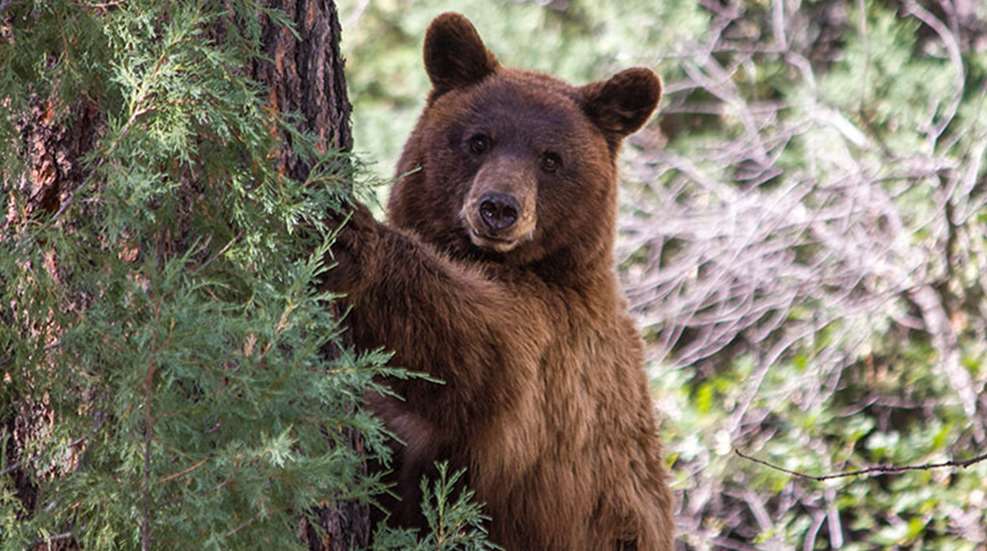
They also leave scratch marks on tree trunks. Black bears have claws that are short, curved and sharp to help them climb to feed on buds and fruits, and escape from grizzlies, so their scratches are often deep cuts into the bark. Grizzlies have digging claws that are long, straight and blunter than a black bear’s. Although a grizzly scratch will often remove a wider strip of bark, its claws won’t dig as deep.
During the bear rut a mature boar will walk the same paths as he waits for a sow to show. “You can sometimes see where their feet have actually stepped in the same spots over and over,” says Mike. “If you find good sign watch your scent. They have so-so eyesight, but they do have the noses of bloodhounds. Call and glass a lot during late afternoon. If you don’t bump that bear—and someone else doesn’t—you should be able to tag that bear.
We went up the mountain and back in time. The logging road wound through a dense pine forest and into softly melting snow and kept going up. Far below the snow was gone and the first days of June were warming green meadows in the forest. We weren’t seeing black bears down there. We were seeing plenty of British Columbia’s grizzlies. After days of glassing we decided to go up out of summer warmth to the first real thaw of spring. We stopped at a snowdrift and went on foot to an avalanche chute on a southern slope.
A young black bear ran past us at 50 yards. The bear didn’t see us. He was so happy to be out of his hole in the ground he was skipping downhill for meadow grass. There were piles of fresh bear scat along the logging road. We slipped into a shadow alongside the avalanche chute and spotted an old black bear grazing. We stalked in and my hunt was done. All it took was figuring out what black bears need.
The Big Melt
Spring moves north along the Rockies and up elevations, waking ground and sleeping bears as it goes. Much of the northern Rockies doesn’t green up until late May or even June. Contact state wildlife biologists or bear specialists in the area where you want to go—and not just months before, but also weeks and days before traveling, as snow pack and spring melts vary by year.
“The younger bears come out first,” says Mike Hawkridge of Big Country Outfitters in British Columbia (bigcountryoutfitters.ca). “I think this is because young bears don’t know how to pick sites on the higher north-facing slopes to prevent early thaws from flooding their dens.” Mike is one of the outfitters whose reputation is so good NRAOutdoors.com books NRA members into his camps; in fact, Greg Ray, national sales manager of hunter services (NRA Outdoors) for the NRA, took a group of people to hunt with Mike last spring and they went six for six on big bears.
Black bears will often sleep in past sunrise and won’t move until late afternoon on a hot, sunny day. They like it comfortable. If you’re uncomfortable in the heat or inclement weather they are, too, and they likely will stay in some spot out of the weather. Mid-morning on an overcast day in the spring can be a good time to glass for bears. The best time is typically late afternoon and evening.
The First Green Grass
When a bear comes out of its den it must dislodge a “fecal plug” that forms in its intestines. To do this a bear has to graze. Mike says, “When the plug comes out they defecate like dogs that have been on rancid road kill, so if you’re not seeing bear scat along logging roads and game trails, move on.”
Just because snowdrifts block trails into the backcountry doesn’t mean the bears aren’t out. Deep snowdrifts on the north and west sides of slopes can be present into July, even as higher south-facing slopes green-up in April or May.
Glass avalanche chutes, old burned areas and other open places on those southerly slopes where the first grasses are growing. Bears are lazy. They’ll use the easiest paths and they’ll head to these first green areas to graze.
“I don’t have to contend with hunting pressure much in B.C.,” says Mike, “but if I was hunting on public lands where there were other hunters I’d search for overlooked pockets and get back farther than other hunters. When you find big bear tracks and piles of fresh scat, that bear is around and he’ll be back.”
Calling Bears
On a day in early June a few years back Mike was with a client who was using a bow. They happened to spot a moose dropping a calf. They watched the calf drop. The calf immediately started to bawl. The cow moose knew this meant trouble. She started to take the calf out of there. Mike says, “I told my client to get ready. If there was a bear in the drainage it would come to that sound.” Sure enough, within minutes he spotted a big boar beelining for where the calf had bawled. “We got the bear at 10 paces,” says Mike. “Calling is often like that. If I see a lot of sign of a big boar I’ll set up and use a calf call. They’ll come right in. Often the older bears even target elk or moose calving grounds.”
Some game-call companies make calls marketed for spring bear hunters, but any predator call that can make a fawn bleat will work. As in calling coyotes, a bear might circle downwind, so set up with the wind blowing away from where you expect a bear to be, but, ideally, also in a place where you can see downwind.
The Bear Rut
Black bears breed in late May and June. The timing of the bear rut varies slightly by region, but often coincides with the second half of a state’s spring season. Mature boars will patrol a territory. Bear territories may overlap and will vary in size based on the local bear population and the terrain. “Look for bear scat on logging roads and in areas where they might be feeding—the bigger the bear, the bigger the piles and the bigger the diameter of the droppings,” says Mike.
Bears will bite the tops off small pines. After standing on its hind legs to rub its back and mark a young pine, a bear will reach up over a shoulder and bite off the treetop. The height of a bitten-off pine will give you an idea how tall the bear is.
They also leave scratch marks on tree trunks. Black bears have claws that are short, curved and sharp to help them climb to feed on buds and fruits, and escape from grizzlies, so their scratches are often deep cuts into the bark. Grizzlies have digging claws that are long, straight and blunter than a black bear’s. Although a grizzly scratch will often remove a wider strip of bark, its claws won’t dig as deep.
During the bear rut a mature boar will walk the same paths as he waits for a sow to show. “You can sometimes see where their feet have actually stepped in the same spots over and over,” says Mike. “If you find good sign watch your scent. They have so-so eyesight, but they do have the noses of bloodhounds. Call and glass a lot during late afternoon. If you don’t bump that bear—and someone else doesn’t—you should be able to tag that bear.
%MCEPASTEBIN%