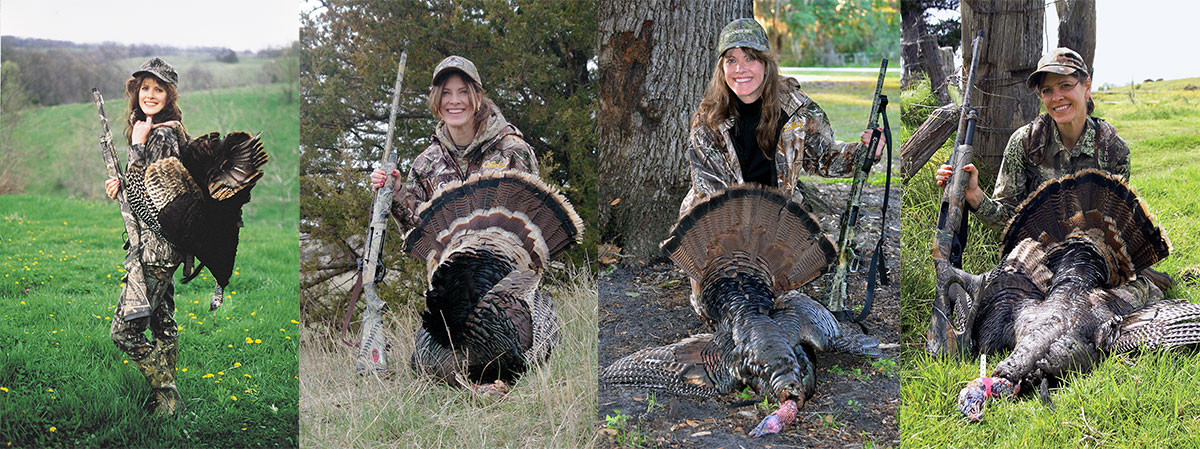
Turkeys have made me crazy for 20 years—why they do what they do, why they don’t do what they’re supposed to do—except for the first bird I ever hunted. When my dad called him in from a good 2 miles away, the eager tom came in strutting, then running, then poked his head up and froze at 20 yards. “Dead bird,” Dad thought. All I had to do was put the bead on his head and fire. But I was so mesmerized by the creature with the scrawny little pinhead that I wasted that precious second by forgetting to shoot. The end result: an education for both me and Tom—and Dad, who learned not to count his chickens, or turkeys.
The next year I got my first bird—a hefty Eastern alongside outdoor-writer buddy and turkey-calling pro Ray Eye. When Ray invited me to film a hunting show with him in Missouri, I never guessed he’d spur a quest for all four U.S. subspecies, partly as I couldn’t seem to get out of Missouri. I joined Ray there for the next five seasons in between bagging Easterns from Maryland to Alabama. I was almost worried on my Alabama venture when the other hunters in camp said the toms weren’t talking. Fortunately my friend Eddie Salter was there, a turkey-calling pro who had been on the Hunter’s Specialties pro staff for years. I told him, “I’ll get a turkey because I’m teaming up with you.” No pressure, Eddie. We dropped one that first hour—the only bird in camp.
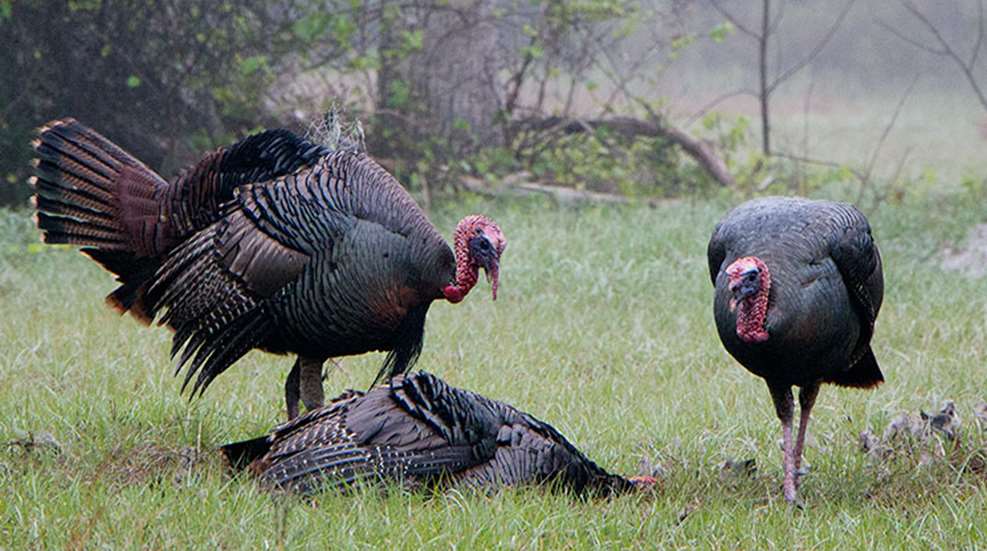
The following year, 2004, I had a chance at a new subspecies when I joined friends at Federal Ammunition for a call-your-own Osceola hunt in Florida. “They look like Easterns—just smaller and not as smart,” was what I’d heard. Still, that first morning I made sure I set up in more open woods—no fences, streams or other obstructions—to help ensure gobbler cooperation. I never heard a gobble. No gobbler challenge? No peeps to blow off steam? On the last day, I crawled into a ground blind against the palmettos and broke out all the toys in my turkey vest. Nada. Then a bird simply appeared—neck stretched, head up—standing quietly on the edge of an opening at 30 yards. In the second it took me to aim, he was gone. It didn’t help that turkeys have monocular vision and can view most of their surroundings without moving their head.
Easterns were more my thing anyway, so I spent the next few years slammin’ a couple more. There was rarely the need for a “rain check” as I realized pelting raindrops forced insects, worms and seeds to the surface, making food easy for turkeys to get while hindering their hearing and eyesight. I also perfected my “fakes with jakes”—using jake decoys to ruffle wary gobblers’ feathers, knowing they’d have to spank the young ’uns and drive them from the hens.
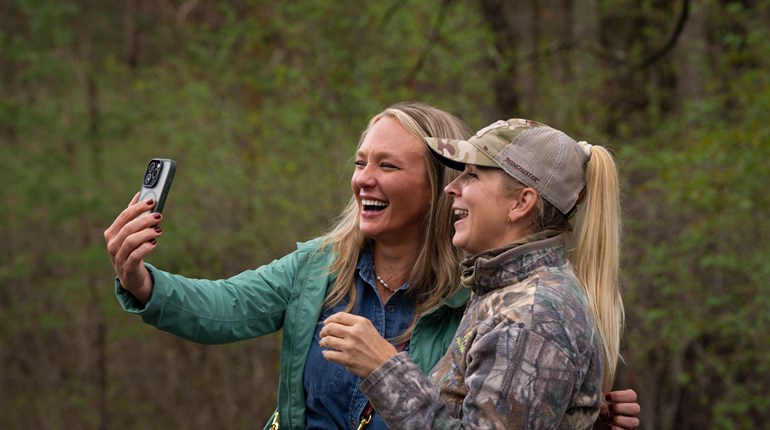
In the spring of 2009, Ray called to say, “Sweet Pea, you need to get serious about this ‘grand slam’ business,” referring to taking all four of the U.S. turkey subspecies—the Eastern, Rio Grande, Merriam’s and Osceola—a prestigious feat he’d achieved many times over. So Ray, our friend Linda Powell at Mossberg, and a few more of our outdoor writer buddies and I decided to go for a Rio Grande—in Hawaii. Where else can you shoot a gobbler and be walking the beach by noon? The morning I shot my gobbler, I remember telling outfitter John Sabati (second from right in the above photo) how surprised I was to hear turkeys gobbling and flying down from the roost in the dark. Then I realized the Big Island had no predators—nothing that put turkey breast on the springtime menu except hunters.
The next spring, Merriam’s were up. Our group headed to Devil’s Tower, Wyo., to hunt at outfitter Mike Schmid’s Solitude Ranch. This was the first time I’d ever hunted with a guide who whipped out a turkey-tail fan to close the distance on a stubborn field bird—not something I’d recommend in the crowded areas back East. (Fans are not legal everywhere so first check the game regs in the state you’re hunting.) We set up against a tree and called. I shot the bird five minutes later. I liked the unique, white-tipped feathers of the Merriam’s so much that the next year I took my sister-in-law, Tricia, on a Cabela’s hunt for her first turkey—a Merriam’s in Nebraska. She not only got a bird—her 30-pounder turned out to be the new women’s record Merriam’s. Seriously?
Then I went back to Easterns for a few seasons. I still needed an Osceola for a slam, but their home range of Florida tended to be off my beaten path. Then Ray called to press the issue and even dangled the “and-a-trip-to-Disney-World” carrot. So Ray, Linda and our crew headed to Orlando. It was 11 years since I’d hunted an Osceola bird. As I pulled into camp at Lake Okeechobee Outfitters with a Mossberg “tom terminator,” I hoped the gun would change my luck.
It didn’t. On the first morning, hens crushed my first two attempts. Then I missed a bird—at 18 yards. Now, not even finding an Osceola at the right time in the right place made for slammin’ success. So I hit the reset button. The next day the guide and I hit a new area. I like it here, I thought, appreciating the slight breeze from my new setup under the pines along the edge of a field. When we saw an albino doe across the field at 150 yards, I wondered whether she was good luck for Osceolas or if she’d just serve me more of the same.
Minutes later we got an answer to our raspy yelps. A tom was on the scene at 100 yards, marching across the field toward us. By the time he hit 30 yards, he was gobbling in five-second intervals, desperately searching for that hen. His head lurched forward once more. Boom. I had my slam.
While some hunters tackle all four subspecies all in one spring season, I opted to spread it out over time—16 years to be exact. But whether you’re after a new subspecies or you’re on Eastern bird No. 22, the familiar sense of anticipation and excitement is front and center every time.