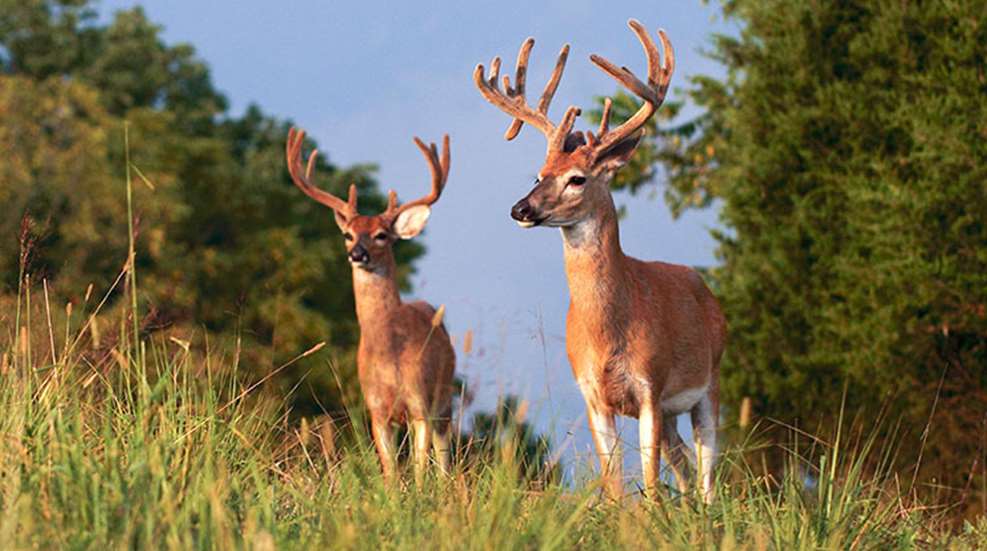
You see a buck across a field in the soft, late light of a summer evening. You tell yourself he isn’t really that big. The velvet on his rack in the diffused light is giving the buck cartoon proportions. But he is big enough. You next look at the woods beyond the buck and wonder how you can get him in your sights in autumn daylight. To make that happen you have to concede and understand a few things.
Bachelor Groups
The bachelor groups of bucks you see in July or August will break up in September or early October in the northern states. Bucks will begin to drift apart when they shed their antler velvet. Ryan Bland, owner of Non-Typical Outfitters in Illinois and one of NRA Outdoors’ trusted partners, puts out trail cameras in the summer but admits you can skip that, as nearly all the bucks he gets photos of move off his properties before the season. Different bucks move in. It’s the fall shuffle, and biologists are still trying to understand it. So are hunters.
“Last season I killed a buck that used to disappear every year,” says Bland. “He did last season, too, but for some reason he popped back on the cameras after Thanksgiving.”
If your deer season starts before bachelor groups break up, you can target them in the evening during the first few weeks. Hang stands in travel corridors to ambush the bucks as they move to feed in a field or on early fall mast crops such as white oak acorns or persimmons.
Early Rubs and Scrapes
Rubs and scrapes in early October tell you one or more mature bucks are on your property, as most early buck sign is made by older bucks. Bland says, “In a few places I have lookout posts that let me glass early-season feeding spots 700 yards away. Mostly I rely on early rubs and scrapes, terrain and past experience to target the mature deer that are now on a bed-to-feed pattern.”
Core Areas
A big buck spotted in the early season is probably bedding nearby. Many GPS-collar studies have shown that a buck’s core area—the Quality Deer Management Association (QDMA) defines this as an area where a buck spends at least 50 percent of its time—is only about 10 percent of its home range. Studies have found that, in most of the country, core areas tend to be around 60-80 acres. In good habitat a home range, in contrast, is typically between 250 and 500 acres. Putting a number on this can be deceiving, though, as a buck’s range is rarely a square—more likely it is as twisted as a gerrymandered congressional district.
Different Personalities
Mature whitetail bucks are individuals. Brian Murphy, CEO of QDMA, points out that a buck’s home-range size is highly variable. Like people, some bucks seem to be homebodies, whereas other bucks like to roam. Murphy also says research shows some deer take short “vacations”: GPS collars have taught us that deer go on brief trips outside their established home ranges. This happens throughout the year, but it increases during the rut. When you’re scouting out a big buck, you need to treat the buck as his personality dictates.
Low Impact
Trail cameras are an incredible whitetail-hunting tool, but they also save the lives of a lot of mature bucks. Hunters who insist on getting back into the cover pre-season to see what bucks are there by hanging cameras and checking the cards are tipping their hands. They leave scent and disturb places where older bucks are very sensitive to intrusion. Every outfitter and biologist who hunts I’ve talked to says to stay out of a buck’s core area until hunting season—and then to hunt as low-impact as possible.
Big Buck Fact: In the search phase of the whitetail rut, mature bucks prefer to walk perpendicular to the wind, not right into it. This allows them to skirt large openings and cover territory with both their noses and eyes. Consider this habit when choosing stand locations.