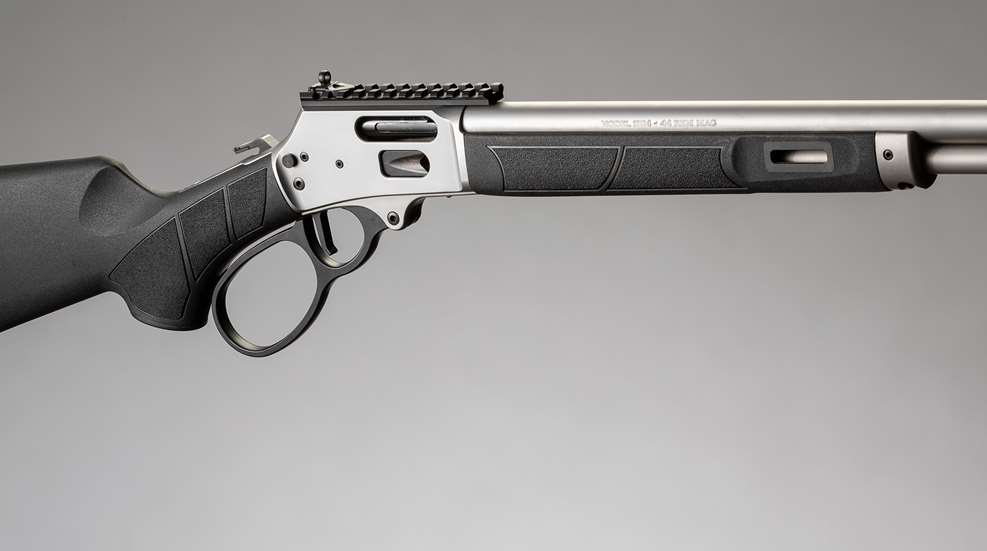
Before its completion, attendees of the 2024 NSSF SHOT Show had already deemed it “the year of the lever gun,” as seemingly dozens were introduced, and many were from unsuspecting manufacturers. Chief among them was the Smith & Wesson 1854, the company’s first lever action in close to 170 years. This mid-length rifle drew quite the crowd. Upon first grasping it, I appreciated the fusion of features, both new and old, and what felt like an impeccably smooth action. Of course, the only way to tell for sure is to cycle some live ammo through it, so before leaving the booth I put in my request for a test sample.
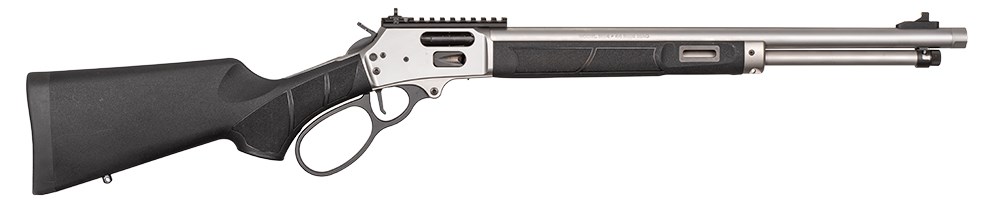
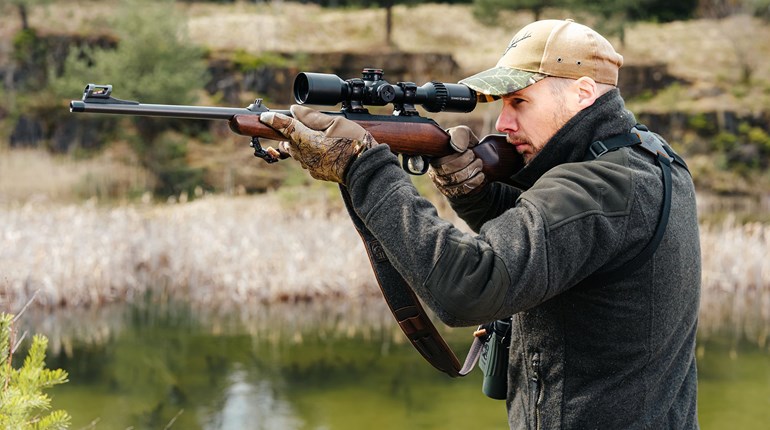
When my test rifle finally arrived, I was pleased to see that it included the combo ghost ring/Picatinny rail that was mounted to it at the show, something that is often used just for display. This aligns with a robust front sight that houses a brass bead. Rifles that arrive ready to shoot are a rarity these days, and those looking to use this as a short-range deep-woods firearm should get by just fine without mounting an optic. I was tempted to test it as it sat but better thinking prevailed. So I mounted a Sightron S1 4-12x40mm optic to ensure there would be less “me” superimposed on my groups later that day. The 1854 is built with a stock that drops down a fair bit, which is partly inherited and partly fashionable to this firearm style. Nonetheless, if you keep to optics with a narrow objective lens and low rings, you should be able to maintain a comfortable cheek weld. I went a touch higher than optimal, as it allowed me to peek through the lower portion of the rings and use my iron sights for the informal portion of my upcoming test.
Smith & Wesson’s lever gun isn’t like any other, as several introductions this year were merely clones of existing firearms. Although there isn’t much room to grow with this platform, the company certainly made it its own, which is largely evident in the feeding system. As of late, the debate between side gate or tube loading superiority has been settled by models that offer both. Smith took a similar route, but instead of going with a conventional “tube within a tube” design, the company got it done with a single sleeve that slides through the fore-end. This yields the benefit of simplicity and openness, allowing for an unobstructed view to ensure the firearm is unloaded, as well as a reduced chance of a round hanging up somewhere between the magazine and chamber. Now, this does come at the expense of not being able to load from the top, but a polished side gate mechanism balances this quite well.
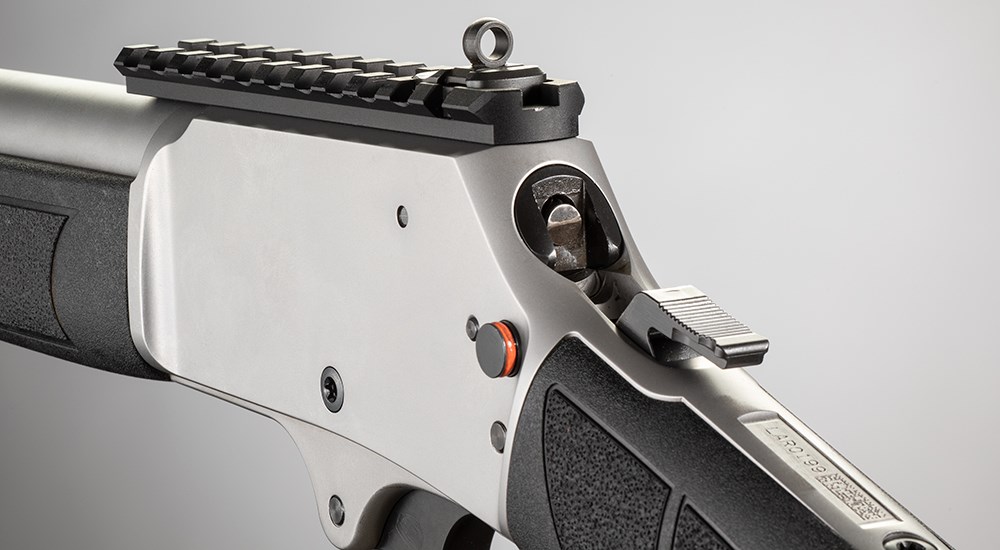
Controls on lever-action firearms are nearly non-existent, so the addition of a cross-bolt safety garnered a few talking points. Admittedly, I wasn’t a fan, as depressing the trigger with it engaged still allows the hammer to fall. Typically, a safety stops the trigger from moving or at least arrests the ignition components. When buck fever kicks in, this serves as a gentle reminder that you forgot to disengage it and offers a second chance on that trigger press. In the case of the 1854, if you forget to flip it off, anything within 50 yards is going to hear that telltale metallic clang and run off. However, S&W got it right by incorporating a half-cock safety. Hunters can use the cross-bolt safety as a layer of protection as they gently decock the firearm. Then, they can bring it to half-cock, flip off the safety and settle in. From here, all one would have to do is bring it to full cock before sending their first round. This is probably a good time to mention that the 1854 isn’t built with a transfer bar, so resting the hammer on the firing pin is not a safe option when a round is in the chamber.
Among the features that I consider modern is the trio of M-LOK slots at the 3, 6 and 9 o’clock positions molded into the fore-end. Being that it’s made of polymer, the most vulnerable ones are reinforced with steel to ensure they can handle a less-than-loving tap against a tree trunk or boulder. In addition, the muzzle is threaded for a suppressor or brake, which wasn’t a consideration when the lever action first saw service. Heck, I’ll go as far as saying we didn’t consider suppressors for hunting until the early 2000s, and even that might be generous. Lastly, the 1854 is built with a modern trigger shoe that is both flat and wide, signifying the discoveries we’ve made in the last decade through the input of accomplished shooters like Julie Golob and the entire Miculek family.
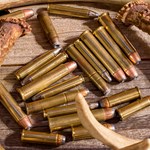
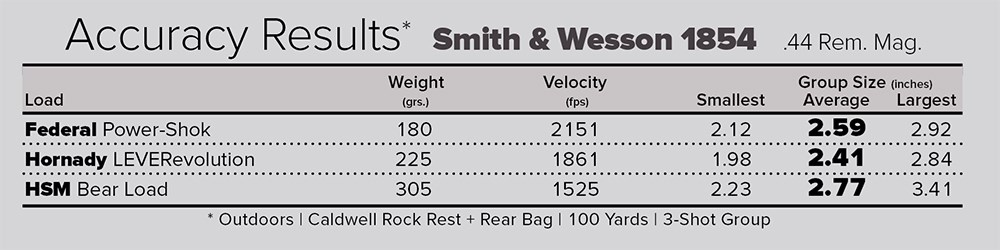
Although the 1854 can technically also fire .44 Special, I kept my test loads to .44 Rem. Mag. On the light side, I chose Federal’s Power-Shok ammunition, as it’s easy on the shoulder and light on the wallet. It’s perfect for short-range whitetail and a terrific practice round during the offseason. For longer pokes, I grabbed a few boxes of Hornady’s LEVERevolution, as their soft ballistic polymer tip helps them fly straighter longer, without the possibility of igniting in the magazine under recoil. Lastly, I selected HSM’s heavyweight Bear Load delivering a 305-grain hard-cast projectile—good medicine for even the largest beasts in the woods.
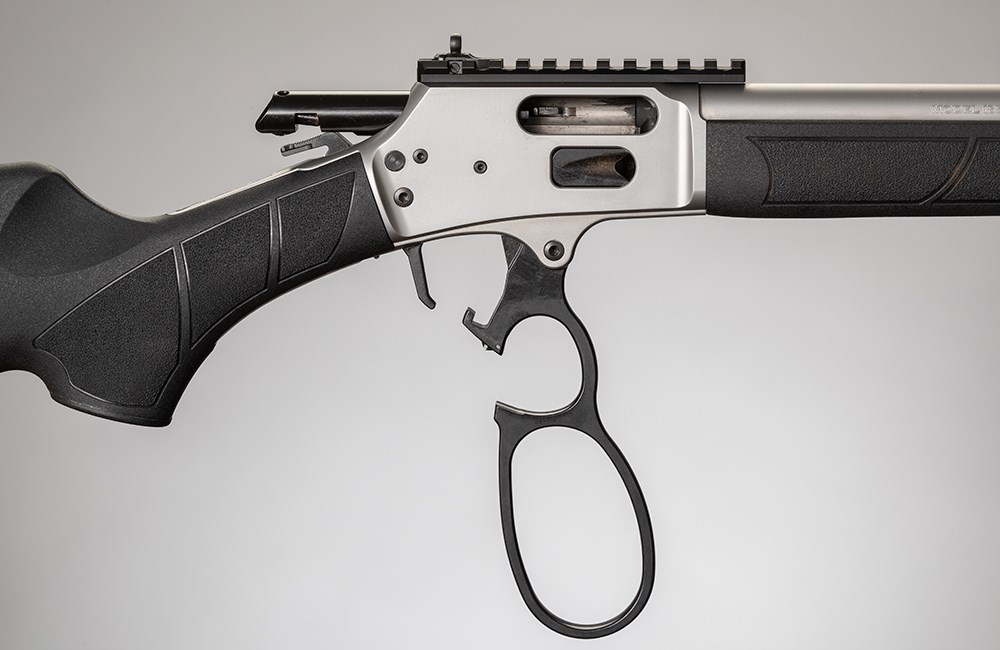
Beginning with a bit of dry fire, it was evident that Smith & Wesson paid plenty of attention to the trigger mechanism. They advertise that they incorporate the same detail as they do their revolvers, and I feel comfortable echoing that claim. I found that it had ample, unburdened slack, a defined wall and only a level of creep that a gun writer might notice. More importantly, it had zero overtravel and broke just over the 5-pound mark. Loading the firearm was effortless, as was unloading it through the tube, which certainly beat cycling every round through the action. Working the oversized loop felt like it was made of greased glass, and touching off the .44 Mag. was exhilarating. Although we pushed the limits of this cartridge’s effective range, groups were respectable and well within the capability of landing a neck shot at moderate distances. I found that the 1854 pulled substantially more velocity from each round compared to what was advertised. This is because nearly all .44 Mag. data is derived using a revolver-length barrel. Not surprising, but our numbers were impressive for a .44 Mag., and worth noting.
I called it a day after running more than 200 rounds through the rifle from various field positions throughout a woods-walk target course, all without a single malfunction. Making hits on vitals from 35 to 109 yards was effortless, as was running the lever in a kneeling and seated position. While accuracy is paramount in my book, I like to judge how well a company navigates uncharted water. Smith & Wesson certainly nailed it. The only downside I was able to find was the cross-bolt safety. However, since there are other mechanical safety measures present, some might view it as a happy one. Overall, acknowledging that I’m just a bit jaded from promises of ingenuity that aren’t met, I think the Smith & Wesson 1854 is a welcome breath of fresh air.
Technical Specifications
• Type: lever-action centerfire rifle
• Caliber: .44 Rem. Mag.
• Magazine: tubular; 10-rnd. capacity
• Barrel: 19.25"; stainless steel; medium profile; button-rifled; 1:20" RH twist,
8 grooves; 11/16x24 threaded muzzle w/cap
• Trigger: single-stage; 5-lbs., 3-ozs. pull weight
• Sights: adjustable rear XS ghost ring, fixed brass bead front; Picatinny rail
• Safety: two-position cross-bolt; half-cock
• Stock: straight comb; polymer (tested, wood available); dark grey; 13.25" LOP
• Metal Finish: matte stainless steel
• Overall Length: 36"
• Weight: 6.8 lbs.
• Accessories: none
• MSRP: $1,279; smith-wesson.com