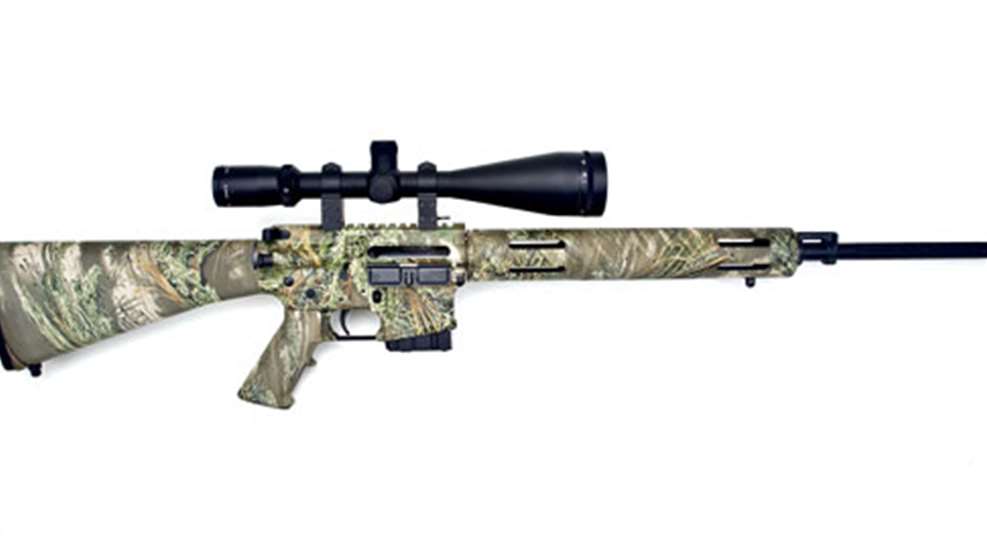
Remington ships the R15 with a shortened five-round magazine. Military magazines of 20- and 30-round capacity will function in the R15. It is chambered in .223 Rem. and .204 Ruger.
The R15’s controls and manual of arms are identical to the AR-15. There is a thumb-operated, manual safety that blocks the hammer and sear, which is ergonomically placed above the trigger, on the left side of the receiver for ease of use by right-handed shooters.
There is a bolt-release button in front of and above the safety. The R15’s bolt carrier locks to the rear when the last round is fired from a magazine; pressing the release allows the bolt carrier to slam forward.
The right side of the receiver houses a magazine release button in front of the trigger and behind the magazine well. There is also a protruding button behind the ejection port. This is the “forward bolt assist” that allows the shooter to shove the bolt carrier forward a half-inch or so in the event of a round failing to go fully into battery. Excessive fouling is an inherent problem with a direct-gas-impingement mechanism, and so for military use when a rifle might be used on fully automatic fire without cleaning in a harsh, sandy environment, the “forward assist” is provided. With proper cleaning after ordinary use by hunters, the forward assist should rarely be needed, but for all-day sessions over a prairie dog town, it could conceivably come in handy.
Remington rifles are renowned for their out-of-the-box accuracy. I’ve never owned a more accurate factory rifle than my Remington Sendero in .223 Rem. and the next closest one is, you guessed it, another Remington, a 700P in .308 Win. Both are half-MOA rifles. The R15 continues Remington’s remarkable run of accurate rifle making. In comprehensive testing conducted by this magazine’s sister publication, American Rifleman, an R15 chambered in .204 Ruger averaged 1.02 inches for three different loads with the best group measuring .79 inch.
Part of the credit for the R15’s accuracy belongs to Remington’s 22-inch, fluted barrel with 1:7 twist rate. The rifle is also available with an 18-inch barrel (and collapsible stock) that the company calls its Predator Carbine. The rest of the accolades belong to the competition-style fore-end that allows the barrel to free-float.
Good optics and mounts are also vital to accuracy. The R15’s receiver boasts a Picatinny rail. On this rail I sported a dual throw-lever base and ring set from Mark LaRue at LaRue Tactical, a maker of military-grade scope mounts. The scope itself was an Alaska Guide 3x-9x-40mm from Cabela’s. How did the setup perform for hunting?
As the pair of coyotes came trotting toward the Fox Pro’s series of yips, squeals, yelps and wails, I flicked the safety off the R15, tracked the first coyote in the crosshairs and waited for him to come a little closer.
So I waited, but suddenly the pair vanished. They’d crossed a snow patch and dropped into some thick brush in the bottom, and I was sure they’d emerge on a slope right opposite me, but they had disappeared.
Jake Sorensen, my hunting partner, suddenly spotted the pair, now running at 200 yards and disappearing fast. Something must have spooked them. The wind maybe?
Jake’s rifle, an older bolt-action, exploded the evening’s silence. He wracked the bolt, but by the time he could get back on the gun, the second coyote was over the hill.
“I got one of them, but I couldn’t get on the other one in time,” Jake said dejectedly as he looked admiringly at my R15. “Wish I’d had one of those new Remingtons.” That second coyote is no doubt glad he didn’t.