If you love to hunt upland birds like pheasants, grouse and quail, there are some dogs that could give you a few pointers—quite a few.
In the world of hunting, few scenes are as electric, as beautiful, as inspiring and as pregnant with potential as a pure pointing dog locked into that classic, forward-leaning, leg-cocked, quivering point. It means the search is over, the Holy Grail has been located and all you have to do is step up and get your hat blown off. The explosive flush of an upland game bird—even if you’re anticipating it—always will be one of the most heart-stopping thrills in all of hunting. So wipe those sweaty hands, double-check those chambers, take a deep breath, step up and hold on tight, because from under that pointer’s nose all heaven is about to break loose.
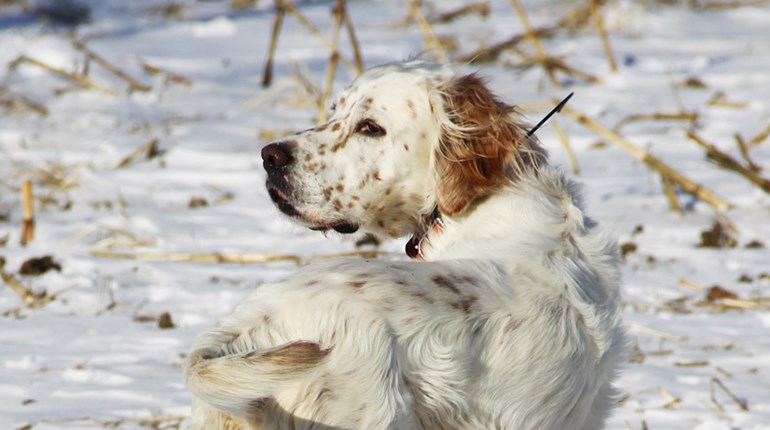
Pure pointing breeds like English pointers, English setters, Gordon setters, Irish setters, red setters and their variants are the epitome of single-use dogs. They don’t fetch ducks. They don’t chase coons. They don’t scent-trail deer and they don’t do windows. Since at least the mid-1800s they have been selectively bred to do one thing extremely well: find birds. Some may retrieve instinctively and all can be trained to retrieve, but their mission in life is to cover ground, a lot of ground, vacuuming out the merest whiff of bird scent. And then they stand transfixed, holding the birds for as long as it takes for you to get there. Consider them the upland version of the waterfowler’s Chesapeake Bay retriever. They are one-trick ponies, but the ultimate bird-finding machines—with heart.
We can include other pointing breeds in this mix, and plenty of their fans will, but they are a bit less specialized and a bit more general in their skills. Brittanies, vizslas, weimaraners, griffons, Spinones, German shorthairs and wirehairs, Pudelpointers and Munsterlanders are great breeds one and all. But their adaptability suggests they be considered in that great mix of closer-working dogs, a more methodical group: the versatile hunting breeds.
Over the past century or so, the fame and fortunes of our pure pointing specialists have waxed and waned. Irish setters were once big field-trial winners and master hunters, but they got sidetracked by beauty breeders. English setters had their moment in the spotlight too, and occasionally they return to center stage, but decade after decade the English pointer retains title as the ultimate bird-finding pointer. Short-haired, long-legged and deep-chested, pointers are bred to run, but not outrun, their superior noses. Sometimes it seems a good pointer can vacuum a field before you even cross the fence. The complaint against them is that they often run too big for their handlers. And they may. Decades of horseback competitions have pushed many breeders to emphasize range, style and speed. Foot hunters often find themselves staring at their pointer’s jet trail and little else all day.
I used to hunt with a man and Jake, the pointer that owned him. Once Jake hit the ground, the man’s day was devoted to trying to collect him for the ride home. But Jake could find birds. And hold them. One October afternoon I stole a nap near a patch of white trash in a thicket. We’d been drawn to it thinking it might be the lost Jake on point. “Looks like an old trash bag in there. Too thick for Jake. I’ll go back and try to find him,” the man said.“I’ll wait here in case he streaks by,” I promised. “Maybe I can throw a lasso around him.” And then I promptly fell asleep.
When the man returned, we’d lost 15 minutes as well as Jake. But this time the man had a new angle on the trash bag below me, and he thought it looked enough like Jake to indulge a closer search. As he stumbled and thrashed closer to the suspect blotch of white, a rooster pheasant erupted from the tangle. Then the white bag transmogrified into Jake.
The crazy thing is that a 15-minute point is not out of the ordinary for great pointers. Nor is exceptional scenting ability. Years ago my setter, Tilly, and I watched a flock of gray partridge sail over wheat stubble and pitch precipitously through a narrow gap that plunged into Idaho’s Hell’s Canyon, nearly grazing the stubble as they went over. Ten minutes later, Tilly slammed on point, her nose aiming precisely at the gap. No birds were there. She was pointing scent that had washed off those birds and settled onto the stubble.With olfactory skills like these, it’s no wonder breeders have encouraged such dogs to run big. It makes sense in big country where prairie chickens, sharptails, Huns, ringnecks and the like live widely scattered in a sea of grass. While a close-working flusher or versatile breed scours a 50-yard swath, a pointing dog is vacuuming 600 yards. But how does the average walking hunter succeed with such a dog? Training.
Train that dog to respond to whatever call-back command you prefer, from whistles to e-collar vibrations, and make him stick to it. Refine this with directional commands that tell him to turn left and right, both audio and hand signals. Above all, socialize that dog and make him part of the team. Pointers are so genetically programmed to hunt that I believe they all too easily slip into a frame of mind in which finding birds becomes their only focus. Moderate that tendency with frequent commands: sit, stay, heel, go, come. Make Dog respond and do things, anything, to keep in tune with you.
Years ago we were hunting the big grass near Wilcox, Ariz., with a new setter that confirmed our confidence in the breed. The new pup ran and ran big, swinging 300 yards toward the wide valley ridge to the north, but turning at the buzz of her collar to sweep clear across the valley until she was 200 yards up its south rim. Back and forth she raced until her nose caught the perfume of a baker’s dozen scaled quail in a barren swath of short grass I wouldn’t have given a second glance. After that covey she was on to singles. By noon we were high enough for her to find Mearn’s quail under the oaks, and as we again drew near the truck on the road, she nailed a big family of Gambel’s. Three species of native quail in one day from country as big as the sky: That’s what a pointing breed can do.