2/11/2011
Brandon Gavrock is a wildlife officer in the Mississippi Delta region of east Arkansas, a region rich with fish and game opportunities but rife with poverty. As is the case in any rural corner of the country, game laws in this region are occasionally broken for the purposes of feeding a hungry family, which is why Gavrock says, “Wildlife officers throughout the Southeast are taught to enforce game laws with a strong dose of common sense, as well as compassion.” However, Gavrock is increasingly finding that there are times when compassion isn’t needed, such as when he uncovers “trophy poaching.” No hunter likes the word “poaching,” he says. But the rise of trophy poaching is giving hunting a bad name.
A case last fall on Fort Campbell, a military base in Kentucky and Tennessee, is a shocking example of trophy poaching. Fort Campbell, home of the 101st Airborne, straddles the Kentucky/Tennessee border, with Hopkinsville, Ky., to the north and Clarksville, Tenn., to the south. Both Christian County (in Kentucky) and Montgomery County (in Tennessee) are well known big-buck producers. Hunting is allowed on portions of Fort Campbell’s 106,000 acres, but being a military base, there are special rules hunters must observe, including off-limits areas of the base.
Jereme Odom, Montgomery County Wildlife Officer for the Tennessee Wildlife Resources Agency (TWRA), grew up in this region and says he’s heard rumors in the past about a group of poachers who sneak into off-limits areas of Fort Campbell and kill trophy-class bucks. On the morning of Friday, Nov. 26, Odom and his partner, Officer Dale Grandstaff, learned there was some truth to the rumors. The officers made two arrests in Fort Campbell that would ultimately lead to one of the largest deer-poaching busts in Tennessee history.
The day’s events began when U.S. Fish and Wildlife Services Refuge Officer Jason Godwin saw two individuals headed into the Small Arms Impact Area on Ft. Campbell. This is a munitions training area (target range) on the base, and is therefore off-limits to hunting. Godwin and his partner notified several law-enforcement agencies in the area, including the TWRA and Kentucky Department of Fish and Wildlife Resources (KDFWR).
Odom and Grandstaff were among the TWRA officers notified, and they ended up confronting one of the two individuals, Edward Page, on foot on the target range. Page was carrying a rifle but offered no trouble. The officers called Page’s partner, Curtis Wallace, and explained the situation to him. Wallace, who was also carrying a rifle, gave himself up.
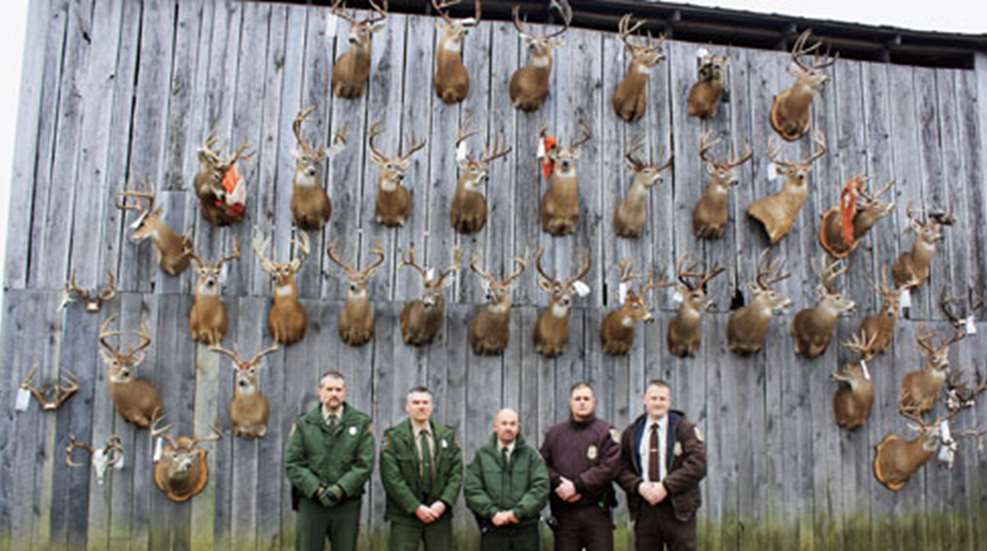
An investigation ensued at Wallace and Page’s residences in Tennessee. What the officers found, especially from the perspective of a legal deer hunter, is sickening. “We confiscated 41 trophy racks and mounts,” Odom said. “Evidently, these guys have been sneaking into these restricted areas for 10 years and poaching trophy deer. Some of the largest bucks score upward of 175 on the Boone and Crockett Club scale. The smallest racks are around 130 inches.”
Charges in the case were also brought against two other individuals: Wendell Taylor and Gregory W. Crockarell, both of Tennessee. “These guys [Wallace and Page] were having someone drop them off before daylight in these restricted areas. They were just cutting the heads off the bucks they’d killed and leaving the meat behind,” Odom says. “Taylor had dropped them off the day we arrested them."
Wallace and Page face numerous charges in Tennessee, including illegal possession of wildlife and tagging requirement violations. They also face charges from the U.S. Fish and Wildlife Service (USFWS), including hunting without a state license, illegal taking of game and Lacey Act violations. Taylor faces similar charges in Tennessee and with the USFWS. Crockarell, who is believed to have taken some of the deer to taxidermists, faces some similar charges, as well as aiding and abetting violations. As of press time, all of them potentially face more charges by the KDFWR.
“Montgomery County is becoming known as a big-buck county, but on a normal year, I only have 65 or 70 big-game cases,” Odom said. “This year I’ve had 200 cases, and about every one of them has been ‘trophy’ stuff. We’ve had guys spotlighting, hunting over bait (illegal in Tennessee) and killing bucks with rifles during bow season—and they’ve been doing it strictly for their racks.”
To combat the trend to steal game from law-abiding hunters, some states are beginning to impose especially harsh penalties for trophy poaching by tying an animal’s Boone and Crockett Club score into the resulting fines. Idaho, Montana, Ohio and Pennsylvania are among such states. Ohio uses a formula to assess fines for illegally killed deer with a gross score greater than 125 inches. Fines are increased with the size of the rack.
Hunters have always been at the forefront of shaping and influencing game laws and are responsible for tipping off wildlife officers to game violations most of the time. No legal deer hunter wants to see the buck he’s scouted and hunted all season killed by a guy with no regard for the law.
“We do receive occasional tips from folks who don’t hunt and fish, but that’s very rare in this area. Most people who call in are sportsmen,” Odom said. “They often want to remain anonymous because they don’t want to be labeled as a tattle-tale or rat. But calls to us are always confidential. And I like to remind people that when someone poaches, they’re stealing from you. The wildlife belongs to you and the state, and when it’s killed illegally, it’s no different than someone breaking into your house and stealing something.”