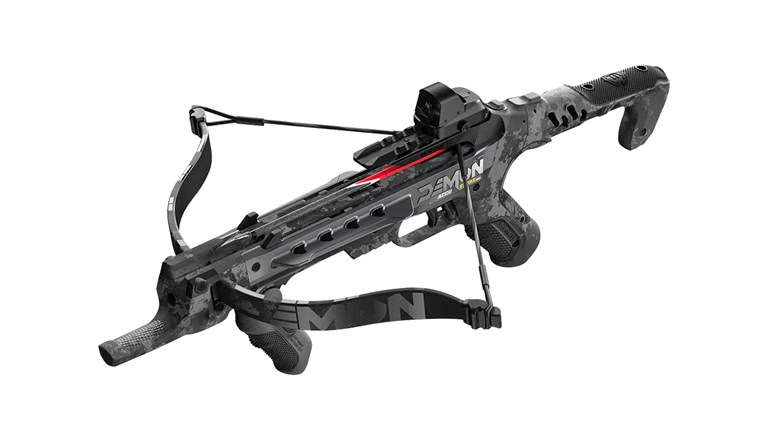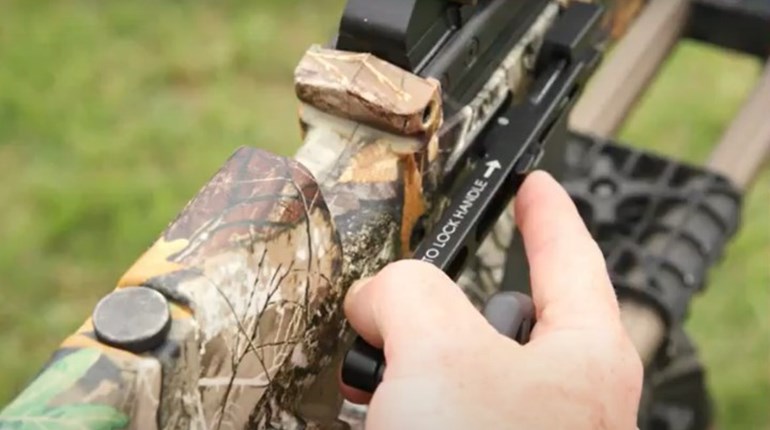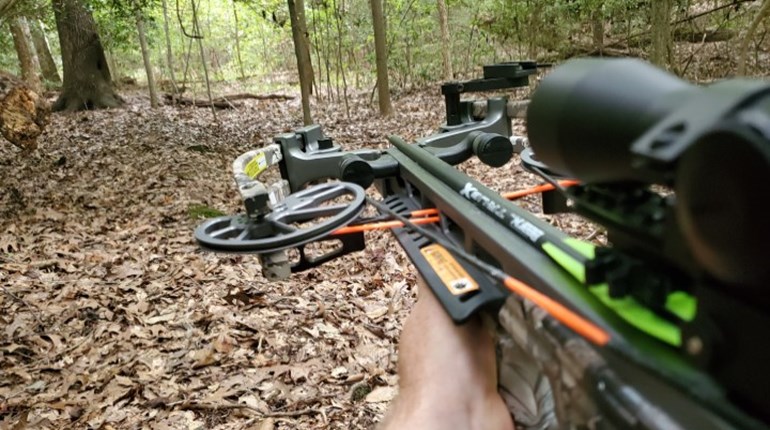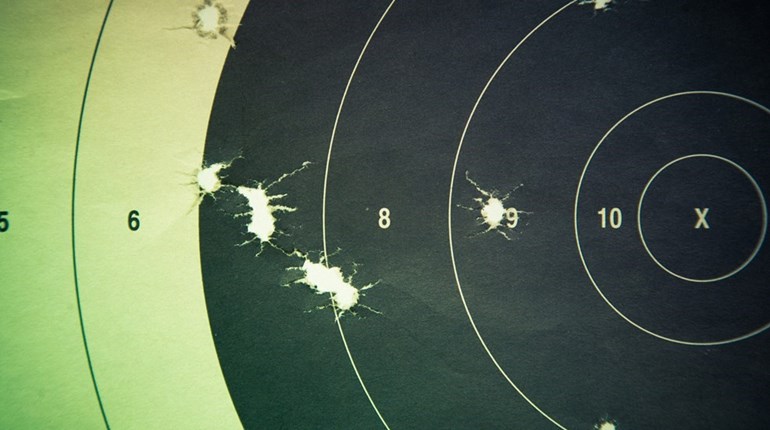
How do you load a crossbow? How do you pull its string back? What’s the trigger like? Do crossbows kick like a rifle? Are they noisy? Are they accurate, and at what distances? Do they have power to kill a deer? When I first started shooting modern crossbows several years ago, I had no idea what to expect. Like many who had never played with them, these tools confused me. I had seen them on TV, but without ever handling one, I wasn’t sure about many things.
Instead of an unwieldy, slow, inaccurate Robin Hood–era tool, modern crossbows are fast, accurate and powerful enough to take the largest big-game animals in North America cleanly. Modern crossbows are a pleasure to shoot, too. But to get the most from your crossbow, you must understand the basics of how to set one up for hunting and how to shoot it. Here are 12 tips to make you a crossbow-shooting machine using a crossbow-and-arrow setup designed specifically for hunting big game.
1. Buy the Best You Can Afford
There’s a big difference between an el cheapo, bargain-basement crossbow and a top-of-the-line model. Sure, the bargain model costs less, but it won’t be built as well, be as accurate or reliable and it will likely fail when the moment of truth arrives. You can buy crossbow packages that include everything needed to shoot and hunt—a crossbow, a few arrows and arrow points, a scope sight, a cocking device and quiver—for between $800 and $1,500. A good crossbow alone costs $300 to $1,000, depending on the make and model. But remember, you get what you pay for.
2. Use Enough Draw Weight
The principal specification that distinguishes a hunting crossbow from a target model is draw weight. Fortunately, most states have taken the guesswork out of determining what’s sufficient by establishing a regulatory minimum. While those regulations vary considerably across states, the overall range runs from 75 to 125 pounds of draw weight. With little exception, any crossbow in that range should be adequate to kill a whitetail at moderate ranges. Most quality hunting crossbows are in the range of 150 to 175 pounds, with a few exceeding 200 pounds. Generally, bigger is better—or, in this case, faster. You can go too heavy, though. And at least one state (Ohio) has a maximum allowable draw weight of 200 pounds.
3. Shoot a Fast Enough Arrow
Crossbow and compound bow makers continually strive to push the speed envelope. You make a crossbow faster by increasing its draw weight. That’s why point No. 2 is so important. How fast is fast enough? I like my crossbows to shoot a hunting-weight arrow with an initial velocity of at least 300 fps. That will give your arrow enough kinetic energy to take any big-game animal cleanly, and will reduce arrow trajectory at longer ranges, which makes accurate shooting easier. Some crossbows are beginning to push the 400-fps envelope, so look for improvements in this number.
4. Use a Scope Sight
Some crossbows still come with open sights, but you’ll be much better served using a scope. These optical sighting devices make accurate shooting much easier. For magnification, you can choose from just about anything—0X to 5X. Inside the scope is the reticle, defined as some configuration of horizontal and vertical crosshairs, though for crossbows, it also includes any object projected or suspended across the field of view. Choices begin with a simple, single red dot or crosshair. With them, you sight-in for a fixed distance—typically 20 yards—but you must compensate for longer shots by holding higher. Multi-reticle scopes are the most popular, particularly those with three or four dots or horizontal crosshairs. The top one is sighted in for 20 yards, and the next two are fixed at intervals that will be dead-on at 30, 40 and 50 yards, respectively, on most bows.
5. Use Quality Arrows
Unless your arrows (bolts) fly like laser beams, you’ll never precisely hit your targets. Cheap arrows manufactured to sloppy tolerances will fly like knuckleballs. That’s why you should use only the best arrows you can afford that are designed specifically for crossbow shooting. Many crossbow companies sell arrows, but they’re made by Gold Tip, Easton, and other manufacturers. Ensure that any arrows you buy have a nock designed for crossbows, not compound bows, are cut to the proper length and have the proper fletches. Carbon and aluminum arrows work well, but by far, the most rugged and high-tech are made from carbon.
6. Use Quality Broadheads
The business end of a hunting arrow is the broadhead. Many makes, models and styles of hunting broadheads are available. Here again, the most expensive are generally those built to the tightest tolerances, have the sharpest blades, fly straight and true and have a long track record of success. Replaceable-blade and mechanical broadhead designs will work well for crossbow shooters. The mechanical design becomes more popular each year. The most common weight for a hunting broadhead is 100 grains, 125 grains coming in at a distant second.
7. Take a Rest
A crossbow is a bit heavy so a rest certainly helps steady it. That can include using standard rifle-shooting positions such as kneeling and sitting, using a set of shooting sticks or monopod and using a shooting rail in a treestand or shooting house. I never turn an arrow loose from my crossbows without taking a rest. When using one, pad the crossbow’s forearm with something soft like your hand, a rolled-up jacket or a daypack. This will help absorb recoil and make precise sighting easier.
8. Learn Arrow Trajectory
All arrows fired from a crossbow travel downrange in a large parabolic arc. Your crosshairs are set to hit dead-on at specific distances, but you’ll often be shooting at a deer or other animal between these distances. When practicing, you’ll soon learn where you must place your crosshairs relative to the animal to hit at these “tweener” ranges. Also, when you understand how the arrow arcs, you can arc the arrow over tree limbs and other obstacles between you and the game.
9. Use a Rangefinder
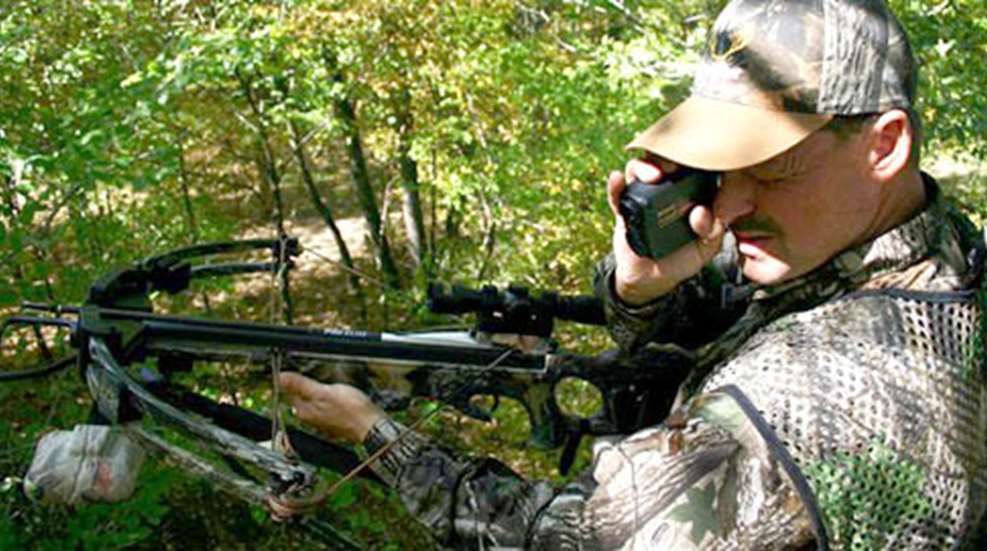
With the click of a button, a modern laser rangefinder can give you the exact distance from you to the target—critical information in accurate shooting when you’re lobbing an arrow at the target. The best laser rangefinders are as reliable as the sunrise. My Nikon Archer’s Choice even tells me exactly where to aim when shooting at steep uphill and downhill angles. Priced between $250 and $400, they’re a lifetime investment that’s worth every penny.
10. Get a Feel for the Trigger
Every crossbow has a unique trigger. You need to shoot your crossbow enough so you know exactly when the trigger will send the arrow on its way—not “maybe” when it will fire. Shoot with and without gloves so you know how both feel. (They will be different.)
11. Practice in the Field
The axiom “practice makes perfect” certainly applies to crossbow shooting. When set up and sighted, spend time shooting using a bench rest. Use these sessions to set your sights precisely and get a feel for the trigger. However, you then need to do “specificity training”—training specifically for the task at hand. Move away from the bench and practice shots that simulate actual hunting conditions. Shoot from the kneeling and sitting positions. Climb into your treestand or ground blind and shoot at the same angles and distances you anticipate for your hunting season. Learn to use your shooting sticks or monopod quickly, quietly and efficiently.
12. Maintain String, Rail and Trigger
A crossbow is a machine, so it will need regular maintenance to keep on ticking like a fine Swiss watch. That means you should always check the string and cables for wear. This is very important because on a crossbow you have direct string-to-rail contact, which creates friction and abrasion during every shot. At the first sign of fraying or abnormal wear, replace them. You can reduce the need for replacement with regular maintenance. Keep the string, cables and center serving clean and well maintained after each practice session and especially after every trip to the field. Lubricate the center serving. The rails should also be regularly lubed with a product designed for this purpose often—generally after every 10 to 15 shots. The rest of the string should be waxed with bowstring wax.
There you have it—12 fantastic tips that will greatly improve your crossbow shooting. Have fun, shoot straight—and stay safe.