One of the many wonderful things about capitalism is we are free to innovate and adapt in the marketplace. Often those most successful have the vision to see change coming before it happens and have the courage to act.
Jon LaCorte and Jon Allen are good examples. They both worked for a major optics brand for many years before they left to start their own company called Tract Optics. These guys understand the industry and realize that while many of today’s riflescopes are good quality, the way they are sold could use improvement.
Tract is innovative in its approach in that the company takes its optics direct to the consumer via the Internet. While other brands have multiple middlemen that erode value from the optics, Tract scopes and binoculars are sold to the consumer by the same people who own the company. There’s no distributor, sales rep, marketing group or brick-and-mortar store. With Tract Optics, the supply chain has one link rather than several, and the savings are passed on to the end-user.
Tract optics are made by the largest and most respected manufacturers in the Pacific Rim. With their knowledge of optics, the “Jons” have designed scopes with top components in each of the product lines. For example, the hunting scopes—the Toric, Tekoa and Turion—all use fully multi-coated Schott HT glass, a hallmark of high-end optics.
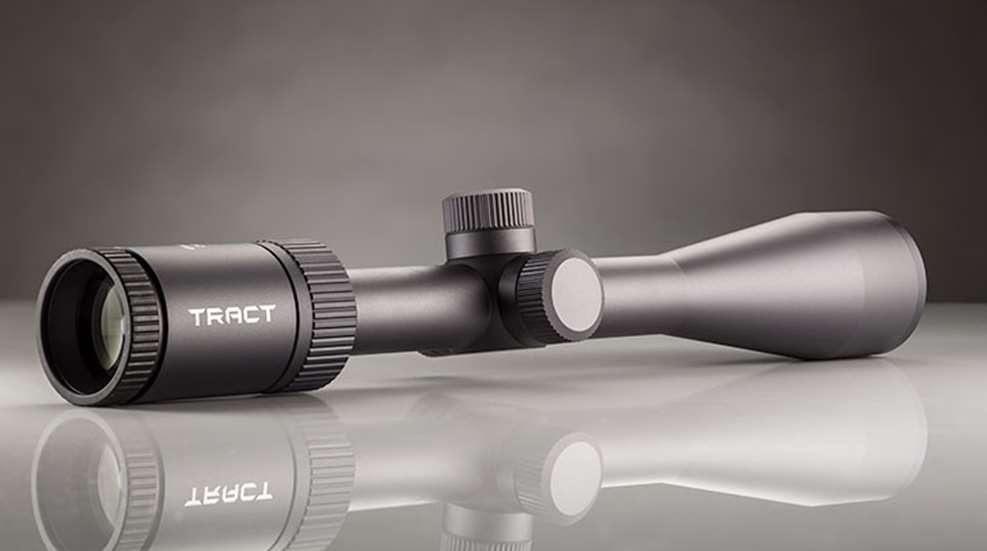
The Toric is at the top of Tract’s five lines of riflescopes, and I recently tested the 3X-15X-42mm model with the company’s Impact BDC reticle. Its one-piece machined aluminum main tube and the other external components are a striking graphite gray in color. The Toric has a quick-focus eyepiece, and eye relief is a constant 4 inches, which can be important with high-recoiling rifles. Tract scopes are filled with argon gas, which is more stable than the traditional nitrogen used to purge moisture from the scope. The windage and elevation turrets can be turned without tools and have .25-MOA click-adjustments, 20 MOA of adjustment per revolution and a 50-MOA range. There is also a locking side-mounted parallax adjustment dial.
The optical quality of the sample Toric I tested was excellent. I compared this scope side-by-side with some of the most respected and expensive scopes on the market and was hard-pressed to see any optical difference. But when I compared it to other scopes at the same price point, the Toric was noticeably clearer.
I mounted the scope on a very accurate rifle chambered for .223 Remington and used Black Hills 69-grain match ammo known for its precision. After bore-sighting, I shot a group and then carefully measured the distance between it and the center of the target. I adjusted the scope for those measurements, and the next group was exactly dead-center.
I then did a test using a Champion ShotKeeper target with five bullseyes set at 100 yards. After adjusting the scope for a center impact, I moved the adjustments up and to the left for the measured distance to one of the corner bullseyes. With me still holding on the center, the next shot hit the 1-inch bull in the top left corner. Then I moved the elevation adjustment down to hit the bottom left bullseye. Next I adjusted to the bottom right bullseye, and finally to the top right. All shots were center hits in the bullseyes. Then I returned the dials to zero and hit my first bullet holes. That was almost 44 inches in total adjustment in all directions, and the scope’s ability to return to zero indicated its internal mechanics tracked extremely well.
Just to be sure, I repeated the test on another day using the Champion Redfield Precision Sight-In Target. Same rifle, same ammo. All shots were less than an inch from the expected point of impact, and the average deviation was about half an inch. As the pollsters like to say, this was “well within the margin of error” when you consider the inherent accuracy of the rifle and other variables like wind and shooter error. Bottom line, the scope performed very well in tests that many others fail. None of this came as a surprise, though, as this was the third Tract Optics riflescope I tested with these techniques and they all performed almost perfectly.
The glass-etched Impact BDC reticle is designed to work with big-game cartridges. If you have a cartridge with a muzzle velocity of 2800 fps, set your zero for 100 yards and use the descending horizontal lines for 200, 300, 400 and 500 yards. If your cartridge produces 3000 fps, zero for 200 yards. The lines will then correspond to 300, 400, 500 and 600 yards. Of course, this system uses an average of the most common hunting ammo. Tract Optics offers its Impact Ballistic Program on its website, where you can enter your specific ballistic information to get the exact distances the horizontal reticle lines represent with your rifle and load. While you should always shoot to confirm it, the program has proven to be very accurate when fed good data.
The second-focal plane Impact BDC reticle uses .5-MOA dots and a pointed-post bracketing system so the aiming point does not obscure the target, even at long range. The horizontal pointed posts allow you to bracket the target, making it easier to hold slightly higher or lower. There are also windage corrections on the reticle based on a 10 mph crosswind.
I have written for many years that with optics you get what you pay for and price is an indication of quality, but that’s all changing with Tract Optics and its new business model. To get this kind of quality in a scope prior to now I would have expected to pay several times the $694 price. In my long career I don’t think I have ever seen this level of quality per dollar spent. I suspect this new way of selling optics is going to change the way American hunters buy riflescopes.
Technical Specifications:
• Type: variable-power riflescope
• Magnification: 2X-10X, 3X-15X (tested)
• Objective Lens Diameter: 42mm (tested), 50mm
• Eye Relief: 3.9"
• Exit Pupil: 10mm (3X), 2.8mm (15X)
• Field of View @ 100 Yds: 34' (3X), 6.9' (15X)
• Reticle: second focal plane; etched, Impact BDC
• Adjustments: .25 MOA
• Coatings: fully multi-coated
• Dimensions: tube diameter 1"; length 13.8"; weight 20.1 ozs.
• Construction: one-piece aluminum tube w/Type III anodizing; Schott HT and extra-low-dispersion glass; locking side parallax adjustment; argon-filled; waterproof, fog-proof, shockproof
• Accessories: high-profile MOA turret kit w/zero stop
• MSRP: $694