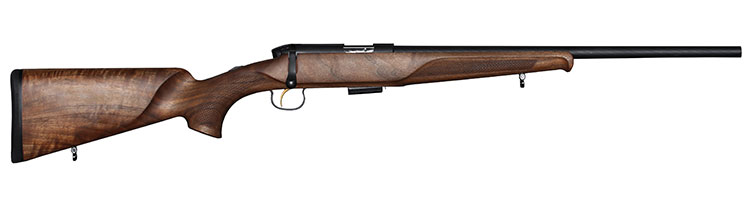
In an age of long-range wonderment and semi-automatic awe, a simple bolt-action .22 rifle would have to be special to be one of the best new guns of 2018. The Steyr Zephyr II is a call back to the day when blued steel and walnut were the foundation on which firearms were built. We’ve not seen elegance like this in the rimfire world for way too long. The Zephyr II is indeed special. It’s a rifle for a marksman and a woodsman. It’s a rifle for a hunter.
Some guns endure in what seems like an alternate universe. Like heirlooms lost to time, they’re housed in the back reaches of gun safes, and only the enlightened know they exist. Such is the case with the original Steyr Zephyr. In production for little more than a decade, it was discontinued in 1971. Considered by some to be the Holy Grail of rimfire rifle excellence, a Zephyr is nearly as rare as Sasquatch footprints on the beach. It’s the rifle Steyr Arms emulates with the new Zephyr II.
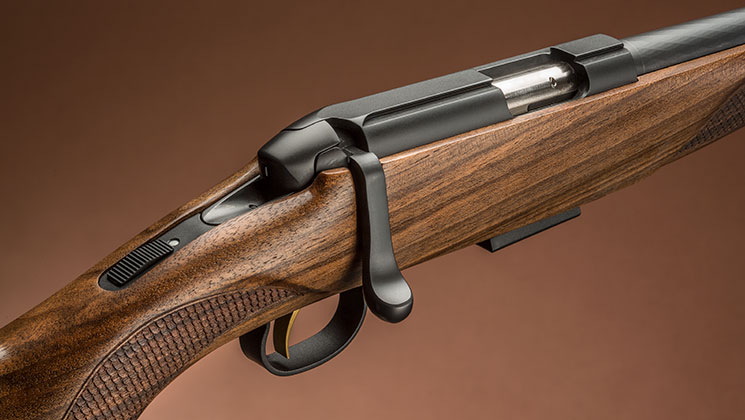
The first feature of the Zephyr II that caught my eye was the distinctive butter-knife bolt handle, like is found on classic Mannlicher-Schoenauer rifles. The bolt cycles with a very short throw, consonant with the length of the .17 HMR, .22 LR and .22 WMR cartridges for which the rifle is chambered. It is easy to open and cycles smoothly, but is irritatingly stiff to close. The short-throw bolt—which is fitted with dual, opposing extractors—can be removed from the action via a small release on the left side of the receiver. An 11mm dovetail is integral to the receiver, offering an inch of space for the front scope ring and about 3 inches for the rear.
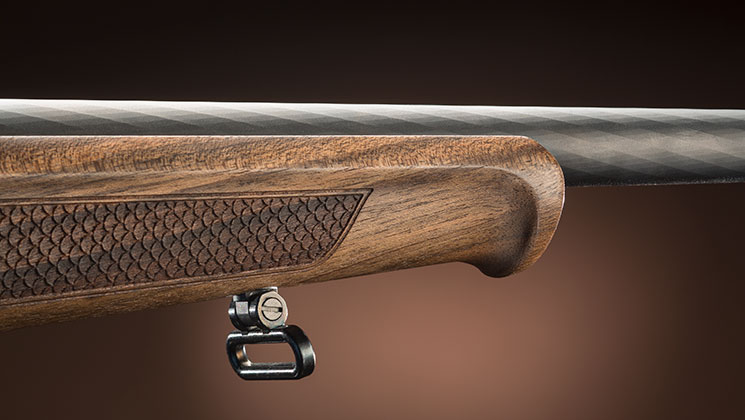
Exhibiting Steyr’s distinctive, spiraling toolmarks, the cold-hammer-forged barrel is 19.7 inches long and measures .59 inch (remember that measurement) in diameter at the muzzle, where a recessed crown protects the rifling. Though the barrel may seem a bit robust for a rimfire, it adds just enough forward weight for the rifle to perfectly balance between the hands when it’s scoped and shouldered.
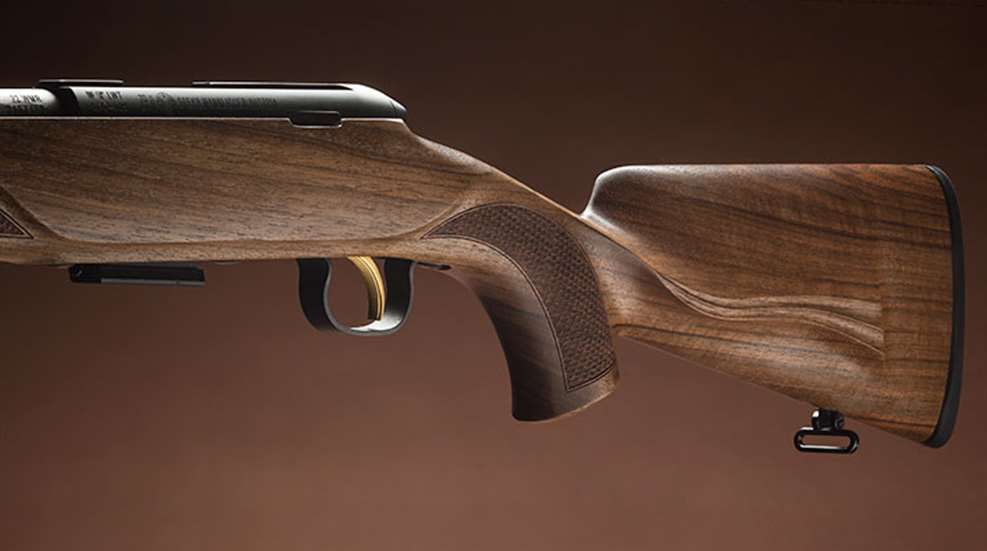
The trigger might best be described as magnificent. It is released for firing by a two-position safety, which is perfectly positioned on the tang for manipulation by the thumb while in a shooting grip. Steyr describes it as a single-stage trigger, but there is about 1/8 inch of effortless take-up, which technically qualifies it as a two-stage unit. At the end of that take-up, 2 pounds of pressure is all that’s needed to release the sear. Past that, there’s just enough tension on the trigger lever to essentially erase any negative influence of over-travel.
Enhancing the seductiveness of the European walnut stock are a Bavarian cheekpiece and a trim line that extends all the way to the schnabel fore-end. This contour runs along the top edge of the fore-end, prompting the support hand to caress, more than grip, the rifle. Bordered, fish-scale checkering on the wrist and fore-end further adds to the stock’s visual appeal.
The rifle feeds from a polymer, detachable, five-round magazine. All of it but the base pad fits inside the magazine well, which makes the rifle comfortable to carry at the balance point. For sling carry, the Zephyr II has 1-inch swivels mounted about 3 inches from the tip of the fore-end and the toe of the buttstock. They proved sturdy and more than sufficient for tensioned sling support while shooting.
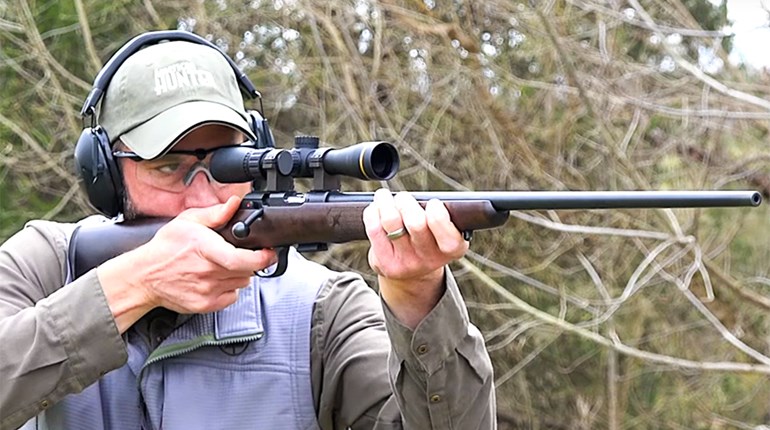
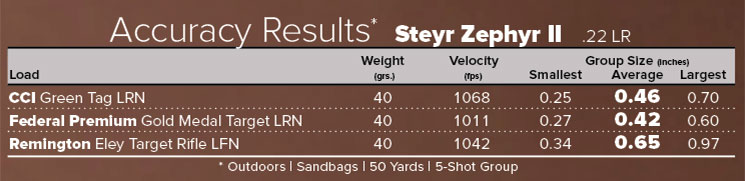
Though the Zephyr II has a grooved receiver, it does not come with scope rings. I used a set of the excellent Steyr rings from Talley to mount a Weaver Classic Rimfire 3X-9X-32mm adjustable objective riflescope, which fit the rifle’s svelteness and personality. After zeroing, I fired five, five-shot groups from the bench, with three different loads. The overall average for the 15 groups was .51 inch—less than the diameter of the rifle’s muzzle. At 50 yards, this truly is a dime-accurate rimfire.
Anyone in his right mind realizes the Zephyr II shouldn’t be limited to sandbags. With a trim fore-end, slight palm-swell and an at-one-with-it feel, this rifle is ideally configured for offhand work. From the standing position, I managed a couple five-shot groups at 50 yards that measured less than an inch. (For me, that’s as rare as Sasquatch footprints as well.) Seated with the rifle slung up, I could almost duplicate my bench results. During the firing of 300 rounds there were no failures to feed, fire, extract or eject.
What’s wrong with the Zephyr II? Aside from the firm-closing bolt—which undoubtedly contributes to the rifle’s precision—nothing, not even its price. This rifle will shoot with rimfires costing twice as much, while looking better and weighing less. It is the prodigy of a legend and maybe the gateway to the other excellent Steyr firearms that come out of Austria.
When I was a young man a .22 rifle was my constant companion. Throughout my youth I dreamed of an accurate and elegant .22 having the class and perfection of the blued-steel and walnut-stocked centerfire rifles of that age. The Steyr Zephyr is a rifle I’ve wanted most of my life; the Zephyr II has the same allure. It begs to be taken on long walks in the wilderness. I want to creep out of the fog with it on an early fall morning and into a stand of hickories infested with fox squirrels. The Zephyr II is the rimfire the gun world needs to help it truly understand that a good .22 rifle is indeed something of value.
Technical Specifications
• Type: bolt-action rimfire rifle
• Caliber: .17 HMR, .22 LR (tested), .22 WMR
• Barrel: 19.7″; cold-hammer-forged; 4 grooves, 1:16″ RH twist
• Magazine: detachable box; 5-rnd. capacity
• Trigger: single-stage; 2-lb. pull weight
• Safety: two-position slide on tang
• Sights: none; 11mm dovetail integral to receiver for rings
• Stock: European walnut w/Bavarian cheekpiece; LOP 14.4″
• Metal Finish: matte blue
• Overall Length: 39.2″
• Weight: 5.93 lbs.
• MSRP: $995; steyrarms.com