Among all the world’s riflescope manufacturers, Nikon has arguably done the best job of making it easy to buy the right scope for specific shooting jobs. The company doesn’t leave you guessing. Its SlugHunter scope includes a BDC reticle tailored to common slug and sabot trajectories. Its Muzzleloader scopes are preset for the trajectories of most modern, in-line muzzleloaders. Can you guess what rounds match up with the M-308 and P-223 scopes? Any BDC reticle can be calibrated to work with virtually any cartridge/bullet/velocity, but building a specific scope with a specific reticle matched to a specific rifle/cartridge/bullet makes things easier for the customer, and Nikon reaps the rewards.
But Nikon isn’t banking just on convenience. The company matches that to high optical quality, precision manufacturing, an impressive No Fault lifetime warranty and innovative customer support through a free online Spot On ballistic software program that guides users in setting up a scope’s reticle to match a particular load. It’s a customer service program that makes the Nikon line quite attractive.
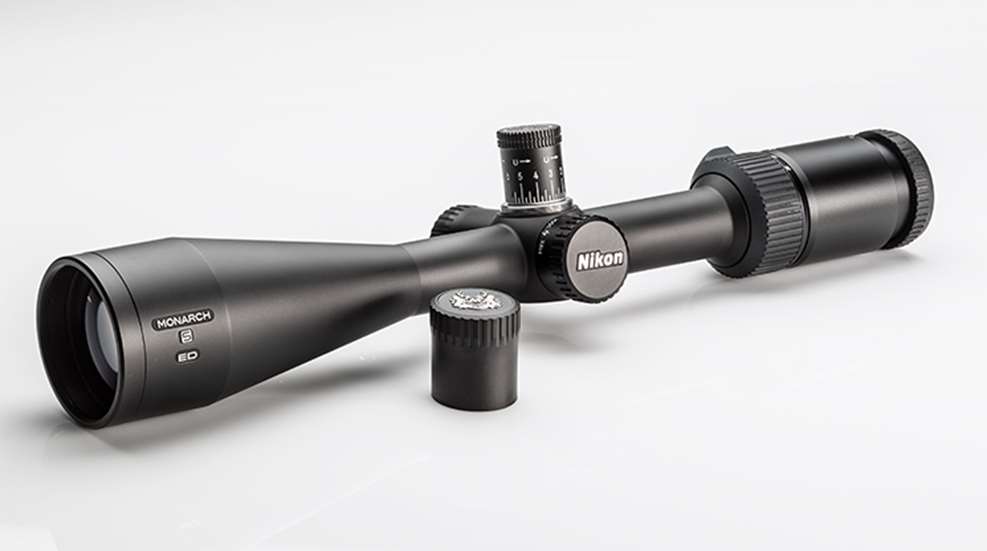
One of the more versatile, all-round hunting scopes from Nikon is its new Monarch 5 ED in 3X-15X-50mm built on a 1-inch main tube milled from a solid block of aluminum. From elk in tight brush to rodents 700 yards out, this scope has the magnification to handle it. While I’m not crazy about bulky 50mm objectives, the extra light they take in certainly helps at powers above 10X. Dialed to 15X, this scope’s exit pupil is still restricted to 3.3mm, which isn’t anywhere close to what the human pupil could handle at dusk when dilated. Still, it beats the heck out of the 2.6mm exit pupil you’d get with a 40mm objective at 15X. If you imagine you’ll need to target game at 15X in low light, you’ll welcome the 50mm.
Light transmission is further enhanced via fully multi-coated lenses. The number of anti-reflection layers and which wavelengths of light they address Nikon doesn’t specify, but with all optics what you see is what you get. Smart scope shoppers compare the view through various models to assess light transmission, contrast and flare control. Compared to Swarovski’s excellent Z5 3.5X-18X-44mm 1-inch main tube scope (with both instruments set to a 4.4mm exit pupil) my subjective observation as a lifelong photographer was that the Nikon might have been a half to two-thirds stop darker. With the evening sun just peeking into the upper right quadrant of the objective lens I detected the first hint of flare—ghost suns in the lower left quadrant. Contrast in the shadows was good enough to differentiate between small branches of a pine and maple intertwined 400 yards away. That closely approached the contrast performance of the Swarovski as well as a Meopta Meopro 4.5X-14X-44mm.
Thirty minutes after sunset I could clearly see the Nikon BDC reticle at 15X against dark brown boulders and a dark pine 80 to 100 yards away, and a neutral gray wall 473 yards out. At 8X the main crosshair even showed against the shadowy interior of a rocky overhang, though I couldn’t make out the sub-reticles. In this extreme test the Meopta appeared to be a stop brighter, but both of the optics would have permitted accurate targeting. Against yellow grass the Nikon reticle was sharply defined 45 minutes after sunset even at 15X.
An extra-low dispersion (ED) glass lens in the Monarch 5 enhances optical quality by focusing more light wavelengths closer to the same point. It nearly eliminates color fringing. (You see color fringing as a halo, usually yellow or orange, around the edges of antlers, ears, etc.) Color fringing becomes increasingly apparent at magnifications above 10X and softens the look of the image. I detected none in this Monarch at top power. Straight-line objects pushed to the very edges of the view showed no barrel or pincushion distortion, either.
Besides color fringing, high-power scopes can suffer from parallax, the result of a scope not focusing the target in the same plane as the reticle. Parallax can be detected by locking the scope on target, then shifting your eye left, right, up and down while watching the target against the reticle. As your eye shifts off axis, the target will appear to shift behind the reticle much like the numbered mph scale shifts behind the speed needle on cars from the 1960s. A parallax shift of just .5 inch at 100 yards becomes 3 inches at 600 yards and 5 inches at 1,000 yards. Nikon fixes that with a side parallax adjustment knob, just what the precision shooter ordered. This focuses the scope precisely from about 45 yards clear to the moon. Nikon designers were smart enough to build this knob with a push/pull lock so you won’t inadvertently be bumping it out of adjustment. Pull out on the knurled cap, turn to eliminate parallax, push in to lock it. Tension is uniform and precise.
In keeping with the long-range potential of this scope, Nikon offers it with an etched-glass Advanced BDC reticle. The familiar “Christmas tree” array consists of a series of four tiny circles down the vertical line plus the joint where the two thicknesses of the post meet, providing five additional aiming points. Small “+” marks right and left of each circle represent hold points for 10 mph right-angle winds at those ranges.
Fitting these sub-reticles to the trajectory of any load can be done online using the Spot On calculator. Enter your ammo brand and bullet type or, ideally, the actual ballistic coefficient and muzzle velocity of your bullet. Spot On spits out ranges in yards or meters corresponding to each sub-reticle. It’s your job to remember them. (Print the chart and tape to your buttstock.) The Spot On program is also available as a free app for iOS and Android devices. Nikon’s new Ballistic Windmeter, which plugs into a smart phone’s earphone jack, reads wind and inputs it directly into the Spot On app. Used together with the reticle’s wind marks, it helps you make an accurate hold.
The Monarch 5’s diopter adjustment wheel is the knurled rubber rim of the eyepiece. It moves with moderate pressure and a bit of inconsistency—tighter in some spots, freer in others—but no roughness. I would prefer more tension to prevent bumping this out of whack, especially when operating the flip-up eyepiece cover that came with the instrument. This style of diopter wheel is a major gripe of mine. Yes, it makes for a cleaner-looking scope because you don’t see threads in front of the eyepiece bell, but someone needs to make it lockable. Diopter adjustment (to focus the reticle) is not something you need to make more than once a year or even decade.
The knurled rubber power ring turns smoothly, but not too easily, with no backlash or creep. It shouldn’t suffer from inadvertent adjustment. A raised thumb-bumper provides additional leverage. Knurled aluminum turret caps turn smoothly on clean threads that match up quickly and easily thanks to a large pitch. Cross-threading shouldn’t be a problem.
The .25 MOA turrets click crisply and audibly, and that’s useful because this scope ships with additional high-profile elevation and windage turrets. Clearly etched in MOA, these can be used to dial corrections for long-range shooting. Maximum adjustment range is 65 MOA, but this can be combined with the BDC reticle to reach well beyond 1,000 yards, which is pushing the limits of 15X. Each turret can be reset to zero after sighting in by lifting the spring-loaded turret to disengage the screw that moves the erector tube. Twist the scale to zero and drop the turret to re-engage. This makes it easy to re-zero when atmospheric conditions change enough to impact your original zero.
Power ring and turret adjustments proved impressively accurate with the center reticle shifting less than .25 MOA as power was turned from 3X through 15X, and that can easily be attributed to gun-handler error at 3X. Elevation and windage adjustments over a 4 MOA move tracked down, right, up and left to return precisely to the original zero setting. During an 8 MOA move they came within .25 to .33 MOA, and that small discrepancy could again be blamed on gun-handling error.
Whether you want to shoot close and fast at low power, or slowly and precisely at higher magnification, this scope will help you do it. Use the BDC reticle for long-range targeting, dial the turrets or combine the two. This Monarch 5 is right there with you, a versatile scope at an attractive price.
Technical Specifications:
• Type: variable-power riflescope
• Magnification: 2X-10X, 3X-15X (tested), 4X-20X, 5X-25X, 6X-30X
• Objective Lens Diameter: 42mm, 50mm (tested)
• Eye Relief: 3.9" (3X), 3.5" (15X)
• Exit Pupil: 16.6mm (3X), 3.3mm (15X)
• Field of View @ 100 Yds: 32.8' (3X), 6.8' (15X)
• Reticle: second focal plane; Advanced BDC
• Adjustments: .25 MOA
• Coatings: fully multi-coated
• Dimensions: tube diameter 1"; length 14.1"; weight 20.8 ozs.
• Construction: one-piece aluminum tube; waterproof, fogproof; side parallax adjustment
• Accessories: sunshade, front and rear flip-up lens caps, high-profile turrets and caps
• MSRP: $649.95
Most Popular