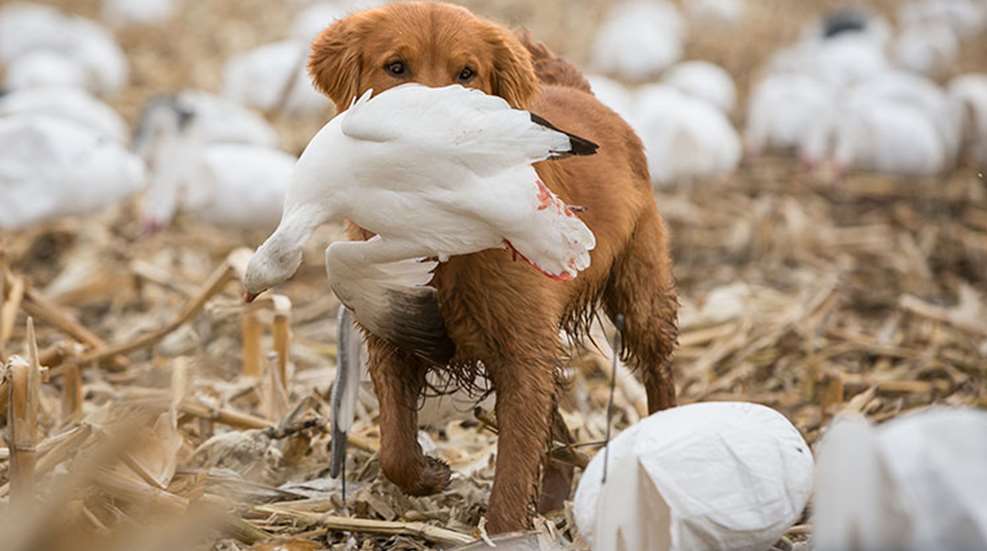
We’ve all been there. Opening day. The sun is shining, birds are calling and our over-eager dogs are racing through the cover, thicket to thicket, horizon to horizon, sucking air, searching for scent. They point. They flush. They fetch.
They collapse.
It’s not even noon and they act as if they’re on their last legs because—they are.
But they don’t have to be.
According to veterinarian nutritionist and sled dog racer Dr. Arleigh Reynolds of Alaska, both proper diet and advanced physical training are keys to hunting dog performance and endurance.
But don’t just take Reynolds’ word for it. Take his race record for it. Reynolds’ dog teams have won the North American Championship Sled Dog Race twice. They’ve won gold medals twice in International Sled Dog Racing Association competitions and Reynolds is the reigning world champion. He recently fed, trained and raced an 8-year old dog that led his team to two, first place championship wins across a 70-mile course in three days.
To put that in perspective, consider this: The average dog achieves its maximum aerobic fitness at 3.5 years old. If an 8-year-old dog can help pull a 200-pound sled in sub-zero temperatures for three days, think what Reynolds’ program can do for your bird dogs.
At a recent Sporting Dog Summit at Purina Farms near St. Louis, seminar speaker Reynolds detailed that feeding and training program, and here are its essential components.
Diet is the Foundation
Regardless how fit and well trained your dog is, it can’t achieve peak performance without the proper diet. And that means fat and protein. How much fat? Try 20 percent. Protein? 30 percent. Yup. Forget your anthropomorphic tendencies. Your dog is not a child. He isn’t even human. He doesn’t benefit from chocolate and he doesn’t need to be on a fat-free human diet. For optimum endurance, he doesn’t need loads of carbohydrates, either. He needs fat, and lots of it, because dogs get their endurance from stored fat. Carbohydrates are burned off quickly, and then canines convert stored fat into energy, which carries them over the long haul.
According to Dr. Brian Zanghi, who studies canine physiology and nutrition at Purina, a high-fat diet increases mitochondria in muscle cells, and that improves efficient fat burning for energy. Protein both builds strong muscles and repairs them quickly after extreme exercise.
Both Zanghi and Reynolds claim you should keep performance dogs on this 30/20 diet year-round. Switching to a “maintenance diet” is like “metabolically de-training your dog,” Zanghi explained. “It decreases your dog’s capacity to use fats, and this reduces endurance.”
To keep the weight off, reduce quantity, not quality.
Conditioning and Training
Reynolds describes this as “improving physical capacity.” You condition a dog to develop the capacity to run fast and long. I interpreted this to mean what most of us would consider conditioning: working the dog. Free running, retrieving drills, swimming—the usual and lots of it for four or five months. Reynolds calls this LSD or “long-slow distance training” in which dogs go at their pace for longer and longer times. It’s essential to keep dogs fully hydrated (offer water every 15 minutes) during this conditioning and give them adequate rest and recovery time.
Following base conditioning, Reynolds ramps up things to a higher intensity level for another five months. With sled dogs this involves harness work, running under load, pulling to build muscle and stamina. Roading with dogs pulling an ATV is a good option. Essentially you force the dog to exceed what he’ll be doing during your hunt. I’m tempted to call it overtraining, though it really isn’t. You’re just pushing your dog to his physical peak so that daily hunting chores will be that much easier.
“Start easy and gradually increase the workload,” Reynolds said. And don’t wait too long. “It takes four to eight weeks for a dog’s body to adapt to a stimulus that creates an overload.” After that the dog plateaus. To increase performance even more, you must add additional work load, or stimulus. That could be more distance, more weight or more speed.
Throughout high intensity training, allow plenty of recovery time as well as fun time. Push a dog too hard and it might get tired or bored, so intersperse training sessions with games and free time fun like taking a car ride to the store, wrestling with other dogs, playing silly games or indulging in silly pet tricks. There’s more to life than chasing and finding game. Reduce stress and let your dog decompress. Then he’ll be eager to again hit the field.
So, if you want your four-legged, off-season couch potato to be ready for autumn attack mode, get started. And remember, a proper diet for a working dog is 30 percent protein and 20 percent fat. Protein and fat are where it’s at