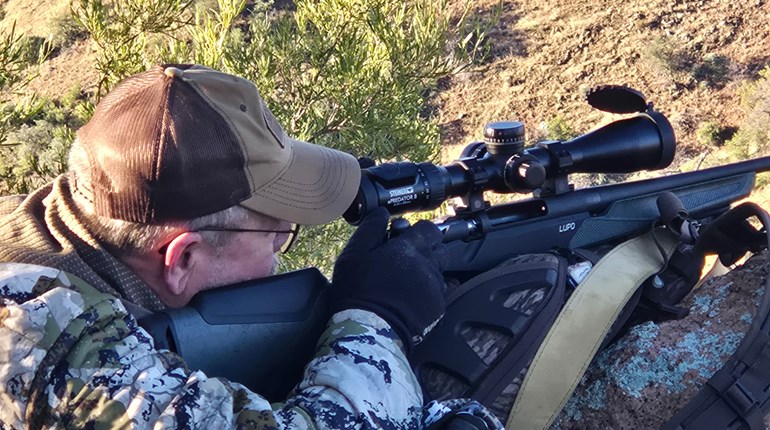
I slid my trusty Winchester Model 70 over the stump and motioned the youth hunter forward. The bull was facing right; perfectly broadside 300 yards below us. Twelve beautiful ivory-colored points were resulting in some anxious and hurried movements. “Okay, hold on the second hashmark under the crosshair and squeeze.” He did as I instructed and put the bullet just over the elk’s back. The bull spun and disappeared in the new growth fir that swallowed him instantly.
I couldn’t believe it. What went wrong? This should have been a chip shot. This 7mm Remington Magnum always hits the mark and was my most trusted rifle at the time. I looked down at the scope. The magnification was set on 4X power instead of 12X, and it was a second-focal-plane (SFP) scope. I don’t swear, but I was kicking myself royally. I had made a mistake that cost this teenager a bull elk.
First Focal Plane vs. Second Focal Plane
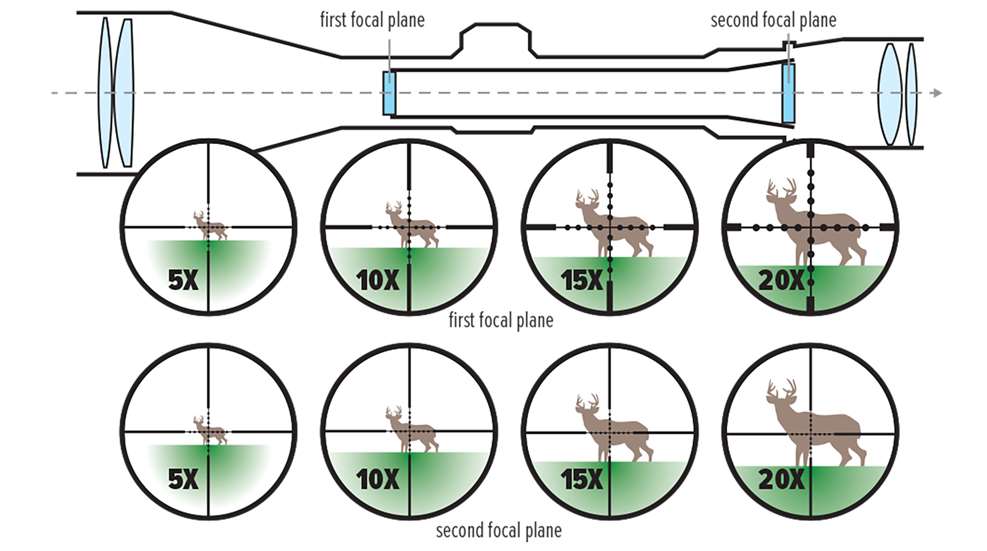
Had this scope been a first-focal-plane (FFP) scope, it would not have mattered at what magnification the scope was set, and we likely would have had 300 pounds of meat to haul out. In a FFP optic, as the reticle is etched or marked on a forward lens in the scope, the holdover hash marks below the crosshair would have been the same value, placing a bullet in the same place at 4X as they would have at 12X. However, this was a second-focal-plane scope, which means the reticle was marked or etched on a lens in the rear, closer to where you look into the scope.
Being a SFP scope, the reticle on my 4X-12X Bushnell will always appear the same size as the magnification is adjusted, but changing the magnification does change the hash marks on the reticle in relation to the target. This is where some of you readers may want to start looking through your scope and twisting that magnification ring. In the story above, at 300 yards, the second hashmark represents approximately 10.5 inches (3.5 inches x 300 yards) of drop at 12X magnification. At 4X magnification, that second hashmark just turned into 31.5 inches (12X = 10.5 inches; 12X/4X = 3 times more value; 10.5 inches x 3 = 31.5 inches). This hold at 4X put the bullet 20 inches over the intended point of impact.
With a FFP scope, the reticle will grow and shrink as you adjust the power ring. This does little good on a scope with a standard duplex reticle, as your only holding mark is the crosshair itself, centered at any power. Where FFP is a help is when you have a drop reticle with hashmarks for simple holdover or when you are using a system such as MIL-DOT. If the scope on that rifle had been a FFP scope with MIL-DOT subtensions, the magnification power would not have mattered as the second hashmark would always be a 10.5-inch value at 300 yards.
MIL-DOT Reticles
I hunt the wide-open mountains of Montana. Shots are often long, but it has never been easier to extend your effective range than it is today. You will need an accurate and terminally adequate rifle to start, and as important, if not more so, is the quality of your scope. I want a scope I know I can trust and a reticle that just flat works. The more complex a reticle is, the more cluttered your mind will be when trying to make a pressured hunting shot.
With that being said, I like a simple MIL-DOT or similar M-RAD reticle on my FFP optics. The beauty of the MIL-DOT is how standard it is across the board. One “MIL” is approximately 3.6 inches at 100 yards. That translates to 36 inches at 1,000 yards. I hunt with a buddy in the high mountains where we shoot muleys across canyons. We don’t have to shoot the same make of scope or style of MIL-DOT/M-RAD reticle, and we can accurately tell each other of our hits and how to adjust our aim as the value of the MIL reticle is consistent with all scopes (give or take a little manufacturer error).
The Pros and Cons of FFP Optics
• Pro: Holdover reticles are always consistent despite magnification and MIL-DOTs are consistent across the scope world.
• Con: FFP scopes are generally twice the cost of high-end SFP scopes due to increased manufacturing complexity.
• Con: FFP scopes are usually much heavier with more moving parts and complex reticles. Ron Spomer recently wrote, “The more moving parts on a hunting scope, the greater the chance to screw up!” He isn’t wrong.
• Con: The reticle of an FFP scope will appear small at low power, potentially making hashmarks impossible to use. If you prefer to hunt on low power, FFP may not be for you.
• Pro: At extended ranges and greater magnification, an FFP optic can decrease the time it takes to make an accurate shot.
So, where does this leave us when it comes to using a FFP scope on our hunting rigs? An FFP scope won’t make you a better shooter, but it will allow for more precision at longer ranges, and with enough practice it will likely extend your effective hunting range.
My suggestion: set up an accurate rifle with an FFP scope with a MIL-DOT reticle and spend time on the range. Learn your FFP optic and reticle inside and out and see what it can do for you. Consistency and practice provide the best performance.