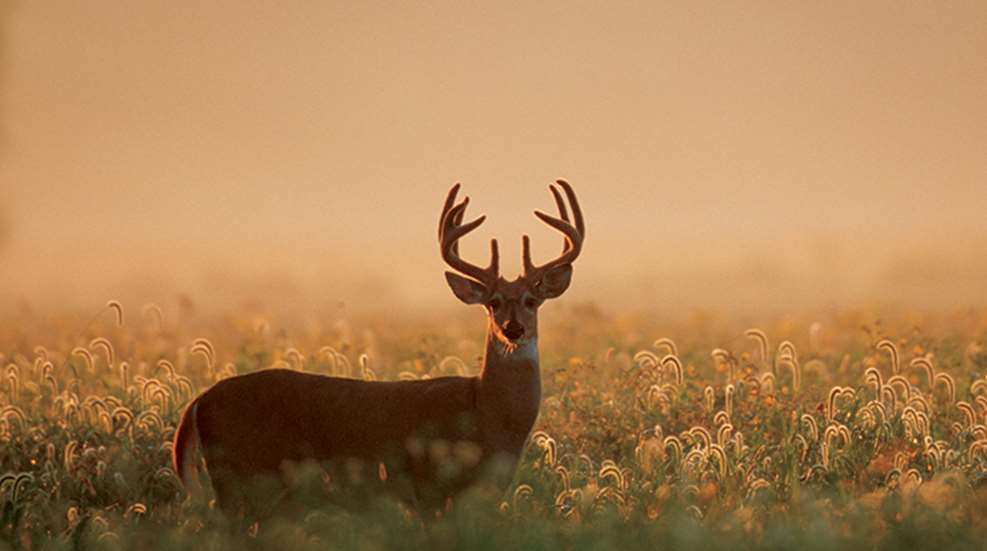
Luke Strommen glassed a cool-looking buck on his Montana ranch one hot August evening and named the buck “Massy.” The 10-pointer had webbed main beams with bases as thick as a Red Bull can. The weeks wore on and Luke encountered Massy some 30 more times in the same alfalfa fields and points of timber. One October morning he killed the old deer with a wooden arrow from his recurve.
That same fall Jay Gregory drew back on a buck that rattled his nerves. Fifty yards out the giant turned and melted into the trees—it wasn’t seen again for 22 months on the Iowa farm. One day last August Jay freaked when he glassed the buck in a bean field. On October 30 he felled the 198-inch non-typical with a 40-yard bowshot.
We tell you to get out there and glass, glass, glass this month. Say you do it and spot one or more 8- or 10-pointers you’d love to tie your tag to; will they be there in October or November, like Massy? Or will they go AWOL, never to be seen again this fall or for years, like Gregory’s monster? For some answers, we asked three of America’s top whitetail researchers.
Seasonal Buck Shifts
Bryan Kinkel of Nashville, Tenn., has conducted extensive preseason censuses of the whitetails that live on his clients’ hunting lands across the Southeast. His observation data and trail-cam photos show that 50 percent of the older bucks may spend the spring and summer months at one end of their home range and then shift to another part of their range for the fall and winter. These seasonal ranges may have little or no overlap. “Our data show that these shifts most often occur around the time bucks shed their velvet,” he says.
That happens roughly between September 5 and 20. So the furry-racked monster you spot in a bean field in the last week of August might be long gone a week or two later.
How far might they go? It depends. Missouri biologist Grant Woods says it could be a few hundred yards or several miles or anywhere in between. If you hunt 1,000 or 3,000 acres or more, no big deal. Most of the bucks that shift will still live in your hunt zone, you just need to scout more after September 20 to pin them down.
The problem is when you hunt 50 to 200 or 400 acres, like most of us do. “On a 300-acre property, a buck that shifts only 500 yards or so could move right off your area and onto a spot where other people are hunting,” Woods says.
But here’s the good news. While half the mature bucks might leave your land in mid-September, that many more that summered elsewhere are apt to move in and stay there all fall and winter. “Generally a property sees a zero net loss of total bucks from summer to fall and winter,” notes Kinkel, “but the identity of those bucks on the place can change dramatically.” So you should keep glassing and scouting into late September and October.
One more thing: “Our telemetry studies show that bucks range less as they increase in age,” says Mick Hellickson, Ph.D., chief biologist for the King Ranch in Texas. And their summer and fall ranges overlap more and more. That might explain the mysterious movements of Jay Gregory’s 198-inch monster. When the deer was 4½ and 5½ he summered on Jay’s Iowa farm and wintered on an adjoining property. The stud was 7½ when Jay killed him. Maybe the big boy’s range had shrunk, and he was summering and wintering in the same general area.
Why They Shift
Some of the summer/fall shifting is caused by bucks’ common and ingrained behaviors, but most of it is probably driven by the availability of food. Two years ago much of the Southeast was unseasonably wet in August and September. Summer forbs, which deer love, grew vigorously all over. Kinkel’s and Woods’ research on many properties showed that less than 15 percent of the older bucks shifted ranges in mid-September. My assumption: The more green forbs, crops and white-oak acorns on your land in late summer, the fewer bucks you’ll “lose.” The less feed, the more bucks will go, so monitor food sources, plant food plots and hang treestands accordingly.
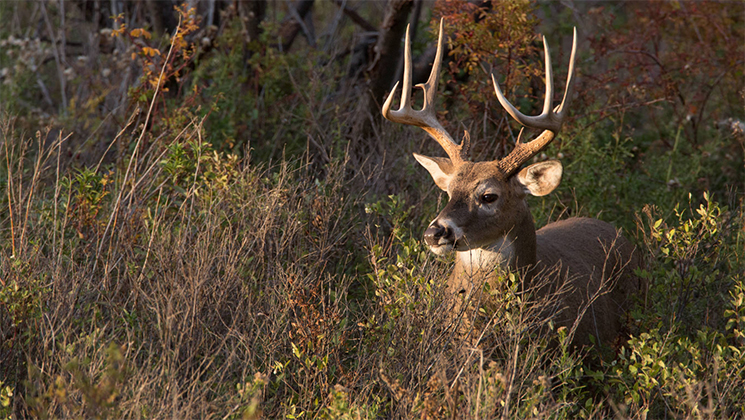 Photo courtesy of USFWS
Rut Shifts
“Nearly all mature bucks expand their home ranges and daily movements during the rut, making them less likely to reappear in spots where you saw them in August,” says Hellickson. This rut shift starts about three weeks before peak breeding. Get this: One of Kinkel’s favorite hunting properties has a peak breeding date of November 18, and the first of the rut-shifting bucks have showed up on his trail cameras on the same day, October 31, during each of the last four years.
While many of the deer you bowhunted in October will go AWOL for two weeks or so in mid-November, you’ll see new rut-crazed bucks. The intruders might cover two or three times the area they normally do each day, circling and contacting as many does as they can. “They won’t be on your property every day, but they’ll drift through from time to time,” says Kinkel. Sit your best rut stands every day for a week and you’ll see bucks big and small that you’ve never seen before.
The Sign to Find
To confirm a shooter has stayed in your woods, or to learn that a new one has rolled into the area, look for three things:
• Tracks: Ordinary-looking tracks that are 2 to 2½ inches long tell you nothing (could be a buck or old doe), but deep, splayed prints that are 2½ to 3½ inches long scream buck of interest. Lots of big, fresh tracks in a small area indicate lots of buck activity—move in and hunt that spot now, before he moves again.
• Rubs: The buck that blazed one of the first big rubs you find in early September might still be around—or he might be 2 miles away. But find a freshly thrashed tree as thick as your calf the last week of September and into October, and you can surmise a shooter’s right there. When the rut-shifters move in around Halloween, look for another flurry of rubs, the bigger the better.
• Scrapes: “During peak rut, with the sudden surge of new bucks on your land comes a surge of new rubs and scrapes,” notes Grant Woods. Find a ridge or bottom littered with those red-hot scrapes, hang a stand and sit in it for a week. You’ll see bucks.