A growing nuisance in 45 states, feral pigs have established an increasing presence in the wine country of California’s northern Sonoma County. And just like nearly everywhere else, they are a problem there, too. In Sonoma the pigs root up vineyards and damage grapevines, and they are among the most prolific animals on the face of the earth. They’re not born pregnant, but it’s close.
In response to rising interest by sportsmen who hunt these destructive animals, one culinary arts school in Healdsburg, Calif., offers all-day cooking classes three times during the winter focusing on how to utilize nearly every part of the pig, domestic or feral. At Relish Culinary Adventures (relishculinary.com) 50 miles north of San Francisco, owner Donna del Rey partners with Dino Bugica, an avid pig hunter and the chef/owner of Diavola Pizzeria & Salumeria in nearby Geyserville, to team-teach techniques associated with the care of the pig carcass following the kill.
Donna and Dino discuss meat cutting, curing options and recipes. This includes cutting loins into chops, making sausage from the front quarters, preparing pancetta (bacon) from the pork belly, and creating roasts, hams and prosciutto from the hindquarters. Their culinary arts classes also explain how to prepare headcheese (Dino insists on calling it soppressata di testa) from the cuts not considered prime but that would be sacrilege to waste, for they are delicious and perfectly good meat.
In these specialized classes, prepare to spend all day (typically a Saturday) learning everything there is to know about processing a pig. When you arrive at Relish Culinary Adventures you will find six tables: Each hosts a butchered/dressed (with hair removed) 100-pound pig, the centerpiece for hands-on learning. Instructional handouts along with recipes for marinades and rubs are provided. Expect Donna and Dino to discuss in detail the following techniques—good tips for hunters who want to make the most out of the feral pig problem.
Carcass Care
When butchering, make sure that intestinal and organ fluids do not contaminate the internal body cavity. The carcass can be hung outside overnight; however, during the summer when temperatures are high the carcass needs to be refrigerated within four hours. Skin the carcass or scald it to remove hair.
Meat Cutting
Dino’s approach to breaking down the animal is Italian-inspired. He likes to remove the rib bones from the midsection, leaving a rectangular-shaped loin and belly canvas for creating delicious porchetta that is stuffed, rolled and roasted for large get-togethers. Front quarters (shoulders) are usually braised, the front legs used for sausage meat.
He removes the head at the vertebra behind the ears and sets it aside to reduce the weight of the carcass during handling. To make headcheese, Dino saws the head into two parts for later processing. He separates the front quarters between the third rib and the spine, and typically uses them for sausage. The chef then removes the loin along the top of the spine so it can be divided into chops. He separates the hindquarters from the carcass at the second vertebrae. (Information is provided in class on processing the hindquarter into hams using various kinds of rubs, marinades and smokers.)
Dino removes the remaining rectangular midsection from the ribs and uses it for salt-curing into pancetta. He sets aside small pieces of pork from the shank, feet and other trimmings for making sausage or headcheese.
Curing Pancetta
Pancetta is the Italian term for cured pork belly (as compared to bacon, which is cured and smoked pork belly). Donna explains that pancetta can be easily made at home since it cures more quickly than other, thicker pieces of meat. The most critical point is deciding when to halt the salt cure, which is then followed by rinsing the pancetta. Next, the air-drying process begins and lasts approximately three days in the refrigerator. Once air-dried the pancetta is sliced like a slab of bacon and can be fried or used in recipes.
Making Soppressata di Testa (Headcheese)
Boil the two halves of the head, along with the trimmings, for about four hours. After the boiled parts cool, pull the meat from the bones and skull, and press using cheesecloth to remove moisture. Chill, slice and serve like a pâté or summer souse.
Pancetta with Bra Spice
Ingredients
• 2-3 pounds pork belly, skin on or off
• 1 cup rock salt
• 1 cup kosher salt
• 6 cloves garlic
• 1 gram nitrate powder for every pound of meat
• 1 bay leaf crushed by hand
• 2 tablespoons white or red wine
• 2 teaspoons freshly ground black pepper
• 1 teaspoon fennel seeds
• 1 teaspoon rosemary leaves
Directions
Combine rock salt and kosher salt in a bowl. Add roughly a quarter-cup of water, or enough to make a paste. Take about 1 tablespoon of the salt paste and place it in a mortar. Add garlic and nitrate powder, and mash together with a pestle.
Place the pork belly flat in a nonreactive (glass or plastic) container or tray. Spread some of the garlicky salt paste on all sides of the belly and gently massage it into the meat and skin. Lay the belly skin-side down on the tray. Drizzle some of the wine on the belly.
Sprinkle the belly with black pepper, fennel and rosemary. Add the remaining salt mixture and wine to the mortar. Then cover the meat-side of the belly with this wine-salt paste, increasing and decreasing the thickness of the salt proportional to the thickness of the belly.
Two pork bellies can be stacked once salted. If stacking, rotate the bellies after three days. The salt mixture will pull water from the pork belly. Do not pour off this water; it’s like a self-brine.
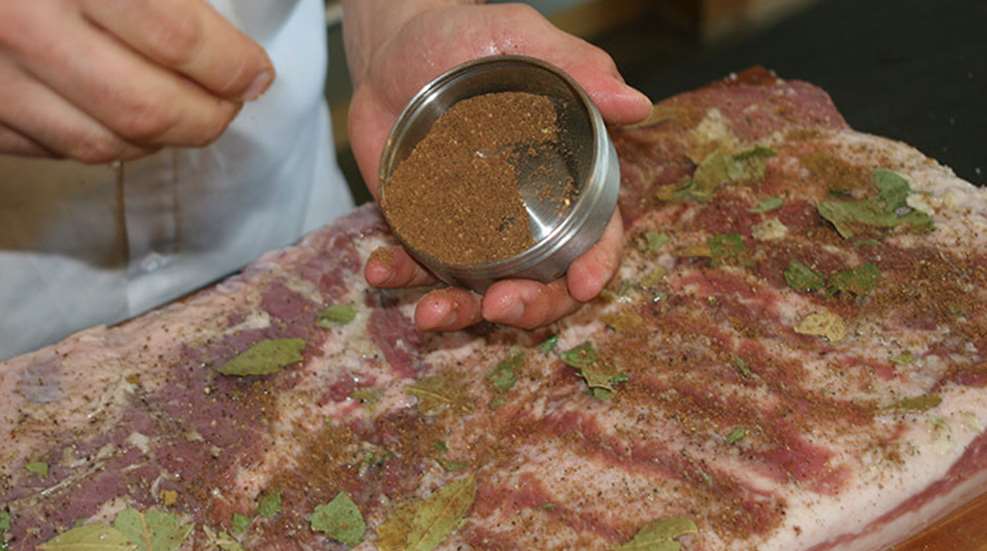
Depending on the size and weight of the pork belly, let it sit for one to four days. When ready, rinse the pork belly in cold water to remove the salt and pat dry. At this point, the meat-side of the belly is rubbed with the Bra spice. To finish the curing process, place the belly on a rack set in a flat pan or on a tray to catch any liquid, and allow air to circulate. Do not cover. Place in a curing room or refrigerator with good circulation for one to three days, depending on the thickness of the belly, until completely dry.
Bra Spice (Courtesy of Chef Dino Bugica)
This is a classic seasoning from Bra, Italy. You can vary the spices based on personal preference, but use an amount of black pepper equal to the total weight of the other spices.
Ingredients
• 10 grams ground allspice
• 10 grams ground mace
• 10 grams ground nutmeg
• 10 grams ground coriander
• 5 grams ground cinnamon
• 5 grams ground cloves
• 5 grams ground star anise
• 55 grams freshly ground black pepper
Directions
Combine all ingredients, and apply to meat-side of belly. Cover and keep regrigerated as you use. Spice will keep at least a few weeks in the refrigerator.
*The ratios above are provided by weight, not volume. Teaspoon conversions won’t work, but ounces will.