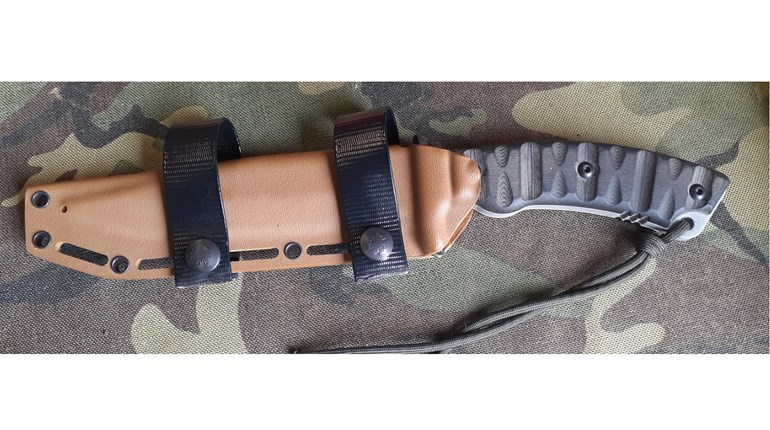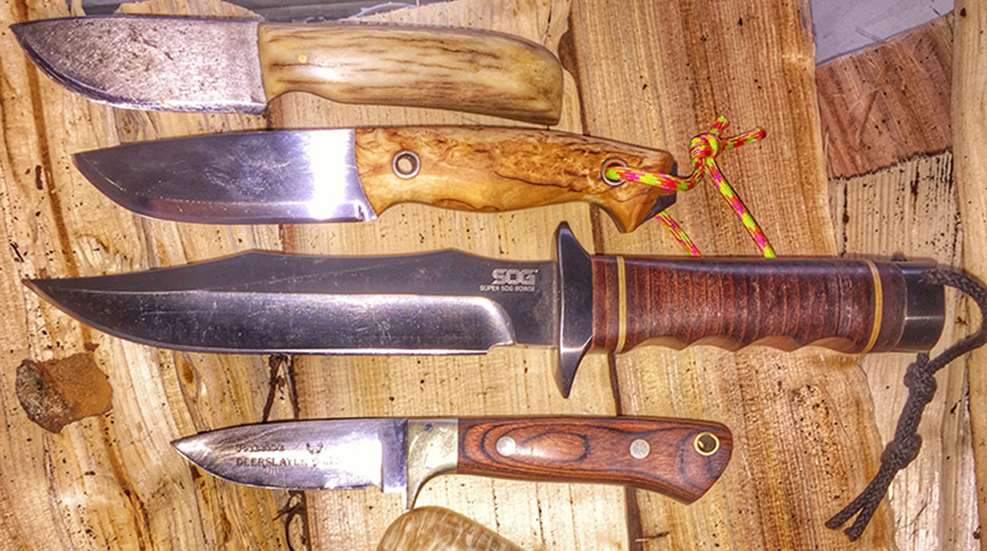
During the first season of Discovery Channel’s, Treasure Quest: Snake Island, I introduced viewers to the Super SOG Bowie. My own introduction to the original Bowie carried by members of the Studies and Observation Group and other special operations units in Vietnam, a design that later made SOG Knives, was the result of my father picking one up at the PX, when we lived in Saigon during the Vietnam War. After many moves since we left the Republic of Vietnam in 1972, I thought the knife lost. When I found it, first thing I wanted to do was take it hunting.
I quickly learned that the chisel type blade was hell to sharpen. I just couldn’t get that blade to take a proper edge. That was until I learned about using steel files, grinders and changing the pitch of blades with that type of edge and hardness.
The Steel
AUS-8 steel is hard enough that sharpening at that steep an angle just did nothing for me. When I went at the blade to decrease the steepness so that it was more like a razor blade than a chisel, suddenly I was able to not only slice paper and shave forearm hair, but also cut thick rope in one sweep!
Personally, I think any steel in the AUS-8 or 440 class is perfect for a good hunting blade. The key is how well it keeps an edge, and how easy it is to resharpen.
AUS-8 is a high-grade Japanese steel that takes an edge easy enough and is hard enough to keep that edge. It’s a good steel for a knife that will not only be used for slicing, but also chopping. 440 is a step up and often used for knives used for slicing instead of chopping, due to it’s being that much harder and brittle.
Many hunters are drawn to the harder 440 steel, and those even harder, because of how well they keep their edge during use. The problem is that when the harder steel is finally dulled by use, it’s a lot harder to sharpen. It’s amazing how easy it is to sharpen an older blade that might not have the hardness of a new 440 or even AUS-8 steel, but can be turned razor sharp with a few going overs with a sharpen stone or diamond rod.
Blade Shape and Size
I’m partial to large knives, which is why the same knife that I carried on the first and second seasons of Treasure Quest, is the same Super SOG Bowie I carry into the wilds of Alaska, an environment where there is still a chance your knife might be a last line of defense against a brown bear.
Attacking large animals aside, I love the multitasking ability of a larger knife: you can use it as a machete to hack limbs off a tree to start a fire or make a tool, or you use it to split a moose or bear’s sternum almost as a well as a full-length machete or axe. The weight in a 7.5-inch in a razor-sharp Super SOG Bowie can cut through a lot of bone, cartilage and flesh as easy as slicing through butter, especially when you’ve honed that blade to such sharpness.
As for skinning, or starting that initial venting up the belly, riding the blade can make this easy. Riding up the blade is the act of forgoing the knife handle as a grip, and gripping the blade as close to the point as to have as fine control as you need. When you ride up on the blade, you can turn a large knife into something as efficient as an ulu or drop point knife for skinning.
This begs the question of how many knives I carry on a hunting trip. If I’m on a long week or more hunt, I carry all three: large Bowie, ulu and a drop-point knife. My large Bowie serves as a full utility knife. The ulu serves well in skinning and meat processing. If you’ve never seen an Eskimo (yes, it’s a name proudly worn in Alaska, unlike Canada, where they call themselves Inuits) or Athabaskan woman work an ulu on a salmon, moose, or caribou, it’s a magical site to behold.
I’ll also carry a drop point, which is often an Eskimo’s men’s utility knife that my friend in Homer, Alaska, Maynard Linder of Dancing Man Knives, fashions from the hard-to-get-anymore steel of old saw blades, or a Helle Utvær from Norway. Both are amazing hunting blades in design and materials.
Knife Handle
If you’ve run enough knives through the hunting process, there are lessons you learn quickly. First, blood can be dangerous. The more you deal with it, the more likely your grip might slip off the handle and you’ll cut yourself with your own knife. For this reason, I look not only at a knife handle’s design, but also its composition.
I’ve found that wood, leather and rubber handles with raised texture offer good purchase and less chance of slippage. For shape, I like handles that have contours to fit your fingers.
Changing Angles, Sharpening and Keeping Honed
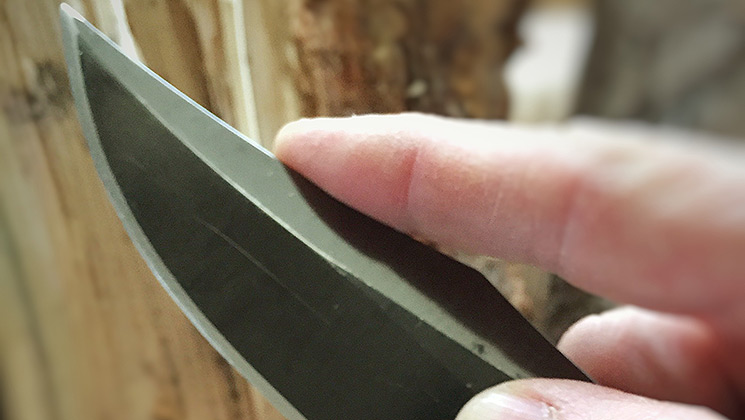
A good blade is all for naught if you can’t make it sharp and know how to resharpen. As I mentioned earlier, my Super SOG Bowie arrived with a blade that was sufficient to cut and hack, but to resharpen was a total headache if I wanted to be able to use a whetstone, or diamond sharpening rod. So, I took the blade to a much shallower angle of 13 degrees, using a metal file.
To reshape a blade, start with the metal file and add pressure as your movement goes from the spine to the edge. It’s basically the same technique I use to sharpen a woodcutting axe. Once you’ve changed the angle, finish off the sharpening process with a whetstone or sharpening rod, the pressure now applied as you move from the edge to the spine.
About the Author
Cork Graham has been covering guns and hunting since 1983, when he asked for an LOA from his NROTC squadron at UC Berkeley, and headed to SEA to cover wars as an 18-year-old photojournalist. He’s presently the team leader on Discovery Channel’s Treasure Quest. For more on his articles and books, visit his official site here.