If there is a hunting company in which I wished I owned stock, it is Bushnell Outdoor Products. The one-time optics-only company has quietly acquired a dozen other companies like Stoney Point, Bolle, Final Approach and others, and now Bushnell offers trail cams, blinds, shooting accessories, sunglasses, GPS units, even duck decoys. But the Kansas-based company's bread and butter remains optics.
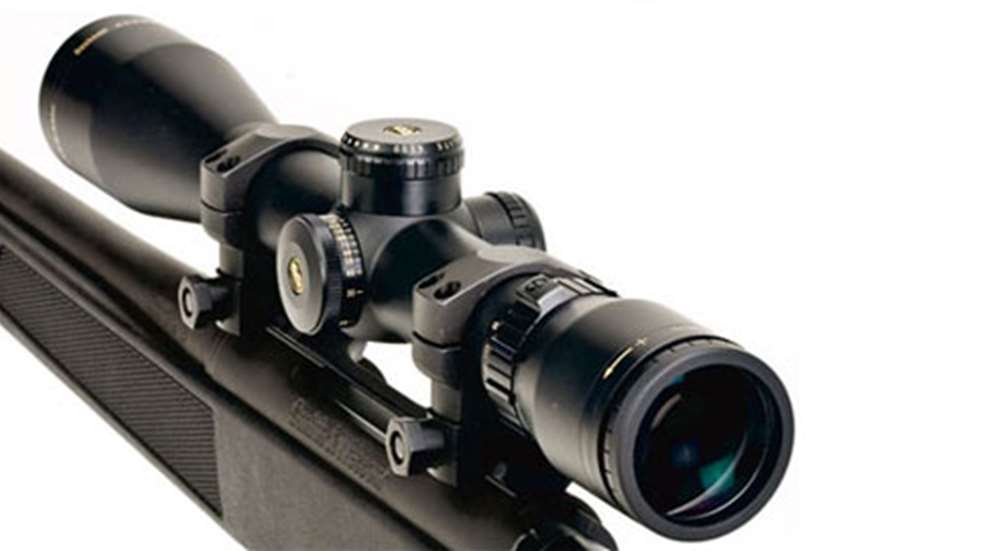
In the last few years Bushnell's Elite series riflescopes have emerged as one of the better values on the market. Its latest Elite, the 6500, is its most expensive to date, but it, along with Swarovski's Z6, is one of the most versatile scopes ever reviewed in these pages.
The 2.5X-16X-42mm 6500's versatility lies in its variable power range of 6.5X. In simple terms this means its magnification may be adjusted by plus or minus 6.5 times its highest or lowest setting. For example the 6500, having a low setting of 2.5X, is capable of magnifying an image 6.5 times that, to 16.25X. Keep in mind that in 1960, a fixed 4X was great. Then came variable-power scopes that eventually earned the trust of the shooting community. The 3X-9X (which has an adjustment range of 3X) remains wildly popular; however, the 2.5X-10X trumps it. Now 2.5X-16X is an option, and there is hardly a shooting scenario that cannot be accomplished with such a riflescope.
In order to produce a wider power range, Bushnell reps told me that its engineers created a new ocular lens system. The resulting new "eye-box" to which one lens was added prompted engineers to also increase the size of the tube and objective lens to accomodate it, hence the 30mm tube and the 42mm objective that differ from the 2.5X-10X-40mm 4200 Elite's 1-inch tube and 40mm objective. But because telescopes are governed by principles of physics, producing a larger power range cannot be accomplished without tradeoffs. I was surprised, however, to learn how little the drawbacks actually effect its use in the field.
The first drawback is obvious: The larger components and extra lens cause the 6500 to weigh more. It weighs 17.3 ounces, 1.3 ounces more than the aforementioned 4200. Less obvious is the mathematical fact that anytime an additional lens is added, it must decrease light transmission, with everything else (lens quality, coatings, objective size, etc.) being equal.
In optics, eye relief and field of view work against each like a teeter totter; engineers can either create a wide field of view at the expense of eye relief, or vise versa. Despite marketing trends, I believe eye relief is of greater value than field of view. The 6500 has one-half foot less field of view compared to the Elite 4200 (2.5X-10X) at 2.5X. But it has 3.9 inches of eye relief at 2.5X compared to 3.3 inches of the 4200 at 2.5X. If this is not enough, additional relief to your brow is provided in the form of a rubber ring on the eyepiece. With everything considered, I feel the 6500's benefits to the hunter outweigh its drawbacks.
The 6500's lenses are fully multi-coated. (You might be sick of hearing about coatings, but if a scope is not fully multi-coated, I won't buy it.) Its external lenses are permanently topped with Rainguard. When water lands on Rainguard it beads up and rolls off instead of smearing and making the lens blurry. I wish all optics had a topical coating of this nature.
Hunters like tactile controls, and this scope has them. Oversized knobs turn by hand, and they are precise. You can literally close your eyes and count clicks either by sound or by feel. The turrets feature a disengaging gear whereby the reticle can be zeroed, then the turret popped up and out of gear and rotated until the hash mark indexes with a number, preferably zero. This way you can quickly return to your zero despite adjustments made for range compensation or if using the scope on multiple rifles.
The 6500 employs a side parallax adjustment. On hunting scopes this would seem unnecessary, but at extreme ranges where 16X might be used, it is necessary. Scopes can focus on one plane at a time, and most are pre-set at 100 yards. For the sharpest focus-and accuracy-at all distances, parallax adjustment is critical. It can be accomplished by moving either the reticle or the objective lens slightly forward or backward. The 6500's system is of the reticle, or side-adjustment type. It is much easier to access from shooting positions than objective-bell-located designs. My theory with adjustable-parallax scopes is much like my theory for long-range shooting: Keep your mind and equipment prepared for the quick, close-range shot; if a long-range shot presents itself, it's wise to allow time for adjustments.
At $700-$900, the 6500 is more closely related to an "elite" class rather than its value-class family. But considering its extraordinary versatility-you can use it for deer in the brush at 2.5x or for 600-yard targets at 16x-it may be your best option if you are looking for one scope that can do it all.
Type: variable-magnification riflescope
Magnification: 2.5X-16X (tested); 4.5X-30X
Objective Lens Diameter: 42mm (tested); 50mm
Eye Relief: 3.9" @ 2.5X
Exit Pupil: 16.8" @ 2.5X; 2.6" @ 16X
Twilight Factor: 10.25 @ 2.5X; 25.92 @ 16X
Reticle: fine Multi-X; mil-dot
Field of View @ 100 yds: 41' @ 2.5X; 6.55' @ 16X
Coatings: fully multi-coated lenses; Rainguard external lens coating
Dimensions: length-13.5";
weight-17.3 ozs.
Construction: hammer-forged aluminum
Accessories: sunshade
MSRP: $699 (tested)-$899