When I am not hunting in the high country, I am dreaming about it. This dream often leads to a draining of my bank account with items more tangible than the dream itself. This is why my hunting room is full of alpine-style hunting boots, leg gaiters, ultra-light tents, down sleeping bags and several lightweight rifles. In short, at the drop of a hat, I have all the accoutrements to go Marco Polo sheep hunting if the opportunity presents itself (which it rarely does). This fanaticism for lightweight equipment naturally turns to scopes.
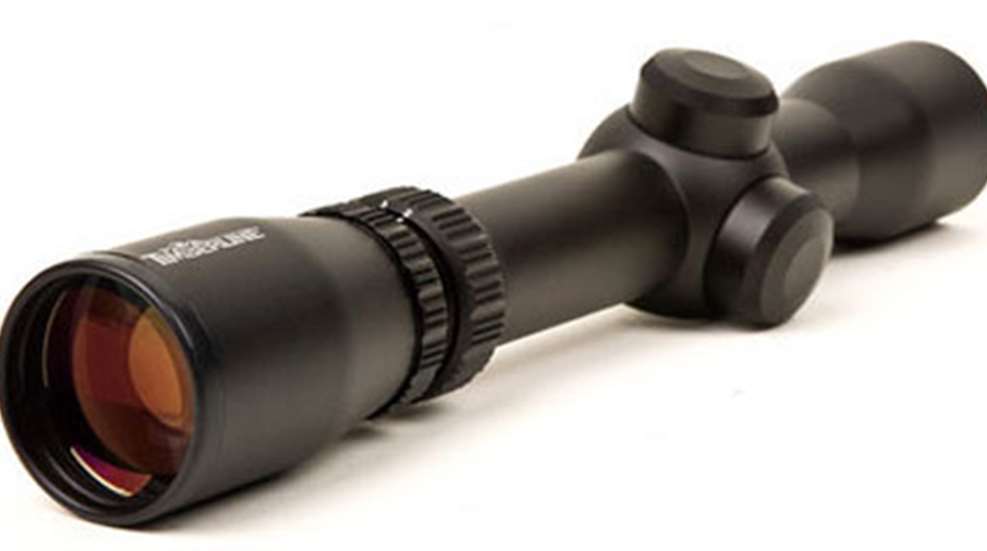
While large-objective, high-powered scopes are fantastic for certain purposes, they are not ideal for mountain hunting. And so I was excited to see the new line of scopes from Burris, aptly named the Timberline series.
Optical Testing
Pulling the little 2X-7X-26mm from the box, it was obvious that the Timberline didn't fall too far from the Burris tree. Like many Burris scopes it sports the characteristic short main tube and short objective bell that have become the American company's trademark style. Unlike most Burris models that are made here, however, the Timberline series is made in the Philippines, hence the lower price.
I tested the scope against a white-and-black checkerboard pattern set back into the shadows of the woods during the early afternoon in different locations from 100 to 300 yards away; I kept checking the scope's performance as the evening turned to night, and, thanks to the Timberline's fully multi-coated optics, I was not disappointed. The 26mm objective lens did not transmit as much light as some of my large-objective scopes, but, when the power was dropped down below four, there was still more than enough light transmission to cleanly make out a trophy animal and take a shot until the last legal shooting minutes.
Next, I ran through both the vertical and horizontal adjustments to the full extent of their range-a total of about 300 clicks each. This equates to about 75 inches of adjustment at 100 yards, compared to Burris' stated 60 inches.
While running through the clicks I noticed that the "hunter-style"turret adjustments, which can be used with or without a coin, were not very smooth. Parts of the range were smooth, parts were stiff, with little consistency. In addition, both the elevation and windage knobs were stamped "UP/R" in what I guess is an attempt to reduce costs in production and assembly. If you have experience with scopes you realize the top turret controls elevation and the side turret controls windage, but if you were novice to scopes, this could be confusing.
Range Testing
To check both the value of the adjustments (with four clicks equaling an inch at 100 yards) as well as the consistency/repeatability of the scope, I mounted it on a T/C Encore rifle and "shot the square." (It should be noted that due to the very short main tube, this scope, like others of its demensions, may be impossible to mount on some long-action bolt-guns fitted with two-piece bases.) Off a solid rest I fired a three-shot group that measured slightly over an inch. I then dialed in 24 clicks of vertical adjustment that should've equated to 6 inches of
elevation. I fired another three-shot group; it printed about 10 inches high-with the first shot being a flyer and the next two printing very close together. Since my Encore normally is very consistent, the flyer was the first indication that the scope may not settle after making an adjustment. I put in 24 clicks of right adjustment and fired a shot.
This bullet moved about 4 inches (instead of 6). I fired another shot and it jumped over to about 6 inches (roughly the right amount). I fired two more shots, for a total of four shots, to form the group. Excluding the first shot, the subsequent three shots clustered under an inch, around 6 inches to the right of the last group. After this group I was convinced the crosshairs weren't settling after being adjusted until after the first shot. I then dropped back down 24 clicks, but after making the adjustments I wrapped on the turret with a spent cartridge case to settle the adjustments. By doing this I eliminated the first-shot flyer from the next group. The downward leg of the vertical adjustment stayed pretty much in relation to the up adjustment for a distance of 10 inches. My final movement was 24 clicks of left adjustment to complete the square. After looking at the four groups, it was apparent that the horizontal adjustment value was about on, while the vertical adjustment was not-but it did remain consistent on the up and down legs.
Conclusion
Is the Timberline a perfect scope for mountain hunting? No, but it is pretty close. It has good optics, and it's available in several models to suit about any mountain hunting situation. It is rugged enough to withstand harsh treatment.
There may be better scopes out there with similar physical traits, but very few come to mind that sport a similar price. You can tuck away the money saved in the "mountain hunting fund" to turn those timberline hunting dreams into reality.
Type: compact, variable-power riflescope
Magnification: 2X-7X-26mm (tested); 4X-20mm; 3X-9X-32mm, 4.5X-14X-32mm
Reticle: plex and Ballistic Plex
Eye Relief: 3.75mm to 5mm
Exit Pupil: 13mm to 3.7mm
Field of View @ 100 yards: 31' @ 2X; 12' @ 7X
Coatings: fully multi-coated
Length: 9.5"
Weight: 11 ozs.
Construction: machined aluminum
MSRP: $149.99