We all owe Elmer Keith a debt of gratitude; he saw the need for several improvements in the cartridges of his day, and went at it like a charging rhino to see them brought to fruition. The .357 Mag. was his brainchild, as was the .41 Mag.; the .334 OKH (O’Neill-Hopkins-Keith) cartridge had a direct and irrefutable influence on the development of the .338 Win. Mag.
But among his works, the .44 Rem. Mag. ranks among the finest. Keith had a penchant for handguns that improved upon the existing cartridges and their performance. The .44 Spl.—introduced in the early 20th century and still a very useful cartridge—was the basis for the development, as Keith began experimenting with higher pressure loads. Keith chose the .44 Spl. for his platform for the choice of bullets, and the fact that the .44 revolver’s cylinder was of the same dimension of the .45 Colt, thereby offering increased strength. Keith’s higher pressure loads were enough to have Smith & Wesson and Remington get behind it, releasing the Model 29 revolver in the mid-1950’s, fueled by ammunition produced by Remington. The Ruger Blackhawk single-action followed quickly, and the handgun world was set on its ear.
 ‘Dirty’ Harry Callahan, played by Clint Eastwood, made that Model 29 famous, relating the fact that it was (at the time) “the most powerful handgun on earth.” And powerful it is; though it may have been eclipsed by the .454 Casull, .460 S&W and .500 S&W, the .44 Rem. Mag. may represent the recoil limit for the average shooter. As far as its power level, the .44 Rem. Mag., when paired with a good bullet, is enough to hunt virtually all of North America’s game, at sensible handgun ranges.
The .44 Mag. shares the same rim dimension as its father, the .44 Spl, at 0.514”, but uses a longer case, at 1.285”. The longer case dimension is not necessarily for additional powder capacity, but to prevent .44 Rem. Mag. ammunition from being shot from a revolver chambered for .44 Spl. only. One of Keith’s best concepts—which is also applicable to the .357 Mag.—is that the improved cartridge is simply an elongated version of the parent, thereby allowing the parent cartridge (of shorter length and less pressure) to be fired in the guns produced for his cartridges. Just as the .38 Special can be fired from the .357 Mag. revolvers, any revolver chambered for .44 Magnum can and will shoot .44 Spl. ammunition very well, making for a great choice for a lighter practice round, and for hunting smaller animals.
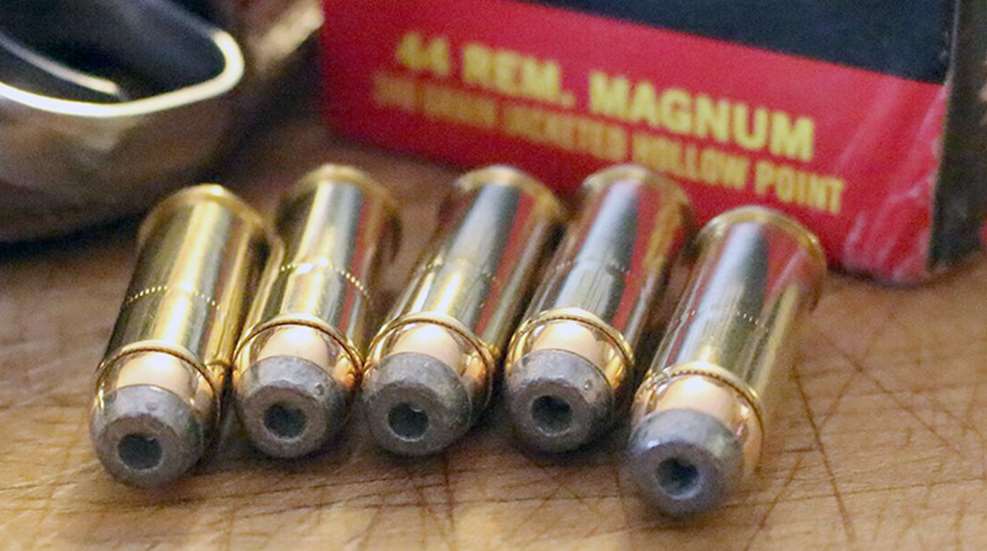
Most popular ammunition for the .44 Mag. will use bullet weights between 180 grains and 300 grains, with some offerings both above and below those weights. Being one of our most popular revolver cartridges, there are some fantastic bullet choices for the .44 Mag., for plinking, hunting, and for self-defense alike. There are pure lead bullets available to the Cowboy Action shooters, and hard-cast lead bullets—as heavy as 340 grains—for those who want to hunt the big beasties. There are traditional copper-jacketed hollowpoints—making a great choice for a defensive round—as well as modern homogenous metal bullets like the Barnes XPB, giving a modern twist on an old favorite. Federal Premium alone loads their Hydra Shok, Fusion and both a Barnes XPB and Swift A-Frame bullet, in addition to the older, more common designs; clearly demonstrating how popular and versatile the cartridge is.
The ability to launch a 300-grain slug at over 1300 fps put the .44 Mag. into the ‘hard-hitting’ class of handgun cartridges, for sure, but it isn’t only limited to handguns. Many lever-action and autoloading rifles have been chambered in .44 Mag., most notably the Ruger Model 44 carbine, a sweet-handling, compact and potent woods rifle, perfect for whitetail deer and black bear where shots are close. If the trajectory of those flat point bullets concerns you, Hornady loads its 225-grain FTX bullet in the LeveRevolution line, offering a spitzer bullet with a rubbery tip that is perfectly safe to use in a tubular magazine. The higher Ballistic Coefficient figure will give a considerably better trajectory for mid-range shots.
While there are many classic wheelgun calibers that date back to the late 19th century—the .44-40 and .45 Colt foremost among them—the relatively modern .44 Rem. Mag. has a well-deserved place among the most effective developments for a revolver, and will undoubtedly remain there for our lifetime and beyond.
Looking for previous installments of Behind the Bullet? We've got you covered.
• .243 Winchester
• .338 Winchester Magnum
• .357 S&W Magnum
• 6.5-284 Norma
• 8x57 Mauser
• .38 Smith & Wesson Special
• 7x57mm Mauser
• 9 mm Luger
• .35 Whelen
• .454 Casull
• .375 H&H Magnum
• .45 Colt
• .22-250 Remington
• 10mm Auto
• .308 Winchester