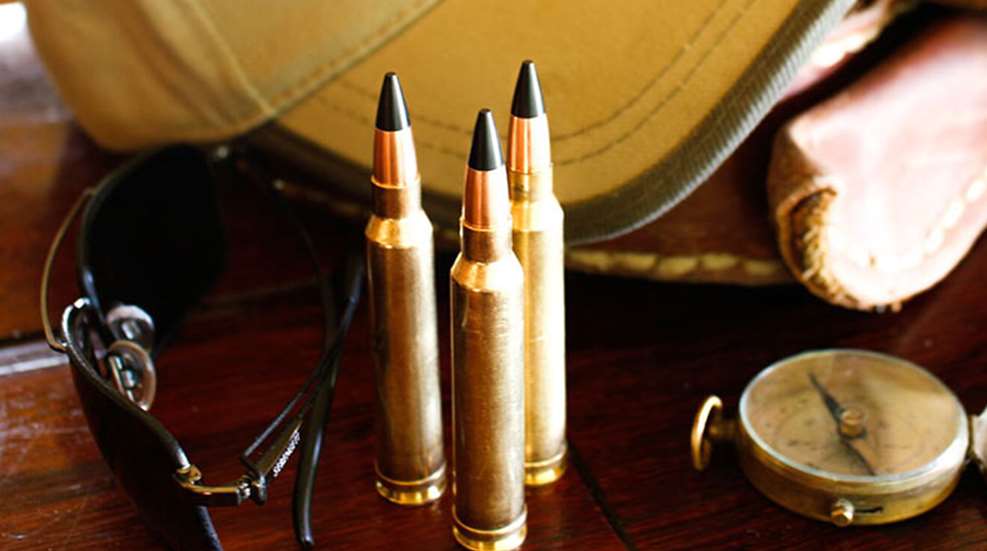
In 1963, after Winchester had released its initial trio of belted magnums—the .264, .338 and .458 Magnums, all based on a shortened .375 H&H case—they announced the coming of the .30 caliber version. Most folks anticipated a case of similar dimension and datum line (the distance from base to shoulder) to the .338 Win. Mag. and .264 Win. Mag., just necked to hold a .308” diameter bullet. However, Norma had filled that void a few years prior with their .308 Norma Mag., which is very similar to the .30-338 wildcat. Winchester thought outside the box, and developed a case completely different from the prior three.
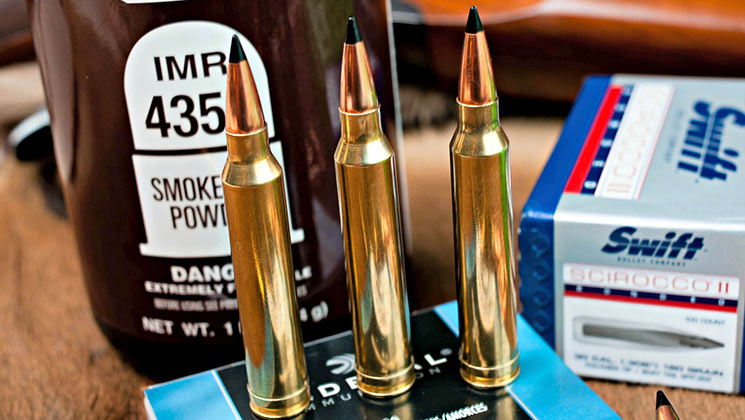
 The .300 Win. Mag. represented (until the advent of the .30 Nosler) the most potent .30 caliber cartridge one could get, at the standard "long", or .30-06-length action. Winchester took the .338 case, at 2.500” in length, and extended it 0.12” to 2.620”, while reducing the neck dimension to 0.264”, in order to maximize case capacity. The resulting cartridge was, and is, what I consider to be the finest .30 caliber cartridge ever made.
Yes, the .30-06 Sprg. is an undeniable classic, and probably holds the honor of being the single most popular cartridge among modern hunters. Likewise, the .308 Win. has proven itself as a viable and extremely accurate hunting cartridge, and the .30-30 WCF remains an undeniable player despite its age and a changing market. But, for me, when I think about a .30-caliber cartridge that can do it all and do it well, I think .300 Win. Mag. Being a .30-caliber cartridge is a good thing; there are an unprecedented number of bullet weights and choices, and there really is something for just about any hunting situation shy of Cape buffalo and elephant.
The .300 Win. Mag. will drive a 180-grain bullet to an average of 2,960 fps—sometimes faster—and delivers a trajectory that will make shots within sane hunting ranges completely feasible. It is faster than the benchmark .30-06—generally offering a 150 fps velocity gain—yet it has a recoil level that is manageable by most shooters; definitely less than the larger-cased .30 caliber magnums. Personally, I’ve used bullets weighing between 140 and 220 grains in a number of varying game fields, worldwide. Dimensionally, some have criticized the .300 Win. for having that short neck—less than one caliber in length—but it has never posed a problem for me. Like the .30-06, you can tailor the bullet for the game at hand, whether it’s a pronghorn antelope or Dall sheep at quite a distance, or a bear at relatively short distances. The .300 Win. may be the optimal elk cartridge, and will cleanly handle moose.
The 180-grain loads are among the most popular for larger game, and most .300 Win. loads will show a preference for bullets of this weight, or very close to it. Most ammunition manufacturers offer good .300 Win. loads, from the Federal Premium loads, to Norma’s fantastic ammo to the Winchester, Hornady and Remington offerings. Many of these loads take full advantage of the premium bullets, and that will only enhance the already great performance of the .300 Win. Bonded-core, monometal, polymer tipped spitzers, round nosed cup-and-core; all are present in the factory loads for the .300 Win.
Personally, I’ve used the .300 Win. Mag. as much, if not more, than any other caliber. I’ve used it for pronghorn antelope on the plains of Wyoming, for caribou in the taiga of Quebec, and for whitetails and black bear in the hardwoods and evergreen forests of the Northeast. I’ve also used the .300 Win. for gemsbok, waterbuck, kudu and other plains game across Africa.
For the reloader, the .300 Win. offers a very versatile cartridge, which is easy to load for. The belt—which was carried over from the Holland & Holland design—really serves no purpose, as the .300 Winchester will headspace off the steep shoulder. You may see some stretching just in front of the belt, and that’s a consideration for any belted magnum case. Use a good Large Rifle Magnum primer and a healthy load of slow burning powder and you’ll see good results. Handloaders can take full advantage of the big .300 case, as you can safely load it down to .308 Winchester velocities, or load it to full-house velocities if you choose.
You’ll see the .300 Win. Mag. in the hands of military snipers and big game hunters alike, with good reason: it is a very accurate cartridge. The case can easily handle the long, sleek bullets that possess the best Ballistic Coefficient for the long range game, and equally handle the heavy, round nose slugs that those who hunt at closer ranges prefer. The .300 Win. was, undoubtedly, the cartridge that knocked the .300 H&H off the stage, and while I have a special place for the .300 H&H, the .300 Winchester just makes more sense. My own pet .300 Win. is a Model 70 Classic Stainless that has been all over with me; I know it well, it’s very accurate, and I have all kinds of faith in it. The .300 Win. has been the cartridge I've reached for most throughout my career, and I don’t think that’s about to change any time soon. The .300 Win. Mag. just plain works.
Looking for previous installments of Behind the Bullet? We've got you covered.
• .270 Winchester
• .222 Remington
• .45 ACP
• .404 Jeffery
• .44 Remington Magnum
• .243 Winchester
• .338 Winchester Magnum
• .357 S&W Magnum
• 6.5-284 Norma
• 8x57 Mauser
• .38 Smith & Wesson Special
• 7x57mm Mauser
• 9 mm Luger
• .35 Whelen
• .454 Casull
• .375 H&H Magnum
• .45 Colt
• .22-250 Remington
• 10mm Auto
• .308 Winchester