The temperature on the thermometer on the side of the house read a whopping 16˚F, but I headed to the deer stand in spite of it. 1993’s Thanksgiving dinner was already being prepared, but, it was deer season. I had a buddy’s rifle in hand, as my own was having some issues, and I knew exactly how accurate the gun was. As a youth of 23 years, there was no keeping me from the woods; the rut was on after all. I piled on the layers—a menagerie of wool and flannel of the highest order I could afford—and made the uphill trek as slow as I could to avoid sweating and the resulting chills.
I sat for as long as I could, shivering in the November wind, watching the few squirrels that were brave enough to look for their stash in that weather. A noise that didn’t seem to align with the squirrel symphony aroused my attention, and upon turning my head to investigate, the immediate glint of sun on antlers held all my attention. He was the first deer I’d seen that afternoon, and he was obviously looking for his paramour, as his neck was completely swollen and the rims of his eyes were red and puffy. He was quartering toward me, head on the ground, when I leveled the Remington 7600’s crosshairs on the inside armpit and tickled the trigger.
Five minutes later, I stood over the largest deer I’d ever seen in real-life; though he wasn’t any record book deer, I was proud as hell of that eight-pointer, and for our region of Upstate New York, he was worth the numb fingers and toes. The cartridge was one I’d never used before: a .280 Rem.
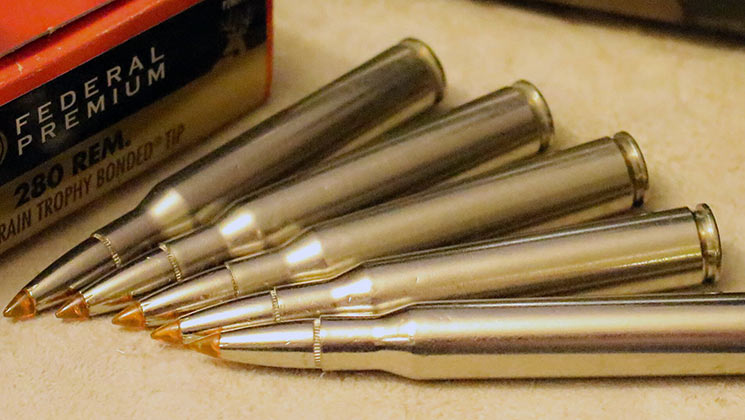
 Mating the .30-’06 case to each and every sensible bullet diameter—from .25 to .35—was, and is, a smart thing, as the case represents a perfect blend of acceptable recoil, powder capacity, and useable trajectory and striking power. Remington’s 1957 release of the .280 Rem. saw the ’06 case launching 7mm bullets—made famous on the back of the stellar reputation of the 7x57 Mauser—providing plenty of energy for almost all the common species, in a package that had a wee bit less recoil than its father does. The .280 Rem. has a case length of 2.540”—in comparison to the .30-‘06’s 2.494” case—actually mirroring the original length of .30-’03 Sprg.. It can use the entire spectrum of bullet weights available to the 7mm Mauser—from 120-grain pills all the way up to the long 175-grain slugs—giving nearly the same flexibility that the .30 caliber cartridges have. To be completely honest, I'm not uncomfortable saying that the .280 represents a better bore-diameter to case-capacity ratio than the .30-’06 does. Considering the fact that the .280 Rem. is much closer in performance to the 7mm Rem. Mag. than the .30-’06 Sprg. is to the .300 Win. Mag., the blend of caliber to case capacity is rather evident. Taking the huge bears of the extreme north and the bison off the menu, there is very little that the .280 Rem. can’t do, especially with the modern developments in bullet technology that have completely changed the game.
Any descendant of the .30-’06 Sprg. is immediately subject to scrutiny and comparison, and if you happen to be the 7mm variant, you are subject to the Caliber Cold War. Yes, it exists. Falling smack-dab in the middle of the useful caliber choices, the 7mm v. .30 War rages on, even if it has simmered down to a passive-aggressive movement. There are those who will debate the merits of each, fervent in their beliefs, but the bottom line is pretty much this: both do their job, and do their job well. I know very few people who take full advantage of the bullet weights on their side of the caliber debate, and in my experiences, the two are close enough to be a moot point in the game fields.
The .280 Rem. would’ve and should’ve been an immediate success, but that wasn’t exactly the situation. Dear Old Dad had a half-century head start, and its half brother—the .270 Win.—had been on the scene for over 30 years, so there was no warm welcome. In the late 1970s, Remington decided it would be a wise idea to rename the cartridge the 7mm Express Remington—presumably banking on the successes of the 7mm Rem. Mag.—but that resulted in an epic failure. It wasn’t long—1981 to be specific—that the .280 moniker was restored, and all was right in the universe.
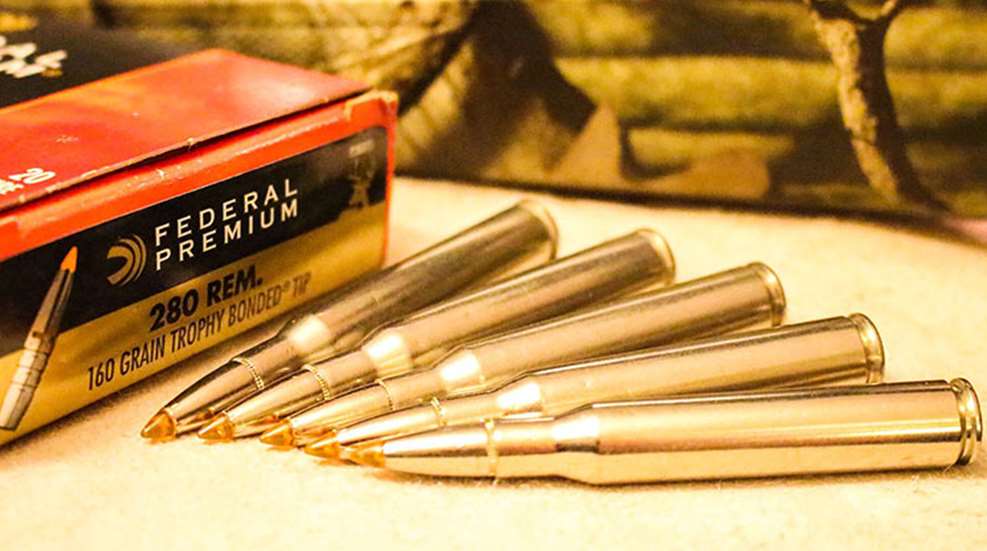
I truly can’t understand why the .280 never achieved the popularity of the .30-’06 or the .270 Win.; I mean it surely delivers the goods in the field, and it represents—at least to the mind of a reloader who looks at things statistically—a wonderfully efficient cartridge. It provides a level of accuracy and terminal performance that any hunter would be happy to employ, though I suspect the announcement of the lineup of Winchester’s Magnums may have outshined the .280’s release. However, driving a 140-grain bullet to a muzzle velocity of 2,950 fps—as in Federal’s Trophy Bonded Tip load—makes for an excellent deer load, and the 160-grain bullet, at 2,775 fps, as the Nosler Custom Partition load does, is excellent elk and moose medicine. I’ve loaded 175-grain Swift A-Frame for hunters headed for the Dark Continent, and they returned more than pleased.
If you’re in the market for a rifle that will cover the bases and cover them well, you could do an awful lot worse than a .280 Rem. If you shoot .280 Rem., you are already in the know.
Looking for previous installments of Behind the Bullet? We've got you covered.
• .300 Winchester Magnum
• .270 Winchester
• .222 Remington
• .45 ACP
• .404 Jeffery
• .44 Remington Magnum
• .243 Winchester
• .338 Winchester Magnum
• .357 S&W Magnum
• 6.5-284 Norma
• 8x57 Mauser
• .38 Smith & Wesson Special
• 7x57mm Mauser
• 9 mm Luger
• .35 Whelen
• .454 Casull
• .375 H&H Magnum
• .45 Colt
• .22-250 Remington
• 10mm Auto
• .308 Winchester