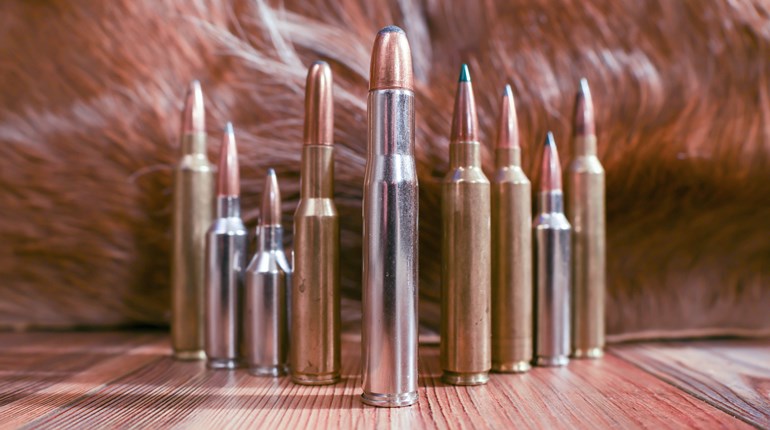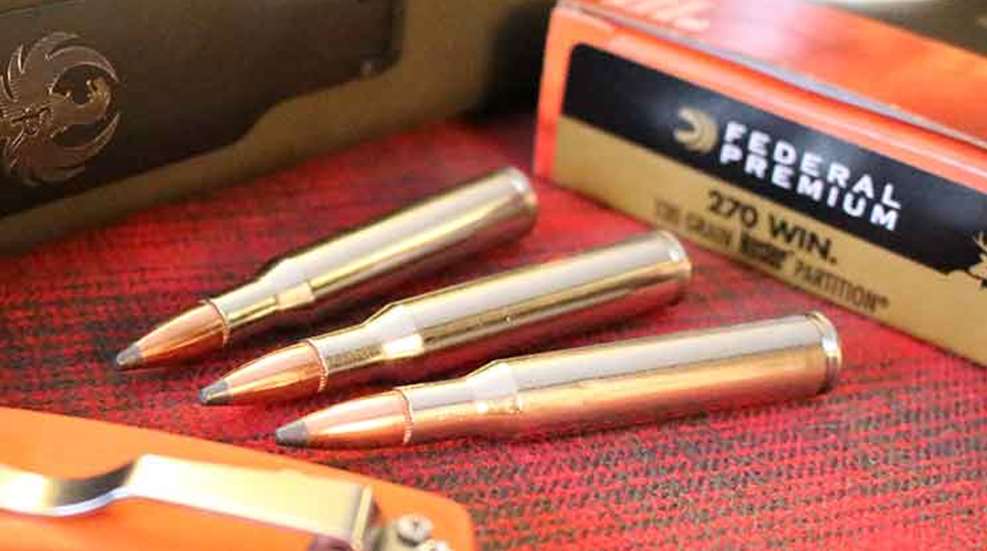
Being the son of a very successful father is no easy task. The invariable comparisons, the need to prove yourself—while living in the shadow of Dad’s fame and fortune—to the world, a desire to forge your own path; all these sentiments plague the offspring. The same concepts apply to the .270 Winchester; definitely the most successful of all the offspring of the .30-’06 Springfield.
Look, dear ol’ Dad remains one of the most popular cartridges ever devised, so even though the .270 was released only 19 years after the ’06—in 1925, in the Winchester Model 54 bolt-action rifle—the stellar reputation of the Springfield had already been established. Who did this kid think he was? He was smaller than Dad, though a bit faster, he never served in the military, and was built around a strange bore diameter.
 Yet, he was of the new mind set, the one that believed in high velocity and flat trajectories. If you consider the players in 1925—the 7x57 Mauser, .30-’06, .250/3000 Savage, not to mention it was still the lever gun’s heyday—the .270 Win. seemed rather revolutionary.
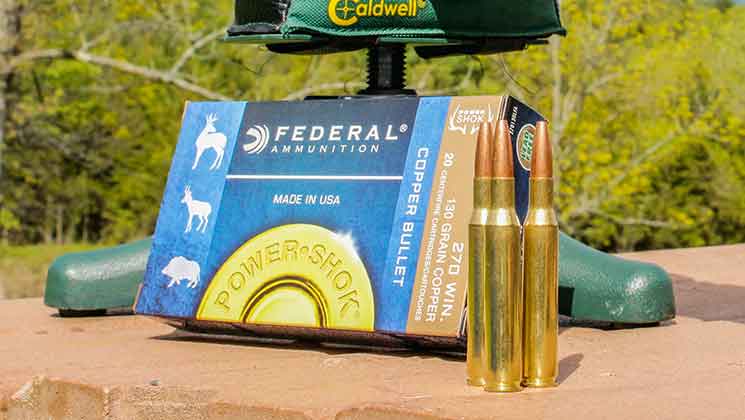
Using a .277” bullet diameter, and a case 0.050” longer than the Springfield design, the .270 Win. launched a 130-grain bullet at a muzzle velocity of 3140 fps. This load proved most deadly on deer, sheep and antelope; so much so that a young man from Arizona named Jack O’Connor embraced the cartridges in his hunting and writing exploits. O’Connor—who would become a staple in Outdoor Life, and the gun industry as a whole—took the new cartridge and had all sorts of good adventures. For you younger hunters, if you aren’t familiar with Mr. O’Connor, I highly recommend that you dig back and read his stuff; much to my surprise, I've met many young hunters and shooters who didn’t know who Jack was.
While O’Connor used other cartridges—including the 7x57, .30-’06, .375 H&H and .416 Rigby among them—he was synonymous with the .270 Win. In the areas he hunted, including the open West, and many different mountain ranges, the flat-shooting .270 made all sorts of sense. That 130-grain spitzer load, when zeroed at 200 yards, hits 6.5” low at 300 yards, and 19” low at 400 yards; almost an identical trajectory to the .300 Win. Mag. with a 180-grain bullet. The 150-grain load—moving at a muzzle velocity of right around 2825 fps—gives a bit more drop with the same zero, dropping 7.5” at 300 and 22” at 400 yards. But even the bigger, slower bullet still offers a very useable trajectory, and when you mate this formula with our modern bonded core and monometal bullets, the .270 Win. is even more effective today than it was in O’Connor’s day.
Dimensionally, the .270 shows its lineage by sharing the same 0.473” case-head and 17˚-30’ shoulder angle of the ’06, but where the ‘06’s case length measures 2.494”, Winchester designed the .270 case at 2.540”, so it wouldn’t chamber in a .30-’06 Springfield.
The 130 and 150-grain slugs are the most popular choices for the .270, with some 140-grain offerings splitting the difference. There are lighter choices—the 90 and 100-grain bullets that make the .270 a viable coyote rifle—and some heavier bullets, but above 150-grains things get tricky. You see, the .270 Win. falls victim to the twist rate of the common barrels, much like the .22-250 and .220 Swift. Most .270 barrels use a 1:10” twist-rate, which generally precludes bullets weighing more than 150-grains. This is the reason that the .270 has not been a true long-range choice, in the modern sense of the term; the twist rate won’t stabilize the heavy-for-caliber, high Ballistic Coefficient bullets that long-range shooters want. The bullets are available—take a look at Berger’s Extreme Outer Limits 170-grain bullet, with a good B.C.—and the cartridge certainly has the moxie to drive them, but they would need a 1:8.5” or faster twist rate to stabilize them.
So, if we’re left with a cartridge that uses bullets between 90 and 150-grains—and uses them well—is that such a bad thing? Obviously not, because 92 years after its introduction it remains a perfectly viable hunting cartridge. It lacks the versatile selection of bullets that both the 7mms and .30 calibers have, and doesn’t use the high B.C. bullets that the 6.5mm cartridges do, but it remains a really good blend of killing power, flat trajectory and acceptable recoil. It has been chambered in every type of rifle action, from bolt to pump to autoloader, and it’s one of those classic cartridges for which you can find ammunition just about anywhere. Though I was raised to be a .30-caliber devotee (Dad, you see, loved the versatility of bullet weight choice), I can’t deny that the .270 Win. is most definitely a contender for the “Best Deer Cartridge” crown.
Of all the Springfield’s children, the .270 has had the most success—though it can be argued that the .280 Remington, with a better selection of bullets, is a more useful design. But, design arguments aside, there’s no denying that the .270 has been getting the job done for over 90 years, with very few complaints.
Looking for previous installments of Behind the Bullet? We've got you covered.
• .222 Remington
• .45 ACP
• .404 Jeffery
• .44 Remington Magnum
• .243 Winchester
• .338 Winchester Magnum
• .357 S&W Magnum
• 6.5-284 Norma
• 8x57 Mauser
• .38 Smith & Wesson Special
• 7x57mm Mauser
• 9 mm Luger
• .35 Whelen
• .454 Casull
• .375 H&H Magnum
• .45 Colt
• .22-250 Remington
• 10mm Auto
• .308 Winchester