Randy Brooks loved to hunt as much as anyone, and brown bears were perhaps his favorite game. But during a slow day of glassing along an Alaska river in the spring of 1985, Randy’s thoughts wandered. A bullet maker by trade, he was mulling over ways to build an expanding bullet that would equal the performance of his Barnes Solid, which in short order had become very popular among safari hunters in Africa.
Brooks had been toying with a design originated by Frank Barnes, the founder of the company now owned by Randy and wife Coni. That bullet, the CE (Controlled Expansion), featured an abbreviated lead core in the nose only. The jacket and shank were a single, unified construct, and while penetration was promising, the CE’s nose-heavy design compromised accuracy. At times, too, the CE would “spit” its core on impact, thus limiting the hoped-for penetration.
Randy thought back to his work on the Solid, essentially a solid steel slug (core) coated in jacket material. What if … ? He turned to bear guide Bill Stephenson and said, “I’m just gonna pull the lead out. How about that?”
Before long Randy was cutting slugs from 3/8-inch solid copper rod, into which he drilled nose cavities, formed points and then beveled the bases. A few test shots into water convinced the Utah-based tinkerer he was on the right track.
That was the origin of the Barnes X-Bullet, now 25 years on the market. The all-copper bullet’s influence on big-game ammunition can hardly be overstated because it delivered previously unattainable levels of penetration, expansion and weight retention, factors that add up to superior terminal ballistics, or, more importantly, quick, ethical killing from any practical range and shot angle. The X-Bullet concept has since been adapted to a host of applications—muzzleloading, handgunning (hunting and personal defense), long-range tactical shooting and more. Indeed, an entire X-Bullet family now exists, including the groundbreaking Triple-Shock (TSX) that solved the tendency some rifles had with inaccuracy and fouling. Annular grooves cut into the TSX’s shank reduce bearing surface and provide a place for the hard copper surface to “flow” as the bullet travels down the bore. The TSX begat the Tipped Triple-Shock (TTSX), which incorporates a polymer tip and deepened nose cavity to cut weight. That boosts velocities while maintaining respectable ballistic coefficients so that downrange trajectory is very flat.
As a result, smaller calibers shooting lighter bullets can now handle tasks once delegated to bigger guns. My No. 1 all-purpose load for anything short of grizzlies or moose is the 130-grain TTSX in .300 WSM. At 400 yards, it drops just 13 inches below point of aim (250-yard zero) and still packs 1580 ft.-lbs. of knockdown energy. Lacking X-Bullet-like penetration, it would require a heavier, harder-kicking .300 Wby. or .338 Win. Mag. shooting bullets no lighter than 180 grains to match that kind of downrange performance. The principle works especially well with the even-smaller rounds appropriate for beginners, like .260 Rem., 7mm-08 Rem. and .308 Win. As a result, we can ethically encourage youngsters and other new recruits to pursue all but the very biggest game with rifles they can comfortably carry and shoot.
 No wonder practically all major ammo and bullet companies now produce or offer copper-based monometal projectiles. Brooks admits he was initially angered by the copycatting, but reflects that ultimately it pushed Barnes to work harder to find new applications for the X-Bullet concept.
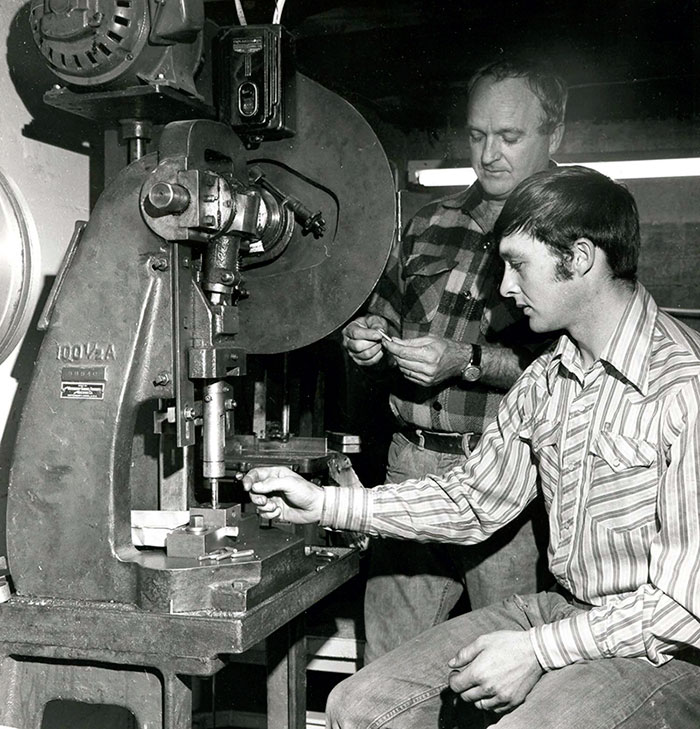
Though the competitors may mimic X-Bullet performance, they can’t begin to mirror what it took to forge the mold. The trial-and-error process was difficult and lacked anything akin to an R&D budget. Early on, Randy, Coni and their young daughters, Jessica and Chandra, worked together to make bullets in the family basement and then in a backyard workshop. It was a struggle to keep the business afloat, with little time for new product development.
Regardless, and with no blueprint but intuition, Randy felt his way through the development, and often that meant fabricating hand tools. First he had to grind drill bits to perfect the size and conical shape of the nose cavity, and eventually, the conclusive breakthrough came from a punch he made to score the inside of the cavity. Up to that point, the bullets expanded readily but at times “mushroomed” off-center—not good enough. Brooks persisted until he devised a tool that caused the front to open in four precisely equal sections. The result was a wide-open maw of sharp-edged petals spread to about twice the bullet’s original diameter, forming a uniform X with every impact.
Finally satisfied, Brooks made a run of 20, .375-caliber, 300-grain prototypes, shot a few for zero, then took off for Alaska, determined to pick up where he left off a year earlier. This time he found his bear on a coastal beach, and hit the big bruin with a shot that broke both shoulders. “I knew right then this was going to be the future of our company,” he recalls. “I guess I was an eternal optimist, because it still didn’t shoot all that well. But I knew I would learn how to correct that.”
Barnes X-Bullets have most certainly made their mark, and for all of us who have used them with much success, the X symbolizes unforgettable hunting.
X-Bullet Lineage
Hunting• X-Bullet—the original all-copper bullet• Triple-Shock—stress-relief rings improve accuracy, lessen fouling• Tipped Triple-Shock—plastic tip and deep nose cavity lower weight, boost velocity• Long Range X—lengthy profile and boattail increase ballistic coefficient
Tactical• TAC-X—designed to track straight through barriers• TAC-TX—plastic tips flatten trajectory• TAC-LR—aerodynamic brass bullets for the .50 BMG
Handgun• XPB—stopping power for big revolvers• TAC-XP—personal defense application for semi-auto pistols
Muzzleloader• Expander MZ—rapid six-petal expansion• Spit-Fire MZ—semi-spitzer profile• Spit-Fire TMZ—plastic tip for fast expansion and flat trajectory