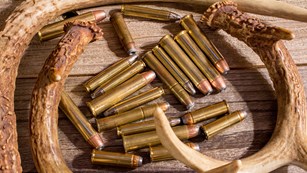
The purpose of shooting a deer is not just to kill it, but kill it as quickly and humanely as possible. Doing so requires using a cartridge with enough power to get the job done when it reaches the target.
Because deer are relatively lightly muscled animals with thin hides and body weights that rarely exceed 300 pounds—and often weigh half that—the list of cartridges that supply adequate power is long. For many years, the accepted minimum kinetic energy, measured in ft./lbs., deemed acceptable for hunting deer-sized game has been 1,000 ft./lbs. at the target. Using this baseline, some short-action .22 caliber cartridges would qualify at shorter ranges. For example, the .223 Rem. loaded with a 50-grain bullet almost makes the grade, delivering about 940 ft./lbs. at 100 yards, while the .22-250 Rem. loaded with 50 grain bullets yields around 1250 ft./lbs. at the same yardage.
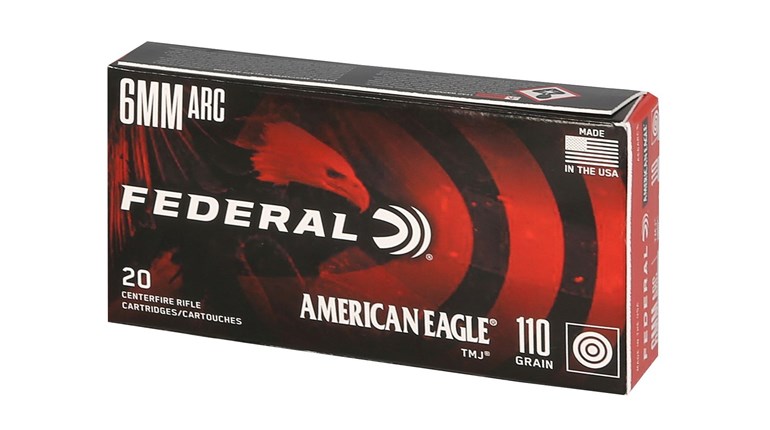
Realistically, for most of us the minimum should be some type of 6 mm (.243) cartridge like the 6 mm Rem. or .243 Win., both of which deliver 1,200 ft./lbs., more or less, at 300 yards. At the top end, the .300 magnums are a bit of overkill—if there is such a thing— loaded with 150-grain bullets producing nearly 2,900 ft./lbs. at 100 yards and almost 1,100 ft./lbs. at 500 yards. In between is a huge array of cartridges that meet the power criteria.
Just as important a factor is bullet construction. Today you can choose from old-style controlled expansion deer bullets like the Remington Core-Lokt and Winchester Power Point, to some of the “improved” old-style bullets like the Core-Lokt Ultra, to one of today’s wide array of “premium” bullets that feature polycarbonate tips, bonded core construction or homogenous solid copper construction.
Here’s something to think about when choosing a bullet: Some of today’s bullets are designed to penetrate extremely deep before expanding and are best suited for larger, heavier game. When used on deer, they may zip right through the chest cavity before completely expanding, and while this will certainly kill a deer, animals struck with such projectiles often run quite a ways before tipping over. I personally prefer “softer” bullets designed to penetrate the on-side hide and muscle—and even crack a big bone if need be —and open up while still well inside the deer.
When it comes to power cartridges loaded with bullets that can get the job done, even when shot angles are less than ideal, hunters have never had it so good.