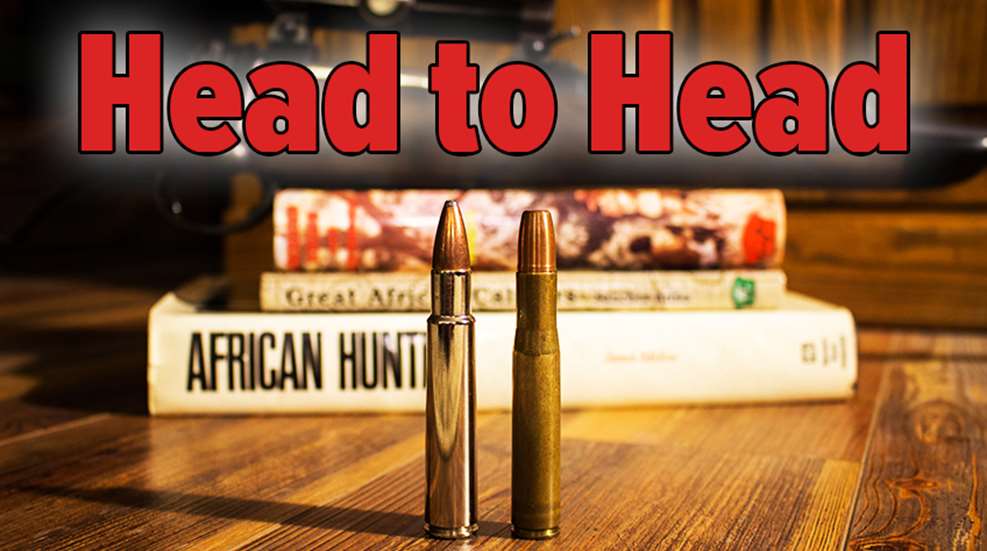
Here is a pair of classic African cartridges, both fully capable of taking any and all game on earth, one having been the workhorse of the African game departments and the other has attained unparalleled glory through the writings of an American on his first safari. Both are designed to function in a bolt-action rifle, both are (relatively) easy on the shoulder, and can be built in a rifle that’s easy to carry. Both came on to the scene before the World War I, when the smokeless powder revolution had changed the course of cartridge development.
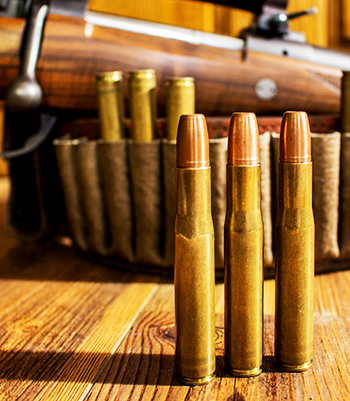 Starting with the elder of the two, the .404 Jeffery came onto the scene in either 1906 or 1907 (this date has been the topic of debate, but my friend Phil Shoemaker has a certified 1907 .404 Jeffery rifle), and was designed to be a rimless variant of the .450/400 Nitro Express, also known as the .400 Jeffery. Instead of simply maintaining the .410-inch diameter bullet of the .450/400, the .404 Jeffery utilized a .423-inch diameter bullet of 400 grains, at the same muzzle velocity of 2150 fps, generating 4,100 ft.-lbs. of energy. A 300-grain load at 2600 fps was also offered, but was not very effective against dangerous game.
With a slight shoulder of 8˚-30′, the Jeffery case feeds like it was greased, and was an undeniable blend of striking power and low recoil. It was chambered in Vickers rifles, and was issued to the game scouts of Rhodesia, Tanganyika and Uganda for dangerous game control work. Some feel that the initial loadings of the .404 Jeffery—the 400-grain/2150 fps combo—are a bit anemic, but for over a century it has worked and worked well. Though it isn’t among the most popular cartridges in the safari world—yet it has earned a place of reverence among professional hunters and those in the know—it has received a facelift as of late, with modern loads sending those 400-grain slugs at 2325 fps, for 4,800 ft.-lbs. of muzzle energy. My own favorite handloads drive the 400-grain bullets at 2280 fps, mainly because that’s where I found the best accuracy; my Heym Express .404 Jeffery will put three shots into 0.75-inch at 100 yards. That load has taken elephant, buffalo and a good number of species of plains game.
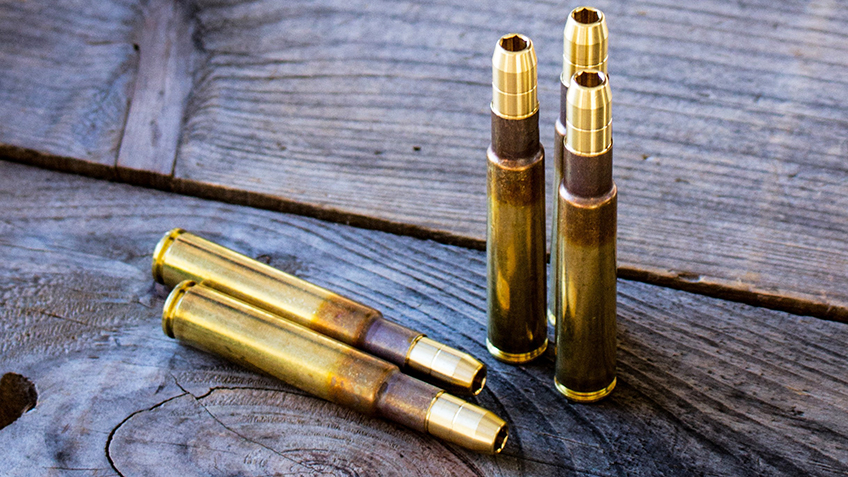
In 1911, London’s John Rigby & Co. released what would become one of their most famous proprietary cartridges: the .416 Rigby. Bearing marked similarities to the earlier .350 Rigby Magnum—they share the same 45-degree shoulder—the .416 Rigby used a unique bore diameter and a case large enough to prevent extraction problems in the heat of Africa and India. The .416 Rigby was advertized as driving a 410-grain bullet at 2370 fps, for just over 5,100 ft.-lbs. of energy. This formula—well, actually a 400-grain 416” bullet at 2400 fps—would go on to become an undeniable classic, with the .416 Hoffman and .416 Remington Magnum replicating the recipe, albeit at a higher pressure. Though the number of rifles produced prior to World War II was actually quite low—a whopping total of 169 rifles—it was the writing of experienced African hunters like John ‘Pondoro’ Taylor who sang its praises; but the 1953 release of Robert Ruark’s Horn of the Hunter, in which he idolized his PH Harry Selby and his .416 Rigby, that sealed the cartridge’s fate.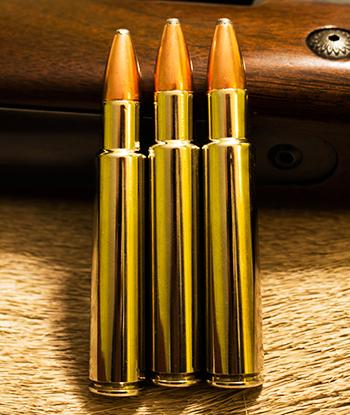
Selby’s .470 double rifle had been accidently run over and damaged, and the only suitable rifle he could find in Nairobi was a “dirty, rusty-looking .416 Rigby.” Though there were so few produced, the reputation of the .416 Rigby inspired writers like Jack O’Connor, who also sang its praises. The 400-grain .416-inch bullet has a sectional density of 0.330, and that plays a big part in the penetration for which it is so famous. Federal and Ruger helped make the cartridge and rifle available, when both announced that ammunition from Federal would feed the new Ruger Safari Magnum, chambered in .416 Rigby in 1989. There are plenty of factory loads, as well as component bullets available for the .416.
So, while both of these cartridges have a rather impeccable reputation, which one makes a better choice for the dangerous game hunter? This is a tough one for me personally, as logic would dictate that the wider availability of the .416 Rigby—including the resurgence of the Rigby Big Game rifle—coupled with the slight velocity advantage would give it the edge. However, having spent a considerable amount of time with both cartridges—in a few different rifles—I will admit that the Rigby recoils harder than does the Jeffery. It’s also easier to get an extra cartridge in the magazine with the narrower Jeffery case than with the big Rigby case. I don’t think the modern Jeffery load—the 400-grain bullet at 2350 fps—gives up much to the Rigby, though the higher sectional density of the Rigby bullet might influence a choice, but the greater frontal diameter—.423-inch v. .416-inch—might offset that concept. In the Norma PH line of ammunition, which uses heavier-than-normal bullet weights, both the Rigby and the Jeffery drive a 450-grain Woodleigh softpoint or FMJ to the same muzzle velocity of 2150 fps. Both kill very well, both have proven to be very accurate (I have sub-MOA loads for both) and both are wonderfully nostalgic.
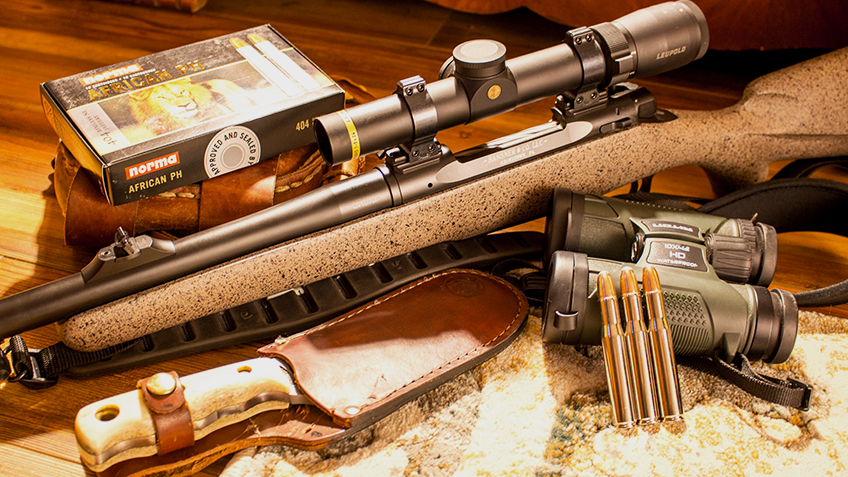
I wouldn’t find fault with a hunter for choosing one way or the other, so I’ll settle the argument with my own personal decision: I own two .404 Jeffery rifles—a Heym Express and a Bansner Custom—and I don’t own a .416 Rigby. That said, you can’t go wrong with either. Though the Rigby is capable of higher velocities via handloading, I don’t really feel it’s necessary in a dangerous game situation. Dead heat here.
Looking for previous installments of our "Head to Head" series? Click here.