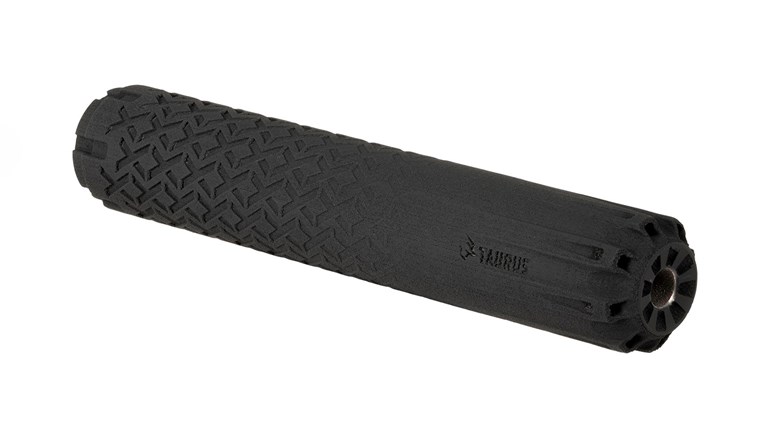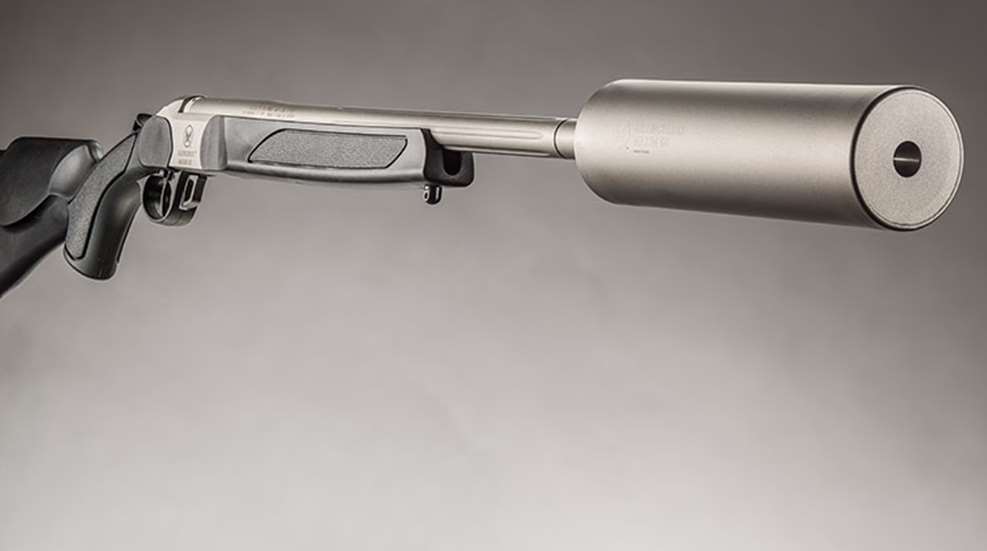
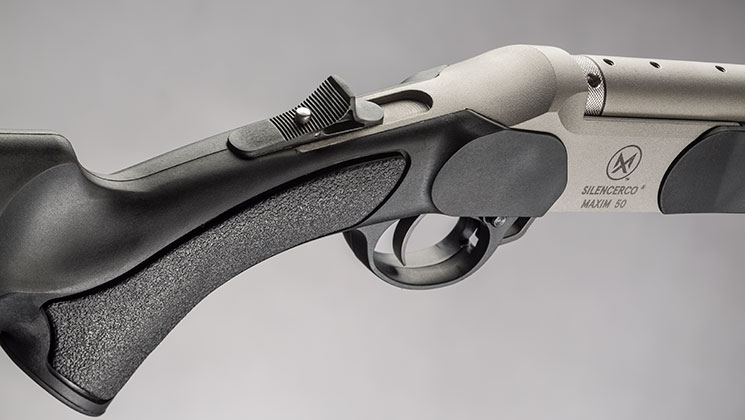
Disruptive by design: That’s how the people at SilencerCo describe their push to develop new shooting sports products—products that break old boundaries and are frequently criticized for being too different. With the Maxim 50, suppressor manufacturer SilencerCo has definitely disrupted the blackpowder world with the first integrally suppressed muzzleloader. A .50-caliber big-game rifle, the Maxim 50 allows hunters to eschew ear protection thanks to a large and, yes, bulky suppressor permanently affixed to the barrel.
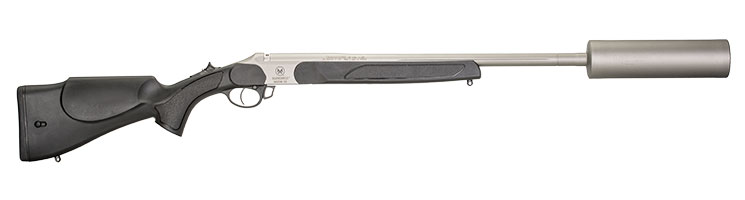
I tested the Maxim 50 on the range and used it on a South Texas hog hunt where I bagged three wild porkers. In addition to sound suppression, the rifle is accurate and has a first-rate trigger. If you are a veteran of all things blackpowder, you’ll likely want this unique rifle in your collection. But it’s just a little too quirky and complicated for a novice muzzleloader hunter.
The Maxim 50 is actually a Traditions Vortek Strikerfire in-line muzzleloader with a SilencerCo suppressor welded onto the end of the barrel. The barrel has been trimmed down to 20 inches (standard Tradition in-lines in this series wear 26- to 30-inch barrels). The rifle does not have iron sights, so for testing and hunting I installed a Traditions optics base and a Bushnell Engage 2.5X-10X-44mm scope.
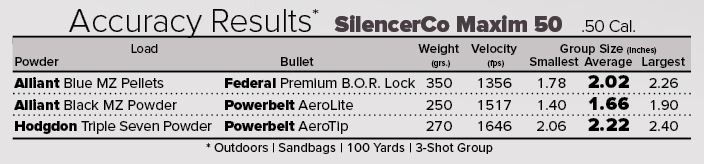
I tried out three different powder and bullet combinations: Alliant Powder’s Blue MZ 50-grain pellets and Federal Premium 350-grain B.O.R. Lock MZ bullets; Alliant Black MZ powder launching Powerbelt 250-grain AeroLite bullets; and Hodgdon Triple Seven powder paired with Powerbelt 270-grain Platinum AeroTips.
Saboted bullets can’t be used in the Maxim 50 as the sabots might get caught in the suppressor baffles. SilencerCo also recommends using 100 grains of loose powder, though the Maxim 50 manual notes pelleted powder is acceptable. SilencerCo staff told me the rifle has better accuracy with loose powder than pellets. I didn’t find that to be true in my relatively limited testing. The loads using Blue MZ pellets placed smack in the middle of my accuracy results.
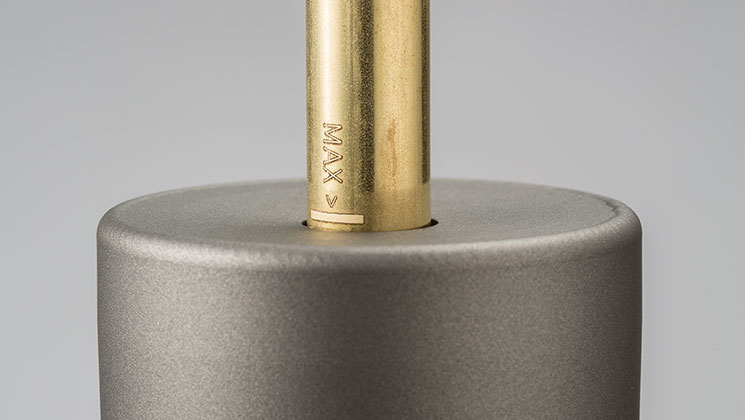
Loading the rifle requires you to slide a short brass tube (provided) into the suppressor then pour powder or slide pellets into the tube to avoid the suppressor’s baffles. Then drop the bullet into the tube, use the bullet-starter rod (provided) to push the bullet fully into the bore, and use the ramrod to seat the bullet. Push the barrel-catch lever to open the action and place a 209 shotgun primer in the breech hole. Snap closed the breech, slide the striker button up the tang until it clicks into place, and you are ready to fire.
My best accuracy at 100 yards came with the combination of the 250-grain AeroLite bullets and 100 grains of Alliant Black MZ, averaging 1.66-inch three-shot groups. This load also placed shots one and two within an inch of each other more than once. The other two load combos produced average three-shot groups just greater than 2 inches.
Accuracy-wise, this isn’t the newest “Creedmoor Mach4 TackDriver.” That’s at least in part because of the short (for a muzzleloader) barrel. Yet the Maxim 50 is more than accurate enough for big-game hunting at distances under 200 yards.
The Maxim 50 may tempt hunters and shooters to do without earplugs or bulky shooting muffs, increasing awareness of your surroundings while hunting and your communication with fellow hunters. SilencerCo rates the noise level of the Maxim 50 at 139.9 decibels (dB), when loaded to specifications. Anything greater than 140 dB is considered damaging to your hearing.
I would’ve guessed it was much lower. Some suppressed firearms, especially when their suppression ability is in the 138.5 to 139 dB range, have a damned snappy report. But the Maxim 50 was easy on my ears. I had two people at my outdoor shooting range tell me the Maxim 50 sounded like a .22 rimfire rifle from 10 yards away.
The suppressor also reduces recoil. Most .50-caliber in-lines I’ve used have recoil similar to a 20-gauge pump shotgun. The Maxim 50 comes in closer to a .410. Plus, there’s no blinding cloud of smoke when the rifle goes off, as most of the blast is held within the suppressor tube. You can actually see your target immediately after the shot.
The rifle also has a great two-stage trigger. Its pull weight averaged just 2.2 pounds according to my Lyman electronic gauge.
Minuses? Suppressed firearms get dirtier than their unsuppressed cousins at a faster clip, and the Maxim 50 is no exception. I could go three shots without cleaning, but shot No. 3 was noticeably less accurate than shots one and two about half the time. And the cleaning time required after three shots was twice as long vs. cleaning after two shots.
Cleaning the rifle requires some practice—and patience. Initially, I used the included Traditions patches already treated with bore cleaner, pushing the patches from the breech. These patches immediately hung up in the suppressor, the stiff, waxy bore cleaner on the material catching the edges of the suppressor baffles. I switched to Remington MZL Patch & Lube pre-saturated cleaning patches, as they are considerably softer and more flexible. Now, these patches occasionally hung up in the suppressor, too. One trick I learned was to twist the cleaning rod as the patch entered the suppressor and pushed through it. This resulted in fewer hang-ups.
I also tried Maxi-Hunter bullets from Thompson/Center. These 275-grain bullets have T/C’s “Bore Butter” lubricant applied to the bases and sides of the bullets. After the third shot, I noticed Bore Butter accumulating inside the brass loading tube. I think the Bore Butter was also blown into the suppressor baffles, fouling the suppressor considerably. I take the credit for that dumb move. There’s nothing wrong with the Maxi-Hunter bullets, but I should’ve realized the Bore Butter would be a problem in this particular firearm.
SilencerCo recommends cleaning the suppressor after 50-60 shots. It’s an easy process. I detached the barrel from the stock and removed the breech plug. I set the suppressor end in the bottom of a sink, and ran warm water into the barrel until the suppressor was filled. Then I flipped it around and ran warm water into the suppressor until it came out clear. I set the barrel—breech end down—in a corner to drain completely and dry.
There are more steps to loading the Maxim 50 than other in-lines, more things to avoid (sabots, etc.) and more cleaning required. The front-heavy nature of the rifle also makes shooting sticks or a rest a need rather than a luxury. In return, you get reduced recoil and the ability to shoot without hearing protection. You’ll also own a rifle that few other hunters will have, without being required to fill out ATF Form 4, pay the $200 tax and wait for months to take possession as is standard with conventional suppressor purchases.
Is this uniqueness worth nearly $1,000? Time and the hunting market will tell.
Technical Specifications
• Type: integrally suppressed break-action muzzleloader
• Caliber: .50
• Barrel: 20″; chrome-moly steel; 1:28″ RH twist; fluted; 9″ welded moderator
• Trigger: 2-stage Traditions Tac2; 2-lb. pull weight
• Safety: ambidextrous mechanical trigger block, internal striker block
• Sights: none; barrel drilled and tapped for optics
• Stock: raised-comb synthetic; black; LOP 14″
• Metal Finish: CeraKote
• Overall Length: 45″
• Weight: 7.5 lbs.
• Accessories: ramrod, bullet starter rod, loading tube, cleaning kit, wrenches
• MSRP: $999; silencerco.com