The man said he was sending me some turkey loads. Why, then, was I looking at shells tagged with numbers more suitable for shooting doves than turkeys? I blinked, rubbed my eyes, and the box of Federal Premium Heavyweight TSS still read “9 shot.” I’d have concluded a mistake was made if not for the distinguished strutter on the packaging.
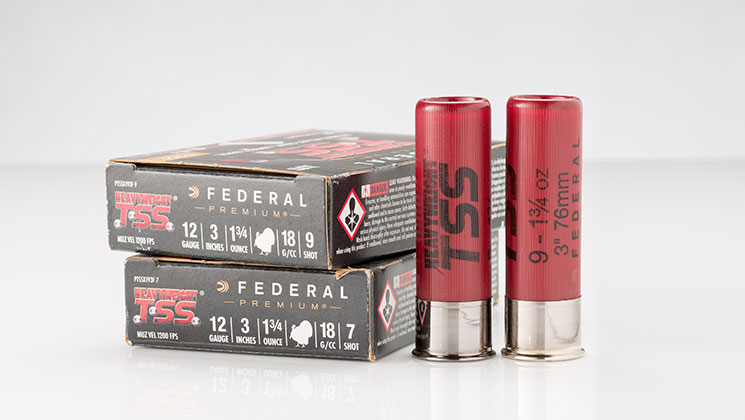
What I was looking at wasn’t a mistake or a fluke in printing. It was, in fact, a new load from Federal Premium, one touted to have the “ultimate pellet count” and “longest range.” But without any turkeys to kill, I’d make my moves on paper targets to see if these claims were true.
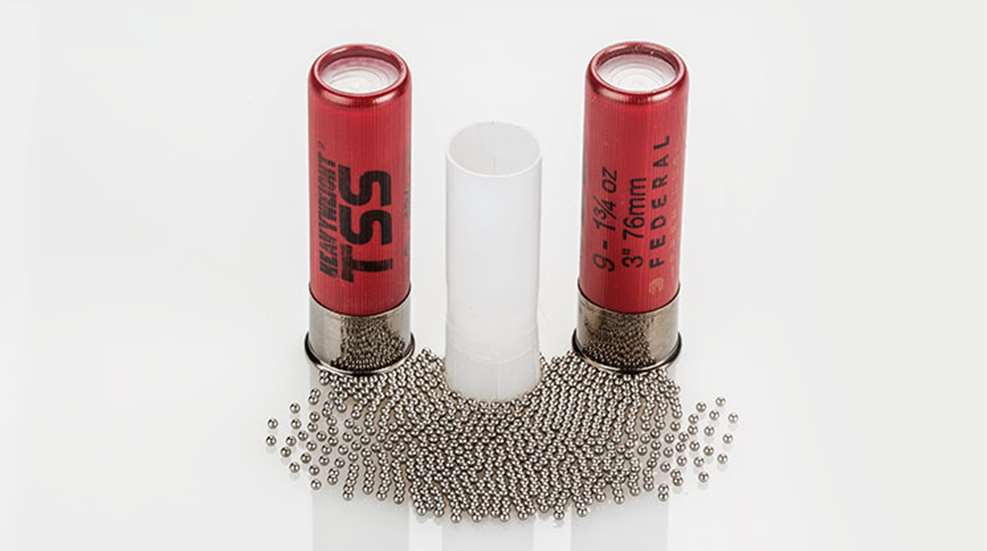
What is this stuff, and how does Federal expect to kill a turkey with No. 9s? By using tungsten, my dear friend, super dense, heavier-than-lead tungsten. Actually, in this case it’s an alloy called Tungsten Super Shot (TSS), and it’s touted by Federal to be 56 percent denser than lead. With that density, TSS carries enough energy downrange to allow a savvy ammo manufacturer to do some pretty cool stuff, like reducing shot size to achieve “up to double” the pellet count of a comparable lead load, while maintaining the velocity and penetration required to drop gobblers at distance.
That’s Federal’s claim, and it seems a pretty simple concept. By my count, a 1¾-ounce load of No. 9 Heavyweight TSS carries 615 pellets, while the No. 5 lead load of the same weight dropped 313 pellets onto my desk. Along with the shot-size benefits a density of 18 grams per cubic centimeter provide, TSS is also incredibly hard. It’s harder than both lead and steel, which means reduced pellet deformation and, all else being equal, tighter patterns downrange.
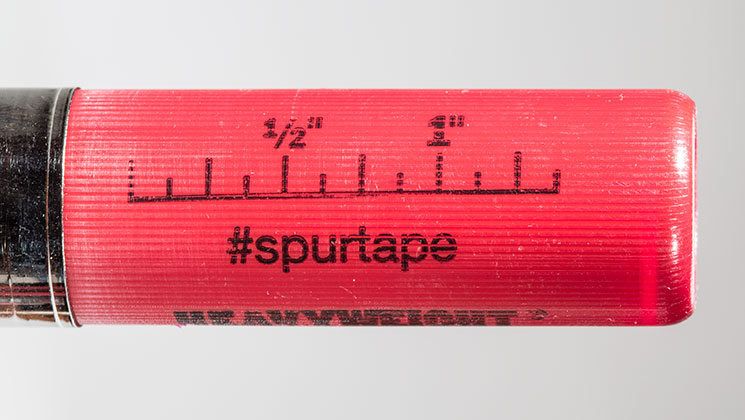
However, all else is not equal in Federal Heavyweight TSS. To maximize the effect of the tungsten alloy, Federal utilizes its FlightControl Flex wad, which was designed to offer optimum performance in both ported and non-ported barrels. The full-length wad acts as a barrier between the extra-hard shot and your barrel, protecting the bore. The wad’s unique rear-deploying fins create optimal downrange separation from the TSS pellets, which combined with a shot buffer (held in place via an over-shot disc and roll crimp), results in a uniform payload for ultra-tight patterns and dense shot distribution on target.
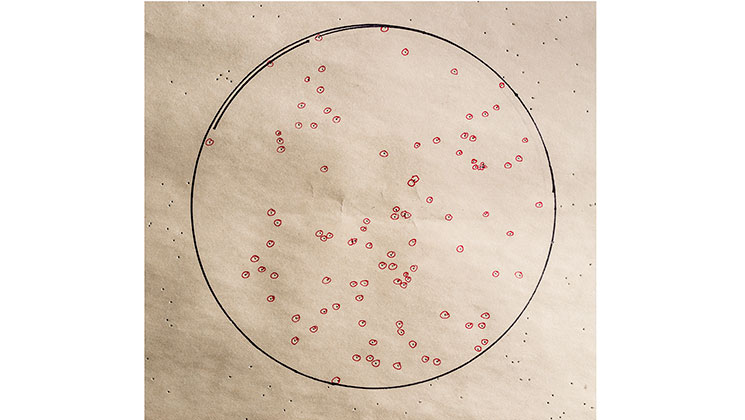
To test these claims I ran two assessments: an on-target pellet count and a penetration test. For the pellet count, I set up a target with a 10-inch circle at 30 and 50 yards, and counted holes produced by both the 1¾-ounce No. 9 Heavyweight TSS load and a No. 5 lead load of the same weight. I fired both from a 28-inch barrel with a full turkey choke. My results, an average of three shots per load, showed 338 No. 9 TSS pellets in the 10-inch circle at 30 yards, and 103 hits in the ring at 50. Compare those results to the 128 holes from the No. 5 shot at 30 yards and the meager 35 holes at 50 yards. The TSS put nearly triple the pellets on target.
My penetration tests were a bit more unorthodox, as I didn’t have access to ballistic gelatin. Instead, I compared penetration of the No. 9 TSS pellets from the 1¾-ounce load with No. 5 lead pellets from a load of the same weight, via layers of cardboard. For the test I sandwiched together 40 layers of cardboard and counted the layers each load’s pellets penetrated at 50 yards. The No. 9 TSS load, with an advertised muzzle velocity of 1200 fps, penetrated 23 layers of cardboard, while the No. 5 lead load, with an advertised velocity of 1300 fps, penetrated only 20 layers of cardboard.
How do you translate that into turkey-killing performance? Well, I suppose that’s up to you. I’m satisfied with comparing the penetration of Federal Heavyweight TSS to that of a known turkey-killing load in the same material, despite not knowing how cardboard stacks up to a turkey’s skull. In fact, I think my 40-layer cardboard target is well beyond the strength of a gobbler’s noggin. Do the math and you’ll see that the No. 9 TSS pellets penetrated a whopping 15 percent more than the No. 5 lead shot.
While my results suggest this stuff will kill birds, I doubt anyone had concerns to the contrary. What Heavyweight TSS provides is the ability to increase pellet count via smaller shot size while still maintaining (or in this case increasing) downrange energy and penetration. It also opens the door for some interesting additions to the line, which right now consists of 3-inch and 3½-inch 12-gauge loads, and 3-inch 20-gauge offerings, with No. 7 or No. 9 TSS. Federal also offers a 7/8-ounce .410-bore option with No. 9 TSS. I haven’t sent any .410 Heavyweight TSS loads downrange yet, but I know the dense shot will do the job traveling at 1100 fps. Assuming Federal can fit enough of it into a .410 shell to get a decent pattern (the company claims there are about 295 pellets in the .410 load), birds inside 30 yards will die.
While a “live” demonstration is still in my future, I’d say if Federal Premium Heavyweight TSS works as well on turkeys as it does on paper (and in cardboard), then we are in business. Knowing the No. 9 TSS pellets have the energy, with the right choke who knows how far you could reach.
Technical Specifications
• Gauge/Length: 12/3″, 12/3½″, 20/3″, .410-bore/3″
• Payload: 1¾ ozs. No. 7, No. 9 (tested); 2¼ ozs. No. 7, No. 9; 1½ ozs. No. 7, No. 9; 7/8 oz. No. 9
• Pellet: tungsten-alloy Tungsten Super Shot
• Muzzle Velocity (advertised fps): 1200
• MSRP: $29.95-$49.95 per 5-rnd. box; federalpremium.com