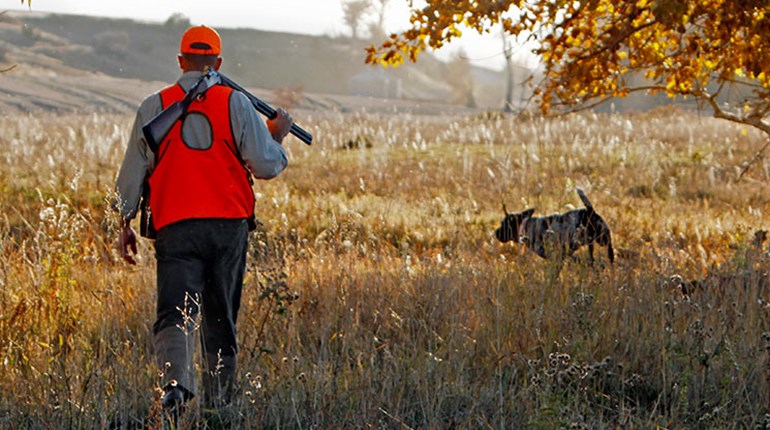
My first hunting dog was 60 pounds of big black Lab befitting my 20-year-old macho attitude. By my mid-30s I’d mellowed down to 40-pound English setters and springer spaniels. Now I’m wondering if a 22-pound cocker would suffice. Or maybe I could train a 10-pound miniature dachshund to hunt birds…
I’m thinking small is beautiful.
Why work with a small hunting dog? Because I’m tired of shoveling. Expensive food in, “used food” out. But also because small dogs take up less space. They are easier to house, easier to haul in cars and planes, easier to control, cheaper to maintain and easier to conceal when the neighbors complain about high-pitched barking. A small dog can squeeze into an apartment, a kid’s bedroom, the backseat floor of a subcompact car or a large coat pocket.
But can they hunt?
You bet your big bag of biscuits they hunt. Ask Teddy Moritz and she’ll wear you out with anecdotes. This veteran breeder and trainer of miniature dachshunds has seen 10-pound dogs retrieving wood ducks in water and 6-pounders trying to drag Canada geese back to the gun.
“Dachshunds work close and work with you,” she says. “They want to squirm into thickets—anywhere birds can go—and flush them out. They’ll flush quail from cactus thickets and packrat nests, ruffed grouse from briars, pheasants from under snow-covered phragmites. They love to roust out rabbits, and they’ll tree squirrels and blood-trail any game.” So versatile are dachshunds that Moritz considers them the hound equivalent of all-purpose gundog breeds like the German shorthair.
Charles Jurney at Beaverdam Kennels in North Carolina trains traditional retrievers but acknowledges nontraditional small breeds can be effective hunters. The key is the training.
“Obedience,” Jurney insists. “We teach and condition ‘here,’ ‘heel,’ ‘sit’ and ‘kennel.’ Then we train force-fetching. Retrieving becomes another command instead of just an instinct.”
Jurney has trained pit bulls to retrieve, but that doesn’t mean just any dog can make a good game dog. There is the matter of “nose,” as Moritz points out. “I’ve seen some terriers that were eager hunters and decent retrievers,” she says, “but they don’t have the nose of a hound breed like the dachshund.”
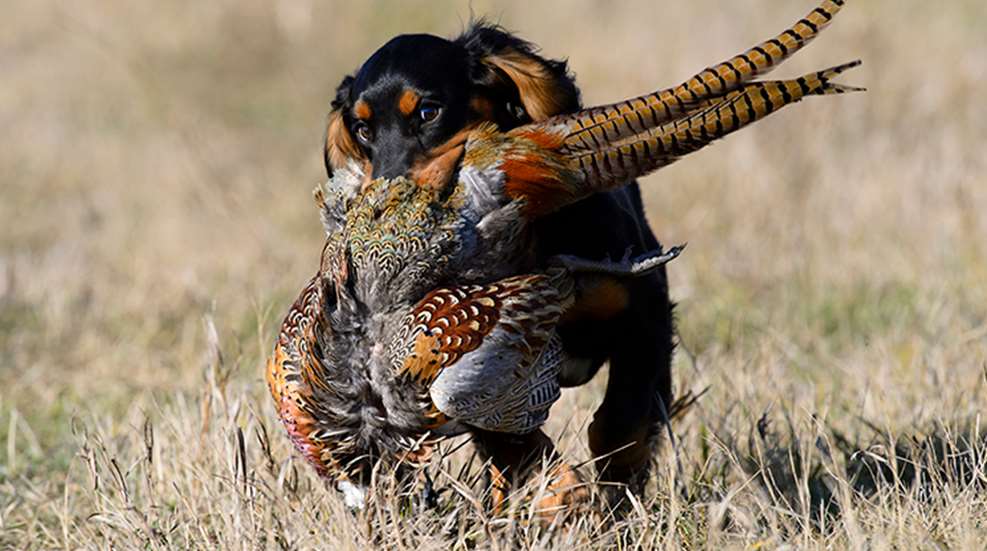
That brings us to the English cocker spaniel. At 20-35 pounds, cockers—the field variety, not the lap decoration variety—are true bird flushers, start to finish. They have long been bred and trained to hunt close, quarter, scour every scintilla of cover, flush birds, and fetch anything they can haul or drag back to the boss. Watching an enthusiastic cocker work birds is watching sheer joy. They are more energy than mass.
“A cocker is like a snake,” says Tom Ness of Oahe Kennels near Bismarck, N.D. “They weave through cover instead of burning energy trying to leap over or bull through it. So they don’t wear out.” Ness describes Dakota pheasant hunts in which big Labs were worn out while his little cockers were cruising. “They’re like marathoners,” he relates. “They don’t have all that bulk to haul around.”
Ness has been training and breeding field cockers since the early 1990s, when he got one that outperformed most larger dogs. “The cocker is at a high point as a breed,” he explains. “Many of us have been breeding for the best hunting traits for a quarter century, and it’s paid off.”
In addition to their convenient size and never-quit enthusiasm, Ness commends cockers for personality. “They’re just plain happy, fun, tough little dogs, both mentally and physically,” he notes. “I’ve never seen a sensitive or nervous cocker. They can be a little stubborn sometimes, but obedience training cures that. Sit. Heel. Here. Reinforce those and the rest comes. Today’s field cocker will hunt hard all day, day after day.”
And that includes retrieving. “Sure, they’re good retrievers,” says Ness. “They do a great job on pheasants, and we use them for early-season ducks all the time. They don’t have the thick undercoat a Lab does for cold weather, but they love to swim. They’re a little small for big geese, but that doesn’t stop them from trying.”
Big birds might be one reason to select a 20- to 30-pound cocker over a 10-pound miniature dachshund for your small-dog solution. As Moritz notes, an enthusiastic, determined dachshund will drag a 3-pound pheasant back and try to wrestle a 12-pound goose, but that might be asking a bit much. The larger cocker would be the better option for winged roosters, too.
“You don’t need to worry about color-heating with cockers, either,” Ness adds. “Our black and liver dogs run just as hard and long as our white ones, but the hunting genetics seem a bit stronger and more consistent in the dark colors.”
Finally, feeding little dogs requires less monetary outlay than fueling bigger breeds, but the requirement for high fat and protein remains. “I feed Purina Pro Plan cradle to grave and just add a few raw soup bones from time to time to clean their teeth,” Ness says. “These active, energetic dogs need a high-fat diet.”