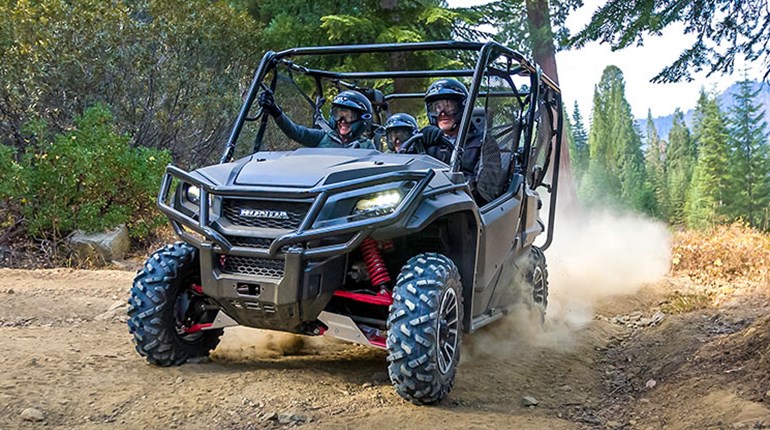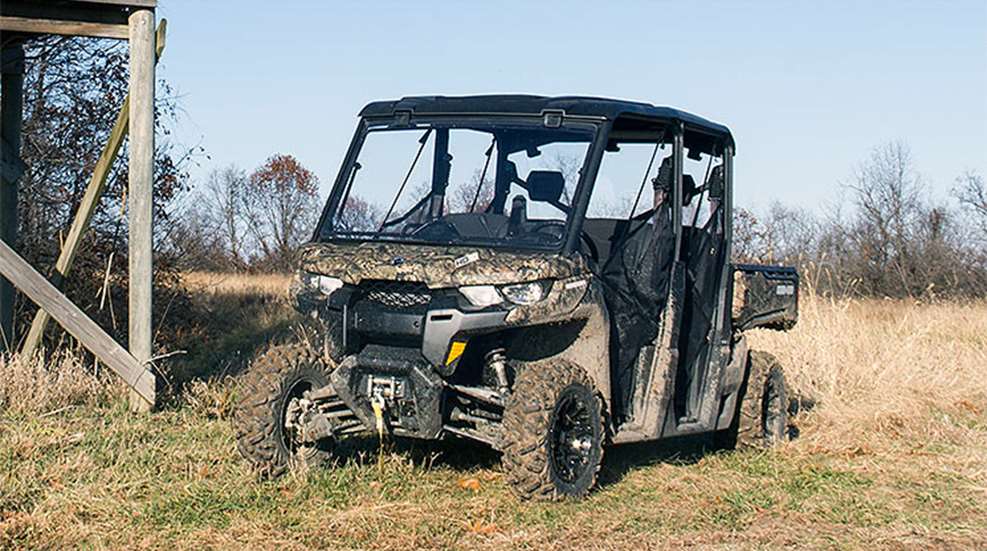
The market for side-by-side vehicles has boomed of late, as hunters, farmers and recreational riders alike have sought to up the maximum capacity of their OHVs. Accordingly, Can-Am Off-Road, a subsidiary of Quebec-based Bombardier Recreational Products, has doubled-down on its side-by-side production. Since the introduction of its original Defender side-by-side last year, Can-Am has remained dedicated to a pledge to deliver new models every six months. Among the more recent additions to the Defender family is the Defender Max XT HD10, a six-seat powerhouse that’ll get you—as well as your hunting buddies, your dog, your gear and your game—wherever you need to go.
The Defender Max XT arrived flanked by three siblings: the standard Defender Max, the Max DPS and the Max XT Cab. All four feature what Can-Am has loosely termed a “pickup truck-inspired design” meant to maximize your cargo and storage space, all while seating up to six adults. But six-seat OHVs aren’t necessarily a new concept—what helps the Defender stand out is in the details.
Like all Can-Am vehicles, a heavy-duty Rotax engine powers the Defender Max XT HD10. The model I evaluated featured a 72 hp HD10 V-twin Rotax engine that yields 61 lb.-ft. of torque. Can-Am purposefully selected an engine that was designed to deliver peak torque at lower RPMs, preparing the unit to handle difficult tasks and terrain. Need to navigate rocky ground with a bull elk dangling from the bed? You’ll be able to do it. The engine in the HD8 yields 50 hp and 50 lb.-ft. of torque. Both packages pack the same Pro-Torq CVT transmission.
The Defender Max line features three driving modes (Work, Normal, Eco) and a four-mode traction system with a Visco-Lok QE front differential that’s meant to provide multiple choices and control for varying terrain and tasks. Using front-and-rear toggle switches, the vehicle’s operator can select between a 2x4 open rear differential, a 2x4 lockable rear, a 4x4 open rear and a 4x4 locked rear for maximum traction. The Dynamic Power Steering system is meant to alternate between working application and recreational usage with ease, and offers its operator less assistance at high speed and more assistance at low speed.
All Defender Max models sport a 1,750-pound payload capacity and a 2,000-pound tow rating. They’re rated to haul an impressive 1,000 pounds in the cargo bed, which features a removable tailgate with its own 250-pound capacity.
Can-Am didn’t hesitate to trick out the Defender Max XT cabs, beginning with the “truck-style” seating. Dual Versa-Pro bench seats each have a 500-pound capacity. The passenger seats flip up to provide additional storage, and a sealed, waterproof compartment can be found under the front passenger seat. An open dash design includes a removable and water-resistant toolbox. The units feature 6 gallons of under-dash storage and an enclosed pocket. Altogether, the Max line offers 16.9 gallons of storage solutions in its cab. Like the original Defender, the Defender Max line’s A-pillars are located forward and positioned at a 25-degree angle to improve visibility and permit easy ingress/egress. Twenty-seven-inch Maxxis Bighorn 2.0 tires complete the package, and are installed on redesigned 14-inch cast-aluminum wheels. The Defender Max XT I had the opportunity to test-drive carried a 4,500-pound winch with a roller fairlead.
Serving as one of the most accessorized Defender Max models, the Defender Max XT starts at an MSRP of $17,199. That’s no small chunk of change, but you’re not getting a small return, either—literally or figuratively. The Defender Max XT combines power and comfort in a way not often seen in the OHV marketplace.
Technical Specifications:
• Drivetrain: 976cc Rotax V-twin engine w/72 hp, 61 lb.-ft. torque; Pro-Torq CVT transmission; selectable 4WD w/Visco-Lok, auto-locking front diff., lockable rear diff.; electronic hill descent control
• Suspension: front double A-arms, twin-tube gas-charged shocks, 10" travel; rear torsional trailing A-arms w/external sway bar, twin-tube gas-charged shocks, 10" travel
• Brakes: front/rear 220mm ventilated discs w/hydraulic twin-piston calipers
• Dimensions/Capacities: overall length 154.8"; width 63.5"; height 78"; wheelbase 83"; ground clearance 11"; dry weight 1,868.7 lbs.; towing capacity 2,000 lbs.; payload 1,750 lbs.; fuel capacity 10.6 gals.