There are, undoubtedly, fervent fans in the pistol cartridge world. Some feel the .45 ACP was, is and always shall be the pinnacle of pistol cartridge development, some favor the wheelgun cartridges like the .44 Mag. and .357 Mag., and with just as much passion, there are those who champion the 9 mm Luger. The argument has raged on for decades, and probably will for decades more, but one thing is clear: irrespective of which camp’s beliefs you subscribe to, the 9 mm isn’t going anywhere.
I am a fan of the venerable .45 ACP; it works and works very well. However, that fact doesn’t discredit the capabilities of the 9 mm Luger; like the huge assortment of rifle cartridges on the market, there is room for many different designs when it comes to handguns, and I firmly believe the 9 mm fills a necessary role for many shooters.
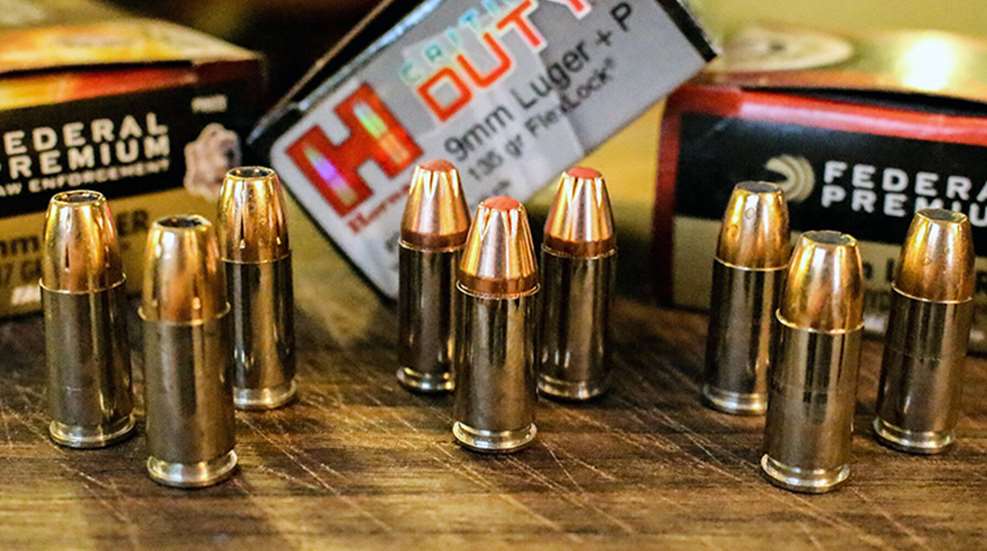
 Germany’s Georg Luger designed his rimless 9x19mm cartridge in 1902, and shopped it to many different outlets as a military sidearm, but it was his own country who adopted it first. Having neither rim nor shoulder to use for headspacing, the 9 mm Luger uses the cartridge’s case mouth as the headspace point, which allows for smooth feeding in an autoloading pistol. The cartridge can use rather wide range of projectiles, starting with the 90 and 95-grain bullets on the low end, the 115- and 124-grain bullets in the middle of the range and topping off with the heavier 147-grain slugs. So, if you’re a velocity fan, there are plenty of choices using the lighter bullets at a higher speed, yet the 147-grain ammo will make the low and slow crowd happy.
In addition, there are many different style of bullet available for the 9 mm. There are monometal hollowpoints that will deliver devastating expansion think Cutting Edge Bullets’ PHD line and the Barnes XPB—there are FMJ ‘ball’ ammo choices, which are perfect for target work or just plain plinking fun, and there are the traditional defensive hollowpoints that have proven themselves for quite some time—like the Federal Hydra-Shok and HST, the Speer Gold Dot and the Hornady XTP.
Many times, while we are all busy comparing and contrasting the minute details of our chosen cartridges, we can lose sight of the real virtues of a chosen round. The 9 mm Luger is a great defensive cartridge. It feeds reliably, it can be housed in a handgun that is easily concealed, yet offers enough striking energy to get the job done. Taking a look at the well-respected .38 Special—a cartridge used by law enforcement for a considerable amount of time—you’ll find that the 9 mm Luger compares very favorable. The .38 Special drives a 158-grain bullet at somewhere between 800 and 900 fps, while the 9 mm Luger drives a 147-grain bullet at 1,000 fps; being virtually the same diameter the performance advantage should go to the 9 mm, based on the greater energy figure. Accordingly, if the .38 Special was enough for the LEOs, the 9mm should be—and is—in the same category. For those of us who are using a handgun for a defensive tool, the 9mm Luger will work perfectly.
The recoil of the 9mm Luger is another benefit; I’ve known shooters that were uncomfortable with the recoil of a .45 ACP, .44 Mag. or even a .357 Mag., yet could handle the 9mm just fine. In any shooting situation, whether it be dangerous game or a life-threatening scenario, a smaller bullet in the right place is better than a larger bullet in the wrong place, or worse a complete miss. If you can handle a 9 mm Luger comfortably, I find no fault with that choice whatsoever.
The 9mm Luger is an easy cartridge to reload; and a reloader can keep him or herself in a constant supply of ammunition. Using powders like Hodgdon’s TiteGroup, Ramshot’s ZIP or Alliant’s BlueDot will give good velocities and accuracy. Because the Luger headspaces off the rim, a roll crimp won’t work, but a good taper crimp will keep things neatly in place. You may have to adjust the cartridge overall length to ensure proper neck tension, depending on the conformation of the bullet.
The 9 mm Luger has a respectable resume, serving many military roles including a stint as the U.S. Armed Forces' chosen cartridge. While the discussions/debates/fistfights will continue to rage, I can confidently say this: for 115 years the 9 mm Luger has doing exactly what it what it was intended to do, and I don’t see that changing anytime soon.
Looking for previous installments of Behind the Bullet? We've got you covered.
• .35 Whelen
• .454 Casull
• .375 H&H Magnum
• .45 Colt
• .22-250 Remington
• 10mm Auto
• .308 Winchester