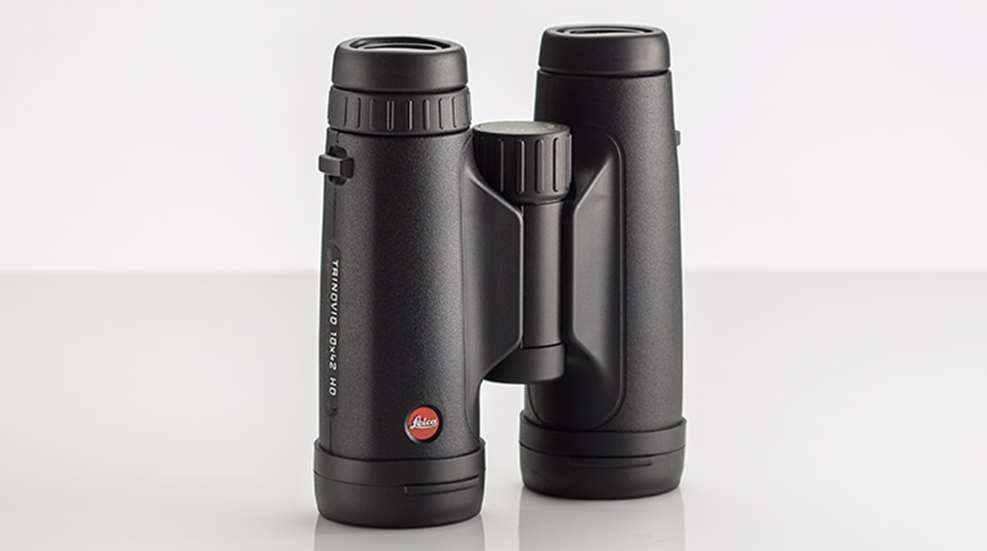
Years ago Leica’s Trinovid was the binocular dream date. Crisp, sharp, clear, bright. Think of a word that describes a great binocular view and it was lavished on the Trinovid, one of the world’s top binoculars.
The old Trinovid was superseded by even better Leica models, the Ultravid and now the Ultravid HD-Plus, retailing north of $2,200. To offer an alternative price point, Leica has brought back the Trinovid for half the cost of the Ultravid but with nowhere near half the performance, as I discovered while test-driving this precision instrument.
This is not the old Trinovid but a new design with fully-multicoated lenses and phase-coated BaK4 roof prisms probably surfaced with Leica’s proprietary HighLux (HLS) mirror layers, which reportedly transmit 99.5 percent of the light that hits them. I say “probably” because Leica does not specify the mirrors in the Trinovid HD. Neither does it explain what constitutes the HD (High Definition) also claimed for this binocular. There’s nothing wrong with this. Leica has every right to guard its ingredients, but as a consumer, I like to know as much detail as I can. In the end, of course, the proof is in the view, but shoppers have an easier time assessing relative performance if they know what parts and treatments are in the instruments.
The good news is that whatever Leica puts in the Trinovid HD works. I realized this by testing a 10x42mm sample against a top-end, 6-year-old 8.5x42mm model from another highly regarded European manufacturer. Judging any binocular on its own has limitations, but comparing the same view through two or more instruments helps put things into perspective.
I began my testing by glassing into shadows just to the left of the sun when it was about a half-hour above the western horizon. To my surprise, the Trinovid showed noticeably increased contrast and color saturation over the benchmark unit. Neither showed much flare, but there was a slight haze evident through the older binocular. I could detect no resolution differences between either, both proving deadly sharp under all lighting conditions. The views were the kind that make you popeyed if you’re not used to the world’s finest binoculars. It’s almost magical the way such tools seem to carry you right into the scenes you’re viewing.
The Leica did suffer focus fall-off toward the edges, with the last 8 percent or so of the view becoming quite soft. At the same time this edge image showed yellow color fringing on the left side of objects and purple on the right. But all of this was on the extreme edges, which I almost never use in a binocular anyway. At best, extreme edges might expose game moving in my peripheral vision, after which I simply move the binocular to center what I want to see.
Low-light comparisons weren’t equitable because the 10X Leica projected a 4.2mm exit pupil while the benchmark, at 8.5X, yielded a slightly larger 4.9mm exit pupil. Regardless, I was able to detect the same details in deep shadows with both. Finding lurking lions at last light would be easy.
Stage two of testing involved durability. I shoved the Trinovid HD into the freezer overnight. Fifteen minutes after removal the next morning, there was no noticeable internal fogging. The knurled focus and diopter wheels turned as smoothly as they had when warm. The unit then went underwater for 10 minutes. After drying the outside, a careful look with aid of a flashlight showed interior walls, surfaces, mounts, etc. dry, pristine, unmarred and completely dust-free.
The twist-up eyecups ratcheted up and locked into several positions. I haven’t been able to determine if there are supposed to be four or as many as seven positions. I was able to achieve all of these, though not precisely or consistently. Suffice to say, you’ll have no trouble finding a locking eyecup position that matches your needs.
The +/- 4-diopter adjustment ring is under the right eyepiece. It turns more easily than I prefer, but due to its location probably won’t accidentally bump out of position. The end cap on the center hinge screws off to reveal a narrow hole to permit mounting a tripod attachment.
Unique to this binocular—and surprisingly useful—is its elaborate neoprene strap, harness and cover. Leica calls it the Adventure Strap. The Adventure Strap folds, zips and snaps to convert from a complete, padded, protective covering to an in-field, partial shield cradled in a stretchy neck strap. Depending on how you configure the straps, you can also use the unit as a shoulder harness or secure it from bouncing by wrapping one strap around your middle. At first the system looks complicated and cumbersome, but with a bit of trial and error becomes eminently useable and effective.
The rubber eyecup protectors with this unit are elastic enough to fit snugly without falling off. Objective lens covers are typical of the breed: slightly elastic cups hinged to a band that fits over the barrel. I find all objective covers superfluous and a distraction afield, especially with the Adventure Strap.
My verdict on the 10x42mm Leica Trinovid HD is not one purveyors of higher-priced binoculars will want to hear: Optically this unit performs so near to those costing twice as much that I, unless blessed with more cash than I have been so far, couldn’t justify buying the more expensive units.
Technical Specifications:
• Type: roof-prism binocular
• Magnification: 8X, 10X (tested)
• Objective Lens Diameter: 42mm
• Eye Relief: 15mm
• Exit Pupil: 4.2mm
• Field of View @ 1,000 Yds: 355'
• Focus Range: 5.3'-infinity
• Construction: magnesium frame; nitrogen-purged; waterproof to 13'
• Coatings: fully-multicoated lenses; phase-corrected, mirror-coated BaK4 prisms
• Dimensions: height 5.5", width 4.6", weight 26 ozs.
• Accessories: neoprene Adventure Strap, neck strap, lens covers
• MSRP: $999