Weatherby is known for rifles, but the company has darn nice shotguns, too. For decades it’s offered side-by-sides, over/unders and gas-operated semi-autos—imported them, actually, and branded them with its own distinctive style—and now Weatherby is solidly into the inertia-operated shotgun game.
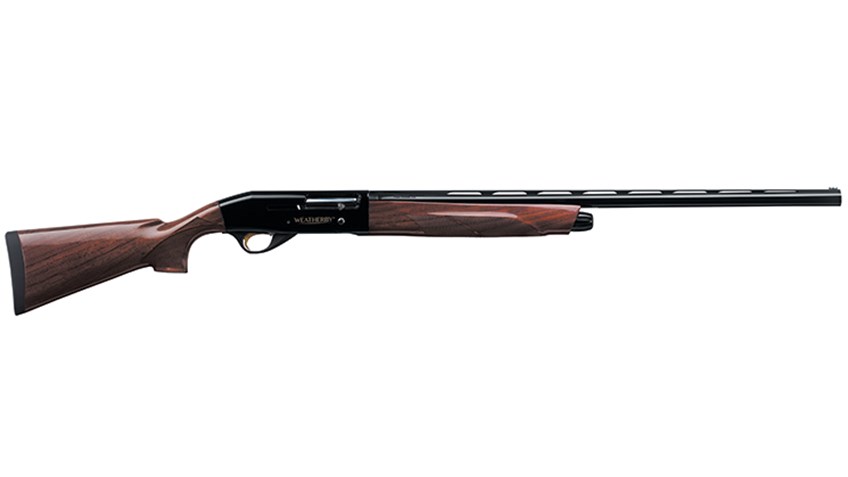
The Element Deluxe is an inertia-action, Turkish-made shotgun for upland bird hunting. Weighing 6.75, 6.5 and 6 pounds in 12-, 20- and 28-gauge, respectively, it’s especially suited for pheasants, quail and doves, but frankly there’s not much it can’t do. The gun’s Deluxe tag indicates that it has a deep, lustrous blue finish and a rich AA-grade American walnut stock. Two other versions—one with a synthetic gray stock and matte finish, the other a synthetic model completely dipped in Realtree Max-5 camo—are also available.
If the gun’s profile looks familiar, that’s because it is. Any discussion of the Element wouldn’t be complete without mentioning the family of Benelli shotguns that it resembles. In 2006, Paolo Benelli’s patent for the ingenious inertia-operated bolt expired, opening the door for other manufacturers to develop similar systems. As briefly as possible, here’s how it works.
The bolt, held in place by a rotating bolt head that locks into the barrel extension, conceals a heavy “inertia” spring within its body. Because the bolt “floats” between this inertia spring and the return spring in the buttstock, it initially remains at rest as the shotgun recoils. The rearward movement of the shotgun compresses the inertia spring until finally it expands, rotating the chrome-plated bolt head, unlocking it and flinging the bolt backward. The bolt travels rearward to eject the spent shell and cock the hammer, and then the return spring sends the bolt forward to pick up a fresh shell from the carrier and lock it in the chamber. It all happens again when you pull the trigger.
The benefits of this system are vast. First, no gassy grime is sent back into the chamber as with gas-operated guns; rather, almost all of it is blown out the barrel. This makes the action inherently cleaner and more reliable. Secondly, the inertia system’s fewer parts mean less chance of failure. If you’ve ever shot an inertia gun, you know it is fast and will cycle all but the lightest loads reliably—like most semi-autos. In my tests the 12-gauge Element cycled 1-ounce birdshot to 3-inch magnum No. 6 turkey loads. I shot a few steel No. 2’s for kicks. Not a hiccup with any of them.
Finally, the lack of a return spring in the fore-end means the gun’s balance point can be moved farther back, exactly where point-shooting upland bird hunters desire it. There are some hunters, mainly waterfowlers and serious sporting clay shooters, who prefer a slight weight-forward balance to keep the barrels swinging smoothly through the arc. But most flushing-bird hunters, certainly this one, prefer a lightweight gun that balances between the hands. The Element is one of those guns that makes you proclaim, “Wow, that’s light!” upon picking it up. I believe part of it is certainly due to its low physical weight owing to an aluminum receiver, but part of it is also because that weight is evenly distributed to both hands, thereby making it seem lighter.
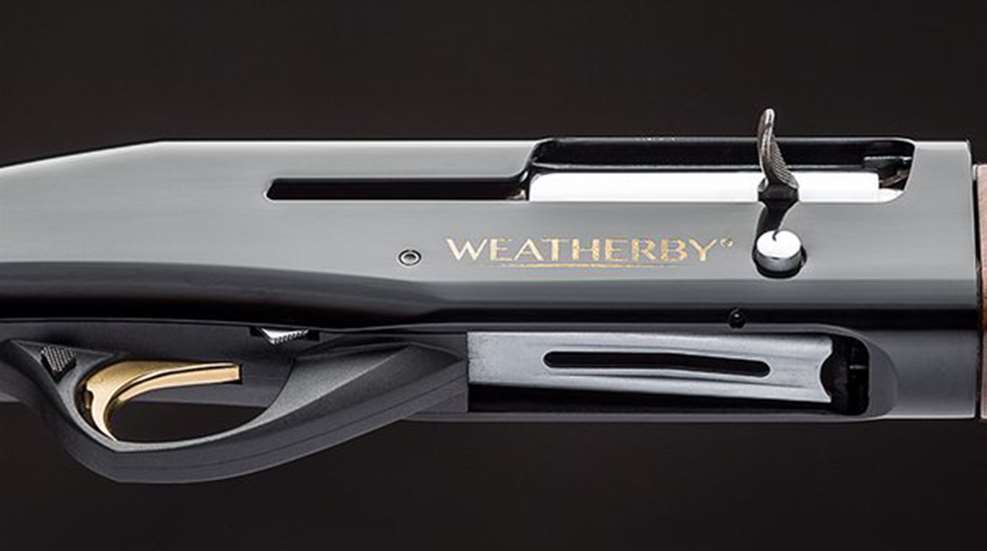
The Element’s trigger guard is made of plastic. This was likely done so it would not negate the weight savings afforded by the aluminum receiver, nor add substantially to the cost. The gold-plated trigger cleanly broke at 5 pounds, 12 ounces and is what I’d call superb for a shotgun trigger. To the rear of it lies a triangular-shaped cross-bolt safety. Ahead of it is a Benelli-like cartridge release button that allows the shooter to manually free the next shell from the magazine, but only if he chooses. If he does not, racking the bolt will merely eject the chambered round and allow the shooter to insert the shell of his choice directly into the chamber without cycling through the magazine. All semi-autos should be made this way.
The entire trigger group drops out easily for cleaning. I’ve had people ask me why this matters, as plenty of ol’ boys go their whole lives without cleaning the trigger unit. Well, several times while hunting in Texas, I’ve dropped guns or had fine sand blow in the trigger and actions. I only wished I’d had a drop-out trigger. It’s not something that would cause me to buy or not buy a shotgun, but it’s a bonus.
Anticipating the Element would find a niche as a gentleman’s upland gun for those who aren’t shy about shooting a bunch, Weatherby stuck to its famous Mark V style. A high-gloss finish was chosen for the wood to highlight and protect the walnut’s rich grain. While the gun’s lines look modern and Italian, its stock dimensions are standard. For those who desire slightly more or less drop at heel and comb, a four-piece shim kit is included; for those weirdos who like a little cast on or off, one reversible shim is included. I like the Element’s buttpad; it’s three-quarters of an inch of cushy rubber, yet it’s beveled and firm enough that it won’t snag your vest on the mount.
This Weatherby was one shotgun that I immediately knew I’d shoot well—assuming the barrel was regulated to the proper point of impact. That’s because when I pulled it out of the box and threw it up, it melded to my cheek, causing its ventilated rib to align perfectly with my eye. This is not a square-stocked Weatherby of old, but a fast, whippy bird gun that’s designed to shoot where you look. Its deep, sharply checkered pistol grip is the exception; it’s bold and robust, bending slightly past 90 degrees. Frankly, to my eyes it’s a little out of place, but it screams Weatherby. The company likes its striking pistol grips, as do most American hunters. Likewise, Weatherby chose to run the slim, Franchi-esk fore-end for a virtual mile. I like the long, lean fore-end because I like a long-armed support-hand hold and, mainly, because it allows the gun to hold four shells in the magazine.
I haven’t had a chance to hunt with the Weatherby Element yet, but after shooting skeet I can tell you it handles wonderfully and shoots where I look. The fact that the Element mimics other inertia-operated shotguns should not take anything away from it. It’s a great feeling, good looking, supremely reliable and incredibly effective shotgun—all at an excellent price.