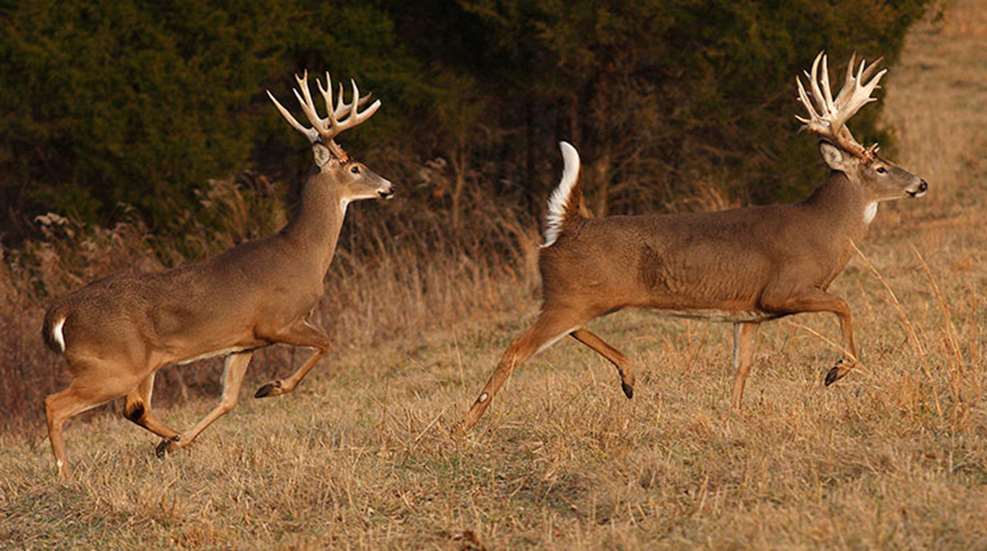
Among yellow leaves on the edge of an overgrown orchard was this shining emblem where an antler rubbed a sapling raw and the tips of tines gashed bark 10 inches above. Bark shavings, damp and smelling of musk from glands in the buck’s forehead, were on the leaves below. I knelt down to look at the rub and like millions of deer hunters every season, I fell into daydreams of this buck before settling practically on the question: How do I catch this buck in daylight?
On all but completely unpressured properties, edges are poor places to begin waiting for mature bucks in October as such rubs are likely made after dark. So I raised my eyes from the rub and looked down the deer trail into briars and then trees and asked myself the next question we all do: How far should I push in, if at all, before the rut?
This is the deer hunter’s calculation. You ask yourself if there are low-impact entry and exit routes that will take you to and from a stand. Can you get a true wind in/near the buck’s likely bedding area? If you’re bowhunting, will you have to cut shooting lanes? Can you afford to risk making this buck even more nocturnal in October? Answers to these questions depend on a lot of variables.
Like many hunters, I don’t hunt one property. I hunt many small parcels in suburbia and some places deep in the big woods. So the oft-repeated advice to start carefully on the edges and work in to rut funnels between bedding areas doesn’t completely apply to me. Also, like many, the number of days I’ll have on stand is finite and so must be used with the greatest odds—you can be too careful. So I break my properties into categories; on some I will go for broke right away, others will be left until the rut is at its maddest.
This time it wasn’t worth the risk. I was the only one with access to the property and I had a perfect funnel in which to catch that buck during the rut.
I was also factoring in something else: Recent deer research in which biologists have caught wild bucks and put GPS collars around their necks indicates that, without a smart setup, it isn’t worth the risk in October.
When October Bucks Move
Clint McCoy is a deer biologist with the Ohio Department of Natural Resources. While doing his graduate research at Auburn University from 2009-2011, he recorded the movements of 37 bucks in the Brosnan Forest, a 6,400-acre study site in the Low Country of South Carolina. Each buck in his study wore a collar that collected a location every 30 minutes from Aug. 24 to Nov. 22. His study area had an unusually early rut (80 percent of breeding in this population occurs between Sept. 20-Oct. 30). He wrote about his findings for the Quality Deer Management Association (qdma.org).
McCoy says the early-season vanishing acts of whitetail bucks are often attributed to home-range shifts in early fall, but he found that some bucks simply shift to a new food source. In early September, for example, a 4 /2-year-old buck in his study suddenly moved to where they’d captured and collared him the previous spring. By looking over the GPS locations from the buck’s collar, McCoy found that the buck moved to take advantage of something the state forest couldn’t offer—a soybean field.
McCoy wondered how a hunter might kill this buck. He saw that, at first glance, the GPS coordinates of this buck’s pattern seemed to show that a treestand on the edge of that beanfield would work. The thing is, says McCoy, setting up on the edge of the beanfield, or even 100 yards from it, wouldn’t have given a hunter a single sighting of this buck, as the buck never approached the field before 9 p.m. Also, the buck “was always back in the safety of his bedroom before the sun came up the following morning,” McCoy says, “There was only one option for a hunter to take advantage of this buck’s predictable feeding pattern: squeeze in as close to the buck’s bedding area as possible.”
Though this buck never came to the beanfield until well after dark, he was typically up and moving about 30 minutes before dark. The only chance a hunter would have on this buck is if he got in close to the buck’s bedding area in the evening. That takes savvy scouting and a low-impact way to get in and out of a stand.
Other studies show the same October behavior; for example, Jim Stickles, a graduate student at the University of Georgia Deer Lab, and others captured, among other deer, nine adult bucks in Morgan County, Ga. Each deer was fitted with a GPS tracking collar. They collared a 3½-year-old buck in June 2012 at the edge of a large four-year-old clear-cut. The buck’s GPS collar recorded its location every hour until Oct. 15, when the collar malfunctioned. According to the researchers, “the buck only left the seclusion of the clear-cut during daylight on five occasions, all in late afternoon. If a lucky hunter was positioned outside the boundaries of the clear-cut at the right time, the buck was vulnerable to being seen only once in the closed-canopy planted pines and four times in the drainage” in the early season.
Rubs in cover leading to a feeding area can give away a buck’s likely route, but hunting bucks like these in the pre-rut requires careful scouting, the right wind, terrain that gives a true wind (wind tends to swirl in bottoms), good entry and exit routes, and a willingness to bump this buck and move on to another.
As for that buck I mentioned in the beginning: I had him at 10 yards on Nov. 10 and drew my bow back on him as he moved between bedding areas, but I opted not to shoot, as half his rack had been busted off—presumably in a fight. In retrospect, I wish I’d taken a risk in the pre-rut. That’s hunting.