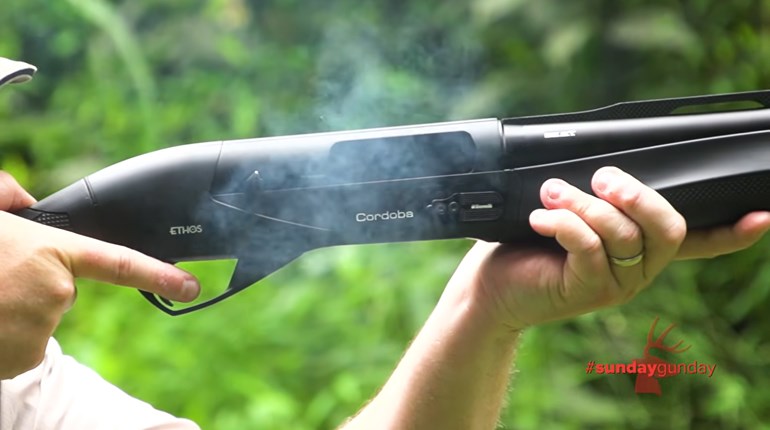
Next to exclusive early and late seasons (when fewer folks prowl the woods), the thing I like most about muzzleloader hunting is its simplicity. The setup is like a little boy’s dream: a pipe stuffed with some propellant, a projectile and an ignition system set off with a mere lever. Pull the trigger and … boom! Then there’s smoke and, if one’s aim is true, a hit. It’s a dream, that is, if like me you grew up playing with Conestoga Big-Bang cannons then graduated to real fire, firecrackers, Roman candles, bottle rockets and tennis ball cannons.
But it’s hard to argue with progress. Thus I was chagrined to admit I really liked Traditions’ latest creation, the Vortek StrikerFire muzzleloader, the moment I saw it, because in a manner of speaking it added bells and whistles where they weren’t needed.“StrikerFire” is exactly what it sounds like: The gun is striker-fired. A hammer is replaced with a sliding cocker/de-cocker. When ready to shoot at game, a hunter thumbs the cocker on the tang forward till it clicks in place and cocks the gun. At that point a panel at the bottom of the tang is orange, indicating the gun is ready to fire with a squeeze of the trigger. A small button on the tang cocker is the thing that goes click as it pops upward almost imperceptibly, indicating engagement. Press the button to disengage the striker, and then slide back the mechanism to de-cock the gun.
It’s simple, safe and separates the striker from any chance of accidentally contacting the primer and thus firing the gun. There is no holding back a trigger delicately while carefully riding a hammer home to its resting place behind the primer. The setup leaves more room for your fingers beneath a scope and, more importantly, employs a brand-new safety system in the muzzleloader world—one used for years by makers of fine European centerfire arms.
There is a second safety, too. A trigger-block button resides at the inside, top portion of the trigger guard; slide it right and left to engage/disengage. So a hunter can go afield with the StrikerFire tang system locked forward and the trigger-block button engaged, then merely thumb off the safety to fire, employing traditional muscle memory. Alternately, he can forego the trigger block and use only the sliding cocker, or use both safeties.
Since I’ve become accustomed to a sliding-tang striker system on centerfire arms lately, in the field last fall I used it only, and did not feel I was slow or unsafe. It does take some thinking, however, because quite a bit of leverage is needed to slide the cocker forward. You won’t do it when you’re looking through the sights; you must think about this step before you shoulder the rifle.
The one-piece Accelerator breechplug is removable by hand. Several full turns with your fingers unscrews it, whereupon you can unload the rifle without firing it—even after many consecutive shots without swabbing. A bit of thread grease applied after cleaning ensures it always remains loose enough to remove with finger pressure.
Attached to the aluminum ramrod is an extension: one end is a cleaning jag, the other a loading jag. Unscrew it, and reverse it as needed.
The StrikerFire is a break-open design. Breech lockup is achieved via a spring-loaded bar at the bottom of the standing breech that moves forward to engage a V-shaped cut in the back of the barrel lug. Squeeze the lever at the front of the trigger guard to release the bar and allow the barrel to swing downward to fit a No. 209 primer with your fingers. Removing the fore-end by turning out a retention screw allows the barrel to be freed from the frame.
The two-stage trigger is normally not my cup of tea. For hunting, I like a crisp, single-stage trigger set at about 3 pounds of pull; such a trigger forsakes any squeeze, bump and squeeze again common to two-stage triggers, and keeps a hunting arm ready to go the instant you will it. Having said that, though, I must admit the StrikerFire trigger is magnificent. It’s called the TAC2, and it’s set at 2 pounds of pull weight. Squeeze it to take up the slack, feel the bump and you know the next instant you apply pressure the gun will fire. It’s the best trigger I’ve ever squeezed on a muzzleloader, and it no doubt aids accuracy.
The barrel is drilled and tapped to accept scope bases. It features a 1:28-inch twist, common in muzzleloaders these days, and is 28 inches long, as it should be. Current muzzleloader design is all barrel, a short action and little else. That means a hunter can count on a long tube to eke out accuracy and still carry an overall relatively short firearm. The barrel is tapered and fluted to knock down weight. The rifle balances nicely; it’s not barrel-heavy even though the frame is made of LT-1 aluminum alloy, and quite light and short. The barrel is counterbored to speed loading in the field and is made of chrome-moly steel, same as most centerfire barrels. All metalwork is covered with Cerakote to ward off the elements.
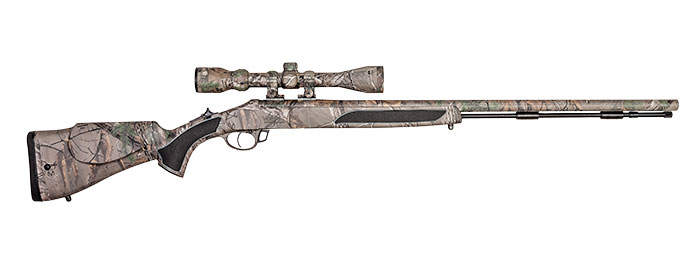
Williams fiber optic sights are standard on two units: a plain Jane black-and-stainless model and a camo number. The third version (the one I tested) also is coated in Realtree camo, and it comes sans sights but has a factory-mounted and bore-sighted 3X-9X-40mm Traditions-brand scope with a BDC reticle.
Traditions calls the camo dip on the stock and metalwork Soft Touch, and it really is—the treatment is tactile, and grip is further aided by inset panels on the pistol grip and fore-end. The recoil pad is not very soft, but it’s not uncomfortable and it doesn’t hang up on clothing when mounting the gun. It’s removed by depressing a button on either side of the butt. Inside the stock is Stow-n-Go storage to hold some possibles, or a ham sandwich.
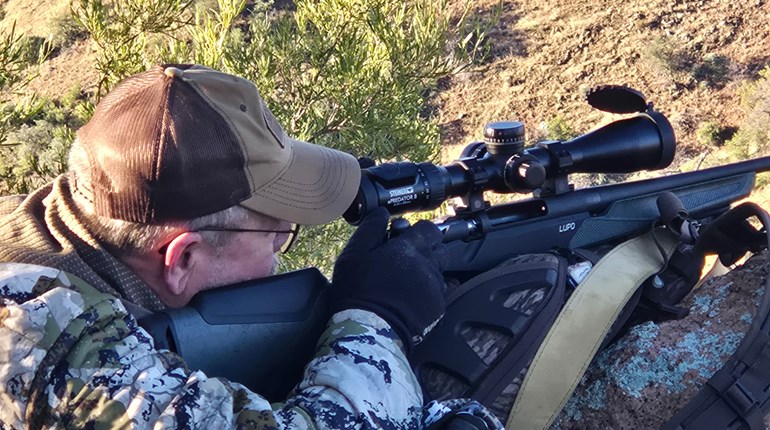
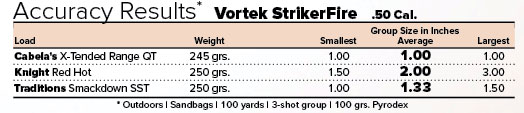
On the range, I swabbed between shots for the best accuracy. I tested four loads; the gun loved three saboted bullets and hated a lead conical bullet. Final analysis: The Traditions Vortek StrikerFire is still a plain old muzzleloader, but it’s equipped with the latest technology—and that’s not a bad thing.
Technical Specifications:
Type: break-action, in-line muzzleloader
Caliber: .50
Barrel: 28"; 1:28" twist; chrome-moly steel; tapered, fluted, counterbored
Trigger: two-stage TAC2; 2 lbs. pull weight
Sights: Williams fiber optics on two units; 3X-9X-40mm riflescope mounted and bore-sighted on third; all units drilled and tapped for scope bases
Safety: sliding cocker/de-cocker, trigger-block button
Stock: Monte Carlo style; synthetic; Soft Touch finish; LOP 14.25"
Overall Length: 44"
Weight: 6.25 lbs.
Metal Finish: Cerakote and Soft Touch
Accessories: solid aluminum ramrod, cleaning and loading jags
MSRP: $493 (black), $583 (camo), $649 (camo, scope)