The Summary
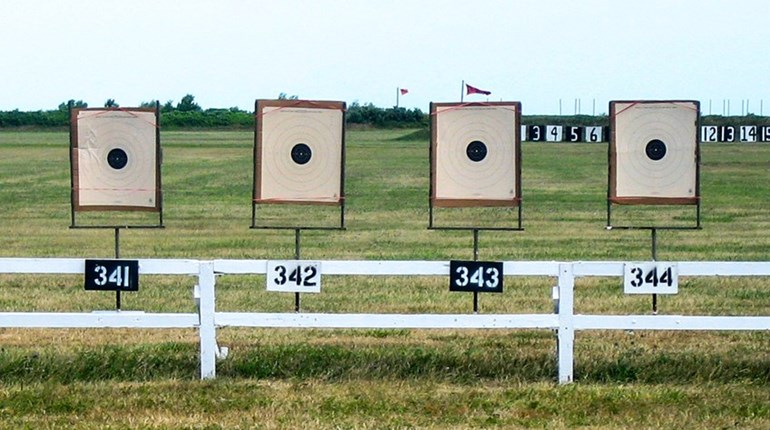
I’ve heard more than one rifleman say that its possible for a rifle to be more accurate at long range than it is at short range. On first hearing this, I assumed they were talking about MOA, rather than actual group size. For example, I thought it might be possible that a rifle could shoot a 1-inch group at 100 yards (approximately 1 MOA), and print perhaps a 1¾-inch group at 200 yards (which is a larger group size but slightly smaller MOA). But, after clarifying, some riflemen say overall group size can indeed be smaller in certain guns with certain loads. They might say, for example, that a rifle’s three-shot group average is .75-inch at 100 yards, but that it averages .65-inch at 200.
They often cite bullet stabilization as the reason, claiming that in some rifles a specific bullet will yaw (a loose term for bullet nutation) and demonstrate poor accuracy before stabilizing and rotating perfectly to become more accurate at a specific longer distance. Because I have never seen this phenomenon occur firsthand, I’m inclined to call 1-800-BullShooters on it. So I investigated.
(*Note: While this question can likely be answered in a complex formula via mathematics and physics, BullShooters is about exploring hunting and shooting via practical side of things—it’s a lot more fun this way. But we welcome your comments and theories on this matter, whether practical, or mathematical.)
The Naysayers
Bryce Towsley is a three-gun shooter, gun writer, reloader and frequent contributor to this magazine because he knows his stuff. Towsley said he’s never seen a rifle consistently shoot better groups at longer range that it would shoot at shorter range. He says that of course it could happen due to a fluke, but he’s adamant that it’s impossible for a rifle to be more accurate at longer range on a consistent basis.
Clay Spencer is a 1,000-yard benchrest shooting legend, a rifle/barrel maker of precision guns and an authority on the topic. Spencer owns Spencer Rifle Barrels, Inc, and the shooters of his rifles have earned multiple accolades in the biggest benchrest competitions for their accuracy. Clay and his disciples earn their keep by eliminated shooter error via benchrests, heavy rifles and load consistency. They measure, with calipers, every group they shoot, and they tediously record everything they do.
“In 36 years [of competitive riflery] I’ve never seen a rifle or a rifle barrel shoot better at 200 or 300 yards [or further distances] than it did at 100 yards, period," Spencer said. "Someone will have to show me before I believe that garbage. It’s B.S!” (Please note that B.S. is short for BullShooters).
Doug “Dog” Pritchard is a former Navy SEAL sniper who now runs a long range shooting school for hunters call the SAAM (Sportsman’s All-Weather, All-Terrain Marksmanship) at Texas’ FTW ranch. Pritchard said, “We have seen the miracle groups, but nothing to put in writing to prove that it is possible to shoot smaller inch spreads at distance.”
The Yes Men
Lex Webernick of Rifles, Inc. has been building accurate, ultra-lightweight rifles for many years, and as such he tediously tests rifles, barrels and loads at all ranges. He’s an honest Texas craftsmen and many people in the shooting industry know and trust him. Webernick reports that he’s personally seen several rifles consistently shoot equal and even smaller groups at long range than at short range. He said it sometimes takes a few hundred yards for a bullet to ‘go to sleep,’—a term he said was jargon for when a bullet stabilizes into its most accurate, tight spin. Chalk one for the yes column.
Steve Adelmann is a former special forces sniper, a tactical rifle builder/proprietor of Citizen Arms, a respected gun writer and a ballistical nerd. He studies this stuff for a living. He has done extensive testing under controlled conditions for the military.
Adelmann said, “In terms of actual group size, it is possible (especially in light of some of the classified work going on with powered and/or in-flight guided projectiles) but doesn't happen often, and I have only seen it happen at distances very close to each other (i.e. 100 and 200 yards). This is mainly a big bullet issue in either case, and basic physics explain the "why" behind it. I first saw it during early .338 Lapua Mag. testing I did around 2004, especially with 300-grain projectiles. I've seen it in other places from time to time too, especially in heavy subsonic .30 loads and even some supersonic 7.62x39 loads. [That said] I do not think it at all likely that you could get this result consistently with conventional projectiles. I believe it is possible to see from time to time because I have seen it, but only within very narrow parameters—i.e. slow, heavy projectiles that are not fully stabilized out of the barrel but then settle down within a reasonable short distance.”
Adelmann also pointed out that the larger group size could be because when some bullets are fired the nutation (or wobble) is larger and could tear a slightly larger hole on the paper target that is measured, compared to the 200 yard hole that was cut by a bullet that has fully stabilized.
Dave Emary is one of the top ballisticians in the firearm industry. Officially he is Hornady Ammunition’s Chief Ballistic Scientist. He is a contributor to the world standard of guns and ballistics, SAAMI (Sporting Arms and Manufacturers Institute). This organization is comprised of mathematical and technical geniuses and they don’t spout B.S.
Emary said, “It’s not very common, but yes it is possible. It is primarily with very heavy for caliber and long for caliber bullets or bullets that are grossly over-stabilized. In both these cases it can take the bullet a long time to “go to sleep” or to damp out all the “wobble” from the muzzle. This would cause the bullet to shoot better at longer ranges than at short ranges. Several cartridges that exhibit this behavior are the .338 Lapua and the 50 BMG.”
The Conclusion
Based on the opinions I’ve gathered, I think it’s possible that a rifle can be consistently more accurate at long range that at a shorter range, but not likely. If you have a video, or mathematical proof that proves or disproves this phenomenon, please comment below, and let the debate continue.
Readers: please feel free to discuss your own experiences in the comments section below! You can also email direct responses—even videos, if you've got them—to [email protected].