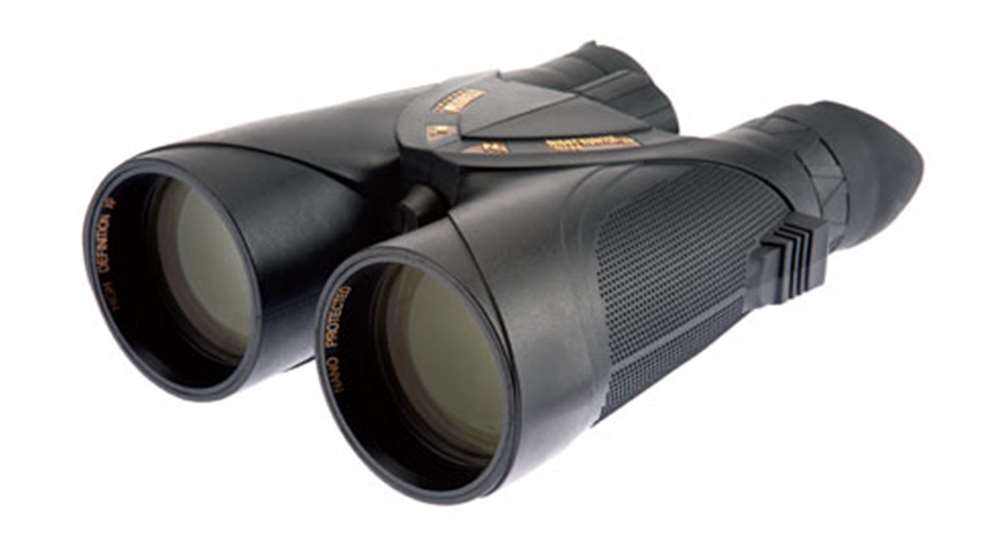
Sometimes you have to go big or go home. With Steiner’s Nighthunter XP 10x56, you don’t have to go home. With this 2-pound, 11-ounce binocular you can stay and watch whitetails until late on a moonlit night. This unit will let the light shine through.
Big objective lenses have always been known as “light gatherers,” although that phrase is confusing. No binocular “gathers” light if you mean that as “collecting” or “increasing.” Big objective lenses are like big windows: They admit more light, but they can’t increase it. Actually, a percentage of light is always lost to reflection when passing through glass. Anti-reflection coatings minimize that, though, and the Nighthunter XP has plenty of them. Every air-to-glass surface has multiple layers of coatings, and the roof-prisms are both phase-coated—which results in the sharpest possible image resolution—and backed by dielectric mirrors, the brightest, most reflective available. The outer lenses are coated with Steiner’s new Nano-Protection coating that repels water from them.
Let’s face it, whenever we grab big binoculars, we’re looking for brightness in dim light. This is critical in many hunting jurisdictions, especially for scouting whitetails and elk. These darned critters are practically vampires.
Starting at dawn, I studied the writing on a box of dish-washing detergent. The white letters were 3/8-inch high and set against a pale green background. After it became light enough to clearly discern the letters through the Steiner, I waited an additional 90 seconds before I could read them through a Vortex Razor 10x42, and another 140 seconds to see them through a Swarovski EL 8x42. (I had no other 10x56s to judge them against; the weaker magnification made it tougher for the Swarovski. But this gives you an idea of the light gain with a 56mm objective, which is about 30 times larger in surface area than a 42mm.) With equally good anti-reflection coatings and prism mirrors, objective lens size makes the difference.
At night under a crescent moon and a bit of glow from city lights I enjoyed the brighter view through the Steiner, with which I could distinguish individual stems of yellow grass against the sky 80 yards away. Boulders in the grass were noticeably brighter through the Steiner. Were I wanting a binocular for studying game in the lowest lighting conditions, I’d certainly pay the Steiner’s price in weight and bulk. This Nighthunter stands toe-to-toe with the best 10x42s in optical quality, i.e. resolution, contrast and sharpness.
The center-focus knob itself is deeply grooved and easy to move without being loose or sloppy. Dished thumb pads under the barrels provide a comfortable place to balance the heavy instrument, but for extended viewing sessions I found myself reaching closer to the eyepieces in order to get a palm fit, as supporting the unit just on the thumbs becomes tiring. The unit has a threaded hole for a tripod mount.
I like that Steiner has not saddled this binocular with a diopter adjustment integral with the center-focus knob. In my experience putting the diopter adjustment in the center-focus wheel is a bad idea. Many instruments I’ve tried with this feature inadvertently changed the diopter setting at some point while hunting. The knob pops up, and when you turn it to focus you mess up the diopter setting by mistake. With the diopter wheel under the left eyepiece, the Nighthunter XP’s diopter stays adjusted.
Edge sharpness was slightly above average for similarly priced binoculars. Listed at $1,249, I’ve seen it on sale for $1,099.
This Nighthunter has pull/twist-up eyecups to accommodate eyeglasses and various eye socket depths. Both cups exhibited an unusual ratcheting sound/action that required some experimentation. The cups lock into several positions with small adjustments in between. It takes some getting used to. The soft rubber sunshades roll down easily for eyeglass use and certainly provide some blocking of distracting sidelight when flicked up.
Give Steiner a blue ribbon for designing objective lens caps that you won’t easily lose. Instead of snapping on or off or clamping around the barrel with “rubber bands” that slip off during your first five minutes of field use, these Steiner lids hang from stems that snap in and out of mechanical locking recesses integral with the rubber armor body coating. Yes, they still flop in the wind, but you can remove them with a push of the locking recess surface then replace them when it’s calm again. The padded neck strap also snaps in and out of recesses on the barrels.
I love the neoprene ocular cover. Instead of trying to get rubber covers to stay in place, Steiner provides a neoprene cup that attaches to the neck strap and slides over the eyepieces. It’s simple, light and quick to use and replace.
The unit is guaranteed (30-year limited warranty) waterproof and fogproof. I left it in the kitchen freezer for two hours. Back in the kitchen air the external lens surfaces grew a stiff coating of ice, but after melting with a hair dryer, it showed no internal fogging. Drowning the unit in the sink for 15 minutes resulted in no leaking, but a thin layer of internal fogging formed under the objective lenses. This cleared within five minutes. I see this on virtually every binocular I test.
Technical Specifications
Type: roof-prism binocular
Magnification: 10x
Objective Lens Diameter: 56mm
Focusing Range: 13.1'-infinity
Eye Relief: 17mm
Field of View at 1,000 yds: 361'
Coatings: fully multi-coated lenses, phase-coated prisms, hydrophobic Nano-Protection
Dimensions: weight 2 lbs., 11 ozs. (w/o accessories); height 4.9"; width 2.6"; depth 7.4"
Construction: polycarbonate chassis, rubber-armored, nitrogen-purged
Accessories: case; neoprene neck strap; objective lens caps; neoprene rain guard
MSRP: $1,249.99