Much like the modern muzzleloader, handgun hunting has turned from a deliberate pursuit of game with a short-range hunting tool to a continuing effort to emulate center-fire rifle performance while staying within the legal definition of a handgun—in essence, a center-fire rifle without a buttstock. There’s nothing wrong with that, but there are still plenty of folks who prefer to hunt with a more traditional belt gun. And it doesn’t get much more traditional than the Colt 1873 Single Action Army (SAA) revolver.
The SAA was the culmination of Sam Colt’s concept of a revolving cylinder repeating pistol and the center-fire, self-contained cartridge. One hundred thirty-nine years ago it was the pinnacle of modern technology. The fact that this revolver—as well as its many iterations and copies—continues to be produced and sold is testament to its timeless design.
Colt first offered an adjustable-sight version of the SAA in 1888. Named the “Flattop Target Model,” it featured a flat topstrap with a small (by today’s standards) rear sight adjustable for windage by drifting. The front sight was adjustable for elevation. Less than 1,000 were produced during its eight-year run. From 1894 to 1913 a similar number of Flattop Target Models were made in the Bisley configuration. It wasn’t until the Second Generation was introduced that Colt would make another adjustable-sight SAA.
The Second Generation SAAs were in response to Ruger’s unqualified success with its Blackhawk single-action revolver. In 1961 Colt produced two adjustable-sight SAAs. Production ramped up a little the following year, and you could buy a New Frontier in ’62 for the sum of $140! It’s a bit more than 10 times that today. From 1961 through 1974 approximately 4,000 New Frontier revolvers were produced, the majority chambered in .357 Magnum, followed closely by .45 Colt. Less than 300 were chambered for .44 Special, and 49 were in .38 Special.
Third Generation New Frontiers began production in 1978 and have been more or less available since. Colt has undergone ownership changes of late, and is now committed to regaining its share of the civilian gun market. Recently I shot the latest iteration of the New Frontier in .44 Spl.
Operation of any Colt single-action revolver is simple, if well timed. The hammer is manually cocked, and as it is cocked, the locking bolt is cammed from its notch in the cylinder. A hand mounted on the left side of the hammer extends through a window in the recoil shield and engages a ratchet machined onto the rear of the cylinder. As the hand engages the ratchet, the cylinder rotates around a central base pin. When the rotation is nearly complete, the bolt is released and under spring tension comes into contact with the cylinder. At the end of the rotation the bolt is forced into a locking notch to prevent cylinder movement during firing. The sear on the trigger engages a full-cock notch on the hammer, and the revolver is ready to fire. Empty cases are manually ejected via a spring-loaded ejector.
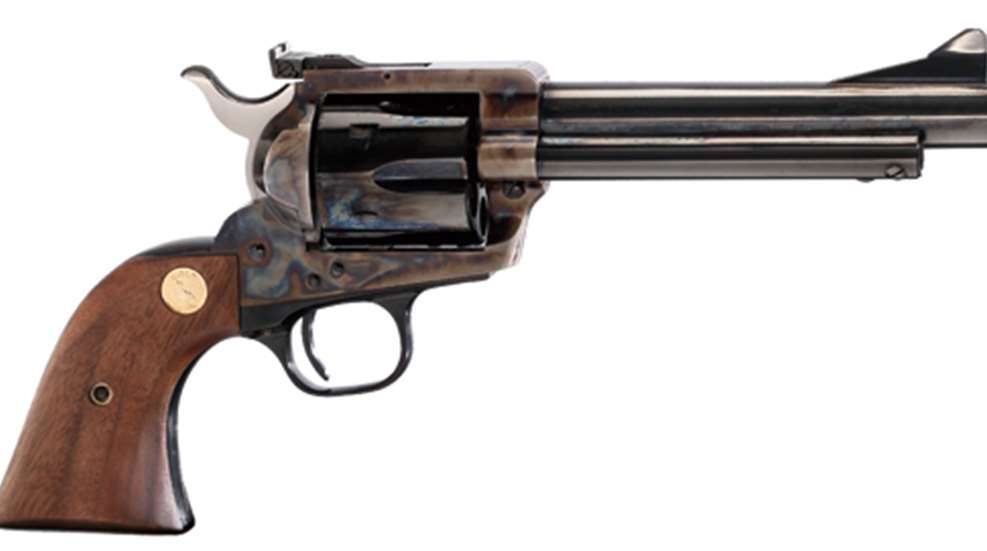
The Colt SAA is perhaps the most recognized handgun in the world. It usually takes a gunner to recognize the difference in profile of, say, a 1911 and a Browning Hi Power, but nearly anyone recognizes an SAA profile, and the response is a quick “Colt.” The modern New Frontier maintains that iconic profile, along with the color-casehardened frame and deep blue gloss finish of the barrel, cylinder and grip frame. The only departure is a flat, squared off topstrap with a fully adjustable Colt Elliason rear sight and a ramp front sight.
To the range I took along my 30-year-old SAA in the same caliber for comparison. Since this review is more about a versatile hunting revolver, I chose my test ammo accordingly. A relatively new company, Double Tap, supplied me with a load featuring a 245-grain cast semi-wadcutter at an advertised 975 fps from a 5 1/2-inch barrel. My Oehler 35P clocked the ammo at 934 fps and 931 fps from the New Frontier and my SAA respectively. Both revolvers grouped that load into 2 1/4 inches at 25 yards.
However, in order to get the best performance from this cartridge one must handload it. My standard .44 Special handload with Alliant Unique behind a Lyman 429421 cast semi-wadcutter shot a bit better—2 inches at 25—and clocked at 969 fps. This is a well-behaved, accurate load for most small-game tasks, as well as self-defense. For hunting deer-sized game out to 50 yards, 141/2 grains of Alliant 2400 with that same bullet is a very efficient load. The New Frontier apparently likes it too, as this load turned in the best grouping, averaging 1 1/4 inches at 25 yards. Velocity is 1142 fps, and the recoil, while noticeably stiffer, is not abusive. These handloads are safe in modern revolvers chambered in .44 Special but should not be fired in .44 revolvers made before 1920.
The Colt SAA has been given a bum rap regarding durability; sometimes it’s called the “gunsmith’s friend.” I seriously doubt a gun could survive 139 years if it were prone to breakage. This reputation was garnered during the 1950s when many shooters got their gun-handling instruction from movies and television. Fanning—holding the trigger down with one hand while stroking the hammer with the other one repeatedly and fast—provided dramatic scenes in Hollywood Westerns, but it’s a terrible and inaccurate way to run the gun. Treat an SAA or New Frontier as you would any fine gun, and it will last longer than you will.
Colt’s New Frontier isn’t some fire-breathing magnum that will lay low a massive herbivore from a quarter-mile. It is a well made handgun that will serve nicely as a small to medium game firearm for the traditional handgun hunter.
Specs:
coltsmfg.com
Type: single-action revolver
Caliber: .357 Mag., .44 Special, .45 Colt
Barrel: 5 1/2" (tested), 7 1/2"; 1:18 1/2" RH twist
Trigger: 3 lbs., 14 ozs.
Cylinder Capacity: 6 rnds.
Sights: Colt Elliason rear; ramp front
Grips: two-piece smooth walnut
Overall Length: 11 1/2"
Weight: 38.5 ozs.
Metal Finish: color-casehardened, blue
MSRP: $1,455