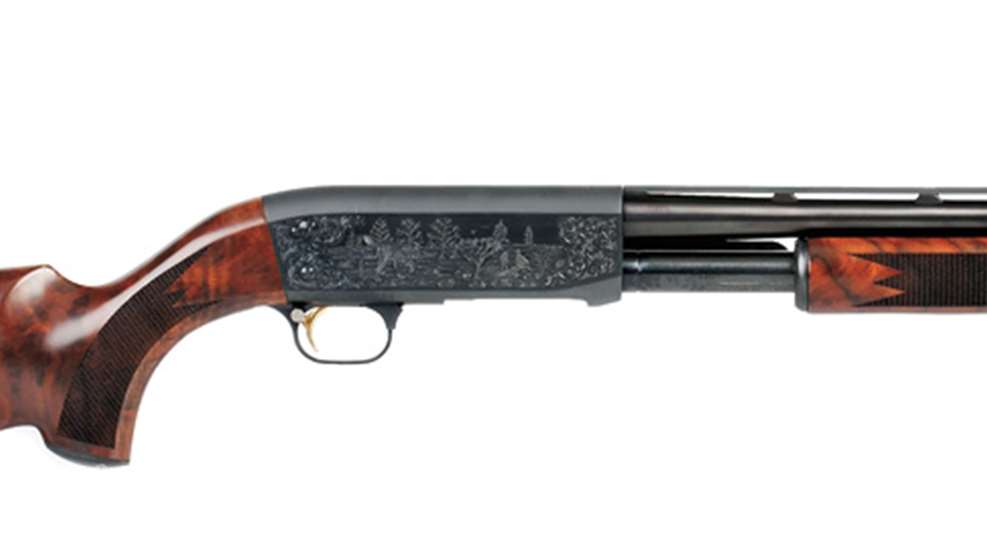
The Ithaca Model 37 is a true American classic. It’s the lone survivor of the pre-World War II pump-action shotguns—the Winchester Model 12 and Model 97, and the Remington 31. What set the 37 apart was its action.
Ithaca began making double guns in 1883, and by the late 1920s company officials surmised that repeaters were perhaps the wave of the future. John Moses Browning designed several bottom-ejecting shotguns that were produced by Remington, and it was the Model 17 that caught the eye of Ithaca gun designer Harry Howland. In 1931, he filed for a patent that improved the firing pin and ejector mechanism of the Remington 17. In 1932, based on Howland’s patent and the Remington 17, Ithaca built 100 bottom-ejecting, pump shotguns. However, before any were released, Ithaca discovered that their new shotgun infringed on existing Remington patents, and so the project was shelved, but not forgotten. When the patents lapsed in 1937, Ithaca took up the torch.
Bottom ejection has several benefits: Empties are ejected at the shooter’s feet (and not at a buddy), the action is better protected from debris and bottom-ejecting guns work well for left-handed shooters. In production, it became evident that the Model 37 could be made very light in weight, and in 1938 the 37 was given the name “Featherlight.”
Manufacture of the Model 37 begins with a 7-pound billet of steel that is machined into the receiver, and the barrels are made by cold-hammer forging. A 15-inch, bored steel tube is placed on a mandrel and then subjected to hundreds of powerful hammer strokes around the circumference that thins and stretches the tube into a barrel. They are made the same way today, only it’s a day’s drive from Ithaca, N.Y.
In the 1970s Ithaca decided to branch out, and it imported Perazzi competition guns from Italy. Then it bought the Mitchell Optical Company, 10X sportswear and several other outdoor-related companies. It also began cataloging semi-automatic shotguns—some imported, others made in it’s factory—among which was the excellent Model 51 and the then-audacious Mag 10, 10-gauge autoloading shotgun. Somewhere in all of this, sales sagged, and in 1986 Ithaca went bankrupt. Following litigation, assets were sold to the Ithaca Acquisition Company in Kings Ferry, N.Y., and it began production of the Model 37, renamed the Model 87, in Kings Ferry. But this company was also forced from business in 2005.
In December 2007, a new Ithaca Gun Company bought out the remaining assets of the Ithaca Gun Company LLC and moved production to Upper Sandusky, Ohio, where production of the Model 37 resumed under its birth name.
The new Ithaca plant was already a top-line machining operation, and hence had the equipment and expertise to produce the classic Model 37 using modern production techniques. Not the least of these is the milled rib posts that are integral with the barrel. The rib slips on and is secured with a single screw near the breech. From near death, the 37 has arisen in all of its original glory of diverse gauges and versions for every style of hunting. The original Model 37 was made in three gauges: 12, 16 (an indicator of that gauge’s pre-war popularity) and 20. Today the 16-gauge has been dropped, but in its place is a sleek 28-gauge upland gun that, despite its diminutive size, provides terrific performance in the field. Current 37s are milled from a solid billet of steel, but added to the line is the Ultalight whose action begins life as a billet of aircraft-grade aluminum alloy.
In operation, the Model 37 is simple. With the bottom of the action clear, one or two shells are loaded into the magazine. Then, pressing the action release button located under the trigger finger at the right front of the trigger guard, the action is cycled, bringing a loaded round into the chamber. Key is the split, fork-shaped shell carrier that sits atop the bolt when the action is closed. When the slide is pulled fully to the rear, a fresh round is released from the magazine onto the carrier that has swung down. In order to clear the bolt as the action is closed the carrier’s design allows it to spread slightly while holding the round as the bolt pushes it into the chamber. As the bolt moves forward the two spring-loaded extractors located at 12 o’clock on the top and 6 o’clock on the bottom of the bolt snap over the rim of the fresh round, controlling its insertion into the chamber.
When the gun is fired, the rearward stroke of the fore-end moves the bolt rearward with the extractors gripping the fired hull. As the carrier sweeps down, it strips the fired round from the top extractor and uses the heavier bottom extractor to hold the round a fraction of a second longer to tip the fired shell down and out through the loading/ejection port. With the forward stroke, the loading process is repeated and the gun is again ready to fire.
Current production includes camo-clad turkey and waterfowl models, traditional blued-steel-and-walnut guns and the ever-popular Deerslayer, reputedly one of the most accurate slug guns ever made. All new 37s come with three Briley screw-in choke tubes—improved cylinder, modified and full.
In shooting the 28-gauge Model 37, I noted it possesses the same smooth action common to older 37s. Surprisingly, the pattern percentages shot with Olin-Winchester 28-gauge No. 8, 3/4-ounce loads were fairly narrowly spaced. Shot at 40 yards (30 yards might have been a better trial of this smaller gauge) IC averaged 59 percent, modified 64 percent and full shot 69 percent.
Now 70-plus years old, the Ithaca 37 remains the sole surviving American-classic pump gun. Gone are the Winchester 97 and 12 and Remington 31, all replaced with guns adapted to modern production techniques. The Browning BPS shares the design, and during Ithaca’s years of financial strife it was the sole bottom-ejecting shotgun.
Those owning older Model 37s can have them again repaired by Ithaca gunsmiths, and they also have the factory manufacturing records, and have them posted on their website.
Specs:
877-648-422, www.ithacagun.com
Type: pump-action, bottom-ejecting shotgun
Gauge: 12, 20, 28 (tested)
Barrel: 26", 28", 30"
Magazine: 4-shot tubular
Sights: ventilated rib w/Ithaca Ray-Bar front sight
Safety: trigger-blocking crossbolt
Stock: wooden field-style with Pachmayr pad; length of pull—14"; drop at heel—2 1/4"; drop at comb—1 1/2"
Weight: 6 lbs., 4 ozs. (28-gauge)
Accessories: three choke tubes, IC, Mod, Full
MSRP: $499-$3,499 depending on model, finish and configuration