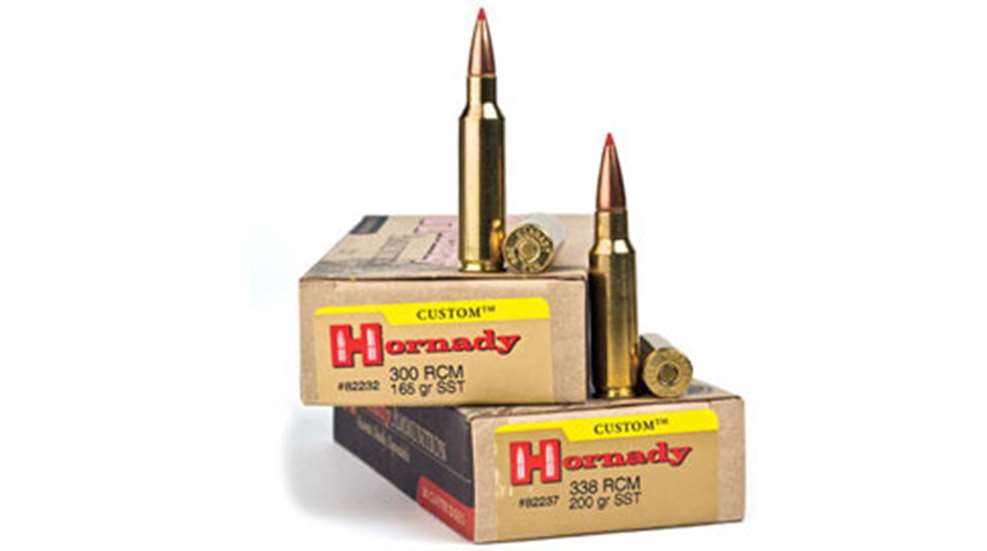
The Ruger Compact Magnums are based on the .375 Ruger case cut down from 2.580 inches. For the .300 RCM, the length is 2.100 inches, the same length as the WSM cartridges. The .338 RCM is a bit shorter at 2.015 inch, the same length as the case on the Remington .300 Short Action Ultra Mag. Both these cartridges fit well into any short-action rifle and they make efficient use of the available space. The rim diameter on the RCM is .532 inch, which is the same as used for ubiquitous belted magnums, so the bolt face will require no changes that would muck up the manufacturing process for current rifles. However, rather than waste case diameter and powder space by wrapping a useless belt on the cartridge, the body of the case is full-diameter, also measuring .532 inch, which makes the most efficient use of the available space without resorting to a rebated rim.
Ruger has introduced the cartridges in its Hawkeye rifles, available in stainless steel/synthetic or blued/wood, all with 20-inch barrels. The design of the Ruger rifles is indicative of the advantage of these cartridges over other short magnums. Hornady engineered them to work with stubby barrels. In the past a "magnum" rifle cartridge almost always required a 24-inch and even 26-inch barrel to achieve published velocities. But long barrels can be a bit of a headache in real-world hunting. They are harder to get in and out of a vehicle or scabbard; they can catch on brush and are awkward in a blind. Also, with all else equal, a short barrel is more accurate as a rule because it is stiffer. The arguments for a long barrel mostly center on more velocity, so clearly, if that same level of performance can be achieved in a shorter barrel, there is little advantage to going long. Hornady uses powders that are engineered to the cartridge and barrel length. The way any gunpowder works is it burns rapidly and expands in volume as it turns into a gas. This creates pressure that pushes the bullet out of the barrel. All cartridges must work within certain pressure guidelines, which are established by the Sporting Arms and Ammunition Manufacturing Institute (SAAMI). The new RCM cartridges have a SAAMI mean average pressure rating of 65,000 p.s.i., which is the maximum the institute will allow in any rifle cartridge.
The Ruger Compact Magnums are currently offered only with Hornady SST polymer-tipped bullets. This is a great bullet for deer and antelope, but in my opinion it's too soft for moose, elk, bear and other tough game. These cartridges, particularly the .338 RCM, would be much better served if Hornady would load them with their tougher, bonded-core, Interbond bullets. The cost per box of ammo would be a little higher, but the enhanced performance on big game would be worth the price. I bet we will see that option soon.
Cartridge Type: centerfire rifle
Product Line: Hornady Custom
Bullet: SST (polymer-tipped, jacketed lead core, boattail)
Case Capacity: .300 RCM-72.7 grs. water; .338 RCM-70.1 grs. water
Overall Case Length: .300 RCM-2.100"; .338 RCM-2.015"
Overall Cartridge Length: .300 RCM-2.825"; .338 RCM-2.830"
Advertised Velocity of Available Calibers/Weights: .300 RCM (20" barrel), 150-gr. SST-3170 fps, 165-gr. SST-3030 fps, 180-gr. SST-2900 fps; .338 RCM (20" barrel), 200-gr. SST-2850 fps, 225-gr. SST-2710 fps
MSRP per box of 20: .300 RCM-$42; .338 RCM-$51