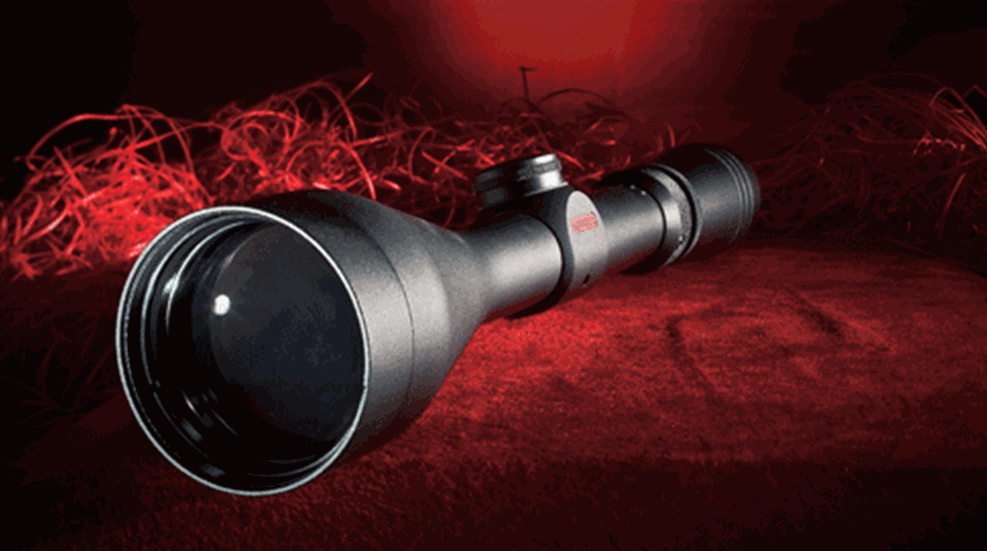
American hunters didn’t invent brand loyalty, but as a group they’re as passionate about it as anyone. Show me a hunter and I’ll show you a favorite Browning, Federal, Filson or Danner, or a favorite cartridge (.30-06, anyone?). Here’s another name hunters favor: Redfield.
The Redfield Rifle Scope Company was founded by John Hill Redfield, an ingenious man whose story is not unlike those of John Browning or Samuel Colt or Bill Ruger. He died more than 65 years ago, but Redfield products have been carried by American hunters for generations. Anyone loyal to the brand he created will be happy to hear that, beginning this month, they can once again buy new, American-made Redfield riflescopes. That’s because in 2008 Leupold & Stevens, the venerable American sports optics company headquartered in Oregon, purchased the rights to Redfield, then planned and executed a renaissance of the once great American brand.
That development is itself an interesting story. But first, a little history. Born in 1859 on 160 acres in Glendale, Ore., John Hill Redfield was one of eight children of John and Adelia Redfield, who had migrated west in a covered wagon some years earlier, fending off Indian attacks along the way. As a boy John loved hunting and exploring, and it was his taste for adventure that took him as a teenager to San Francisco, then Nevada and to unknown parts of Idaho. While away, he became a deputy U.S. marshal—and for the rest of his life carried the scars of four bullet wounds as testament to his service. He also became a gambler of some repute. And his skills as a marksman served him well as a meat hunter for the Northern Pacific Railroad.
In 1893 Redfield returned to Oregon and set up shop as a gunsmith. But he was inspired by the mining boom in Colorado, and a little tinkering in his shop produced an innovative rock drill. He moved his family to Denver in 1906 and his drill earned him notoriety. It wasn’t his only invention, either. Others included a timed shotgun that fired at regular intervals to keep coyotes at bay around sheep herds, a water-powered washing machine, an astronomical instrument and several guns.
In 1909, he launched the Western Gun Sight Company in a small building behind his home on Gilpin Street in Denver. Redfield sights proved superior to the competition, and soon John’s son, Watt, began working full-time for the company.
During World War I, Redfield designed the JR & SR rotary dovetail mounts for telescopic sights for U.S. Army special units—the foundation of the very Redfield mounts we all know and use today. In 1932, the company was renamed the Redfield Gun Sight Company. In 1944 John died and Watt took over.
Many optical advances followed, including centered reticles, internal adjustments, second-focal-plane reticles (which hold their size throughout magnification changes) and one-piece tubes. Probably the most famous Redfield product was the Widefield riflescope, introduced in 1970. It's distinguishable by its oval objective lens, which is wider than it is tall. It’s akin to a TV screen and provides upwards of 30 percent more field-of-view than conventional scopes. I still have mine, a 4X that to this day sits atop my dad’s old Marlin 336.
All that history dovetails nicely with the company that this month begins selling new Redfield riflescopes. You see, two years before John Hill Redfield started his business, Fred Leupold and Adam Voelpel launched Leupold & Voelpel in Portland, Ore., the very company that eventually became Leupold & Stevens, makers of the popular line of riflescopes we all know today.
But how Leupold & Stevens acquired the Redfield brand is a tale with a lot of plot twists.
In 1998, the original Redfield Rifle Scopes Inc. ceased operations in Denver. Through the 1980s and ’90s, the company had found it increasingly difficult to keep up with the competition. Like others, it began marketing scopes with foreign components, and sought toward the end of its life to re-enter the high end of the market with its Ultimate Illuminator series. But it was too little, too late. Competition had surpassed Redfield.
Coupled with all this was a dirty mess in Denver. In January 1998, samples taken from groundwater monitoring wells on a corner of the Redfield property indicated pollutants were likely moving offsite and into the surrounding neighborhood. That didn’t sit well with the Environmental Protection Agency, and the company was charged. It was the straw that broke the camel’s back—the company was disbanded, its assets sold off and a new company, RRS Inc., set up to service existing warranties. The Denver facility sits vacant today.
In the fall of 1998, Blount International purchased Redfield’s operating assets, which consisted of inventory, machinery and equipment, trademarks, sales literature and patents. Blount, the parent company at the time of Federal Ammunition, moved Redfield manufacturing and distribution to Onalaska, Wis., and distributed Redfield-branded products through its Simmons and Weaver optics dealers.
Four years later, in the fall of 2002, Meade Instruments Corp. purchased all common stock of Simmons, which included the rights to market Simmons, Redfield and Weaver products. At the time it seemed like a good marriage; after all, Meade is a major player in the astronomical optics market; everyone in the outdoor press assumed the company would leverage its expertise to produce and market sport optics.
In fact Meade planned—even advertised—a new-from-the-ground-up Redfield riflescope made in California that used components from a similar Simmons product (made overseas). I saw a prototype, and so did a lot of writers. Mark Keefe IV, Editor in Chief of American Rifleman, had airline tickets in hand to visit Meade’s facility … then the whole project came unraveled. The scope was never produced and everyone in the outdoor press who wrote about it was left holding the bag.
So were American hunters who wanted a new Redfield scope.
Fast forward to April 2008: Meade divests all interests in the sport optics business. ATK, now the parent of Federal Ammunition and a host of other companies, purchases from Meade the rights to Weaver products, and Leupold & Stevens purchases the intellectual property of Redfield.
Finally, after a decade in the wilderness, a venerable name in American field sports has a new lease on life. New Redfield Revolution series riflescopes are being produced by Leupold & Stevens at its Beaverton, Ore., facility.
Now, given recent history, American hunters have a right to be skeptical. But last August I visited Leupold’s factory and saw Redfield scopes coming off the line with my own eyes. I can attest to this project’s viability. And I can attest to the fact that they are, indeed, American-made.
There are four scopes in the current Revolution line: a 2X-7X-33mm, 3X-9X-40mm, 3X-9X-50mm and a 4X-14X-50mm. All are available with either a “4-Plex” or an “Accu-Range” reticle (an original Redfield design). Prices run from $129.99-$219.99. In Oregon, I had the opportunity to test them all, and for the money the quality is surprisingly good—quarter-minute click adjustments, bright images, very good resolution. You can expect a complete technical review of them later this year in “Hardware.”
In the meantime, they are on dealer shelves now, awaiting American hunters’ fervent attention. And I’d say, given the present state of the economy, an American-made scope for $129 should have no trouble finding old-timers and newcomers alike who will once again ride for the Redfield brand.