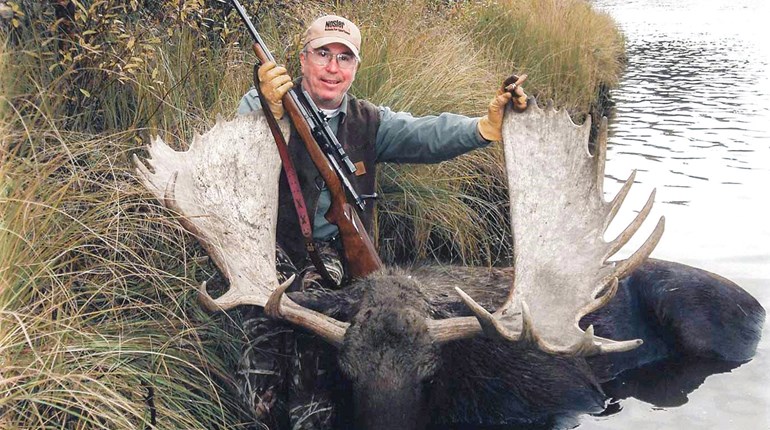
The big kudu bull was standing on the ridge acting very much like an elk. As his thick spiraling horns flashed in the sun, my hands began to shake with excitement and my breathing grew heavy. I slipped down behind the fork of a small tree that looked like it grew there for just that purpose and used it as a rest. My nerves calmed by a few deep breaths, I slowly squeezed the Model 70’s 3-pound trigger and sent a 200 grain Swift A-Frame 235 yards across the canyon. The bull didn’t flinch. I cycled the bolt and found his shoulder again with the same result. As I made ready to shoot for a third time, he shook his massive headgear and walked behind some thick thorn, which obscured my target. After an agonizing minute, he re-emerged and I sent shot number three into his shoulder- he finally collapsed. When we traversed the canyon and got to him, I could cover all three shots with the palm of my hand—all were vital hits (if a bit high); he just didn’t know it. No one must have told him that he’d been shot with a .300 Win. Mag. For my first African safari, I knew that I needed a powerful rifle. I was relatively new to big-game hunting at the time, but I’d read so much about the tenacity of Africa’s game animals that I had to have more horsepower.
Fast-forward seven years and once again I’m after a big kudu bull after a day spent trying to locate a poacher-wounded elephant. We’d blown two stalks on a bachelor herd when we came around a corner to find them standing in the open in the grey dusk. I jumped out of the truck, grabbed my little 7x57 Mauser and shot the bull stone dead. Is the 7x57 a better cartridge for elk-sized game than the .300? Is the Partition a better bullet than the A-Frame? Not necessarily. The difference between the two bulls was several years of experience shooting animals big and small and steel and paper targets near and far. The difference was shot placement—put a decent bullet through the heart of any animal and it will die.
I don’t care who you are or how much you shoot, recoil and muzzle blast are not contributors to better shooting. I don’t count myself as recoil shy, but I’m not immune to the laws of nature—its OK to be afraid of explosive forces near your face. I can shoot .338s and .416s with precision, but it takes far more concentration than it does to hit the same target with something like a .270 or that little kudu-slaying 7x57.
The term “magnum” can mean a lot of things (the term comes from extra large bottles of wine) but it generally refers to a cartridge with additional powder capacity that pushes bullets faster than its standard counterpart. Lets take the American standard .30 caliber as an example. If we assume that the .30-06 is the baseline, with most 180 grain loads producing muzzle velocities of 2,800 fps, we move up through the various magnums and watch the velocities (and recoil levels rise).
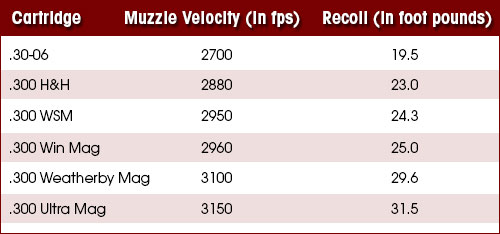
Clearly, the .30-caliber magnums produce faster velocities than the traditional .30-06 loads. But what does that mean in the field? If we can agree that the .30-06 is an effective cartridge for most big game animals using well-constructed 180-grain bullets at 300 yards, we have a means of comparison. At 300 yards, that .30-06 bullet is moving at roughly 2,200 fps (many premium bullets such as the Nosler Partition and Accubond are designed to expand at as little as 1,900 fps). Lets examine at what distance the various magnums meet that same velocity threshold.
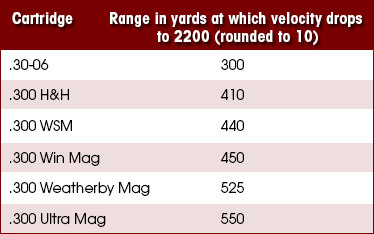
Once again, we see an advantage to the magnum cartridges when it comes to impact velocity. How about trajectory, don’t magnums shoot “way flatter?”
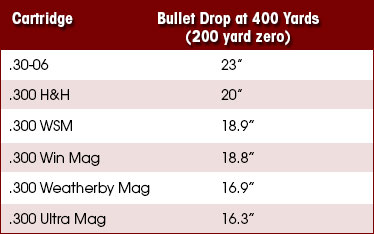
This is where we start to see reality hit. The mighty .300 Ultra, producing nearly 1.5 times the ft.-lbs. of recoil of the .30-06 only gives you 7 inches less bullet drop at 400 yards.
OK, I know what you’re thinking, speed kills right? Within the bounds of reason, my experience tells me that bullet velocity does not have a dramatic effect on the lethality of a cartridge. I’m not saying that velocity doesn’t matter: If it didn’t, rifle cartridges wouldn’t be more impressive on game than handgun rounds. I’ll even concede that velocity can result in a faster kill due to rapid bullet expansion and more violent tissue damage. That said, I’ve never seen an animal that either died or got away wounded because of a few hundred fps of bullet speed. Animals die when bullets strike vital organs and the brain’s oxygen supply is cut off. So, the most important factor in ensuring the game animal’s demise is making sure that the bullet reaches the anatomical target and destroys it. That means a) shot placement, and b) proper bullet construction.
What’s the difference between the big-bodied whitetail that dropped last year with my .260 and the big bull elk that I shot but didn’t recover with a .300 WSM? It obviously wasn’t speed: It was bullet placement. Whether my bullet was deflected in the thick timber or I simply made a bad hit, the magnum headstamp on the cartridge didn’t make a difference on the elk. If I could get in a time machine and take that shot over again, I wouldn’t bring a bigger rifle, I’d take a second longer to pull the trigger.
I’m not saying that magnum cartridges don’t have a purpose, I own many and use them when they’re needed—if you can honestly shoot them well, they have their advantages. My point is that if you’re hunting deer- or elk-sized game at ranges of 300 yards or less, you’re far better off with a less-powerful cartridge that you can shoot well than a boomer that punishes you every time you pull the trigger. Next time someone tells you that your .30-06 is no good for elk but their .300 Wby. will smoke them out to 500 yards, show them the math.
Most Popular