I’ve always been a Run ‘N’ Gun turkey hunter. Whether hunting private or public land, I prefer to get in close, set up quickly and gun the bird down.
The one problem with this style of hunting is that you can easily bump a bird if you get too close. In fact, I have done this many times, especially when hunting out west where the birds can see so much farther than the Eastern subspecies that I normally pursue. A few years ago on a hunt in Texas with Federal Premium Ammunition, I had to force myself to slow down after bumping three birds. One way to slow down is by putting out a spread of decoys.
I learned about turkey spreads while hunting with National Wild Turkey Federation Senior Editor P.J. Perea on the Sumter National Forest in South Carolina. As we were walking in, a bird sounded off to an owl call, but it cut off very quickly. It was almost as if the bird realized he had messed up midway through his gobble. I wanted to go after the bird, but Perea decided that we would come back to that bird later in the morning. He felt there was no way we could take that particular bird off the roost.
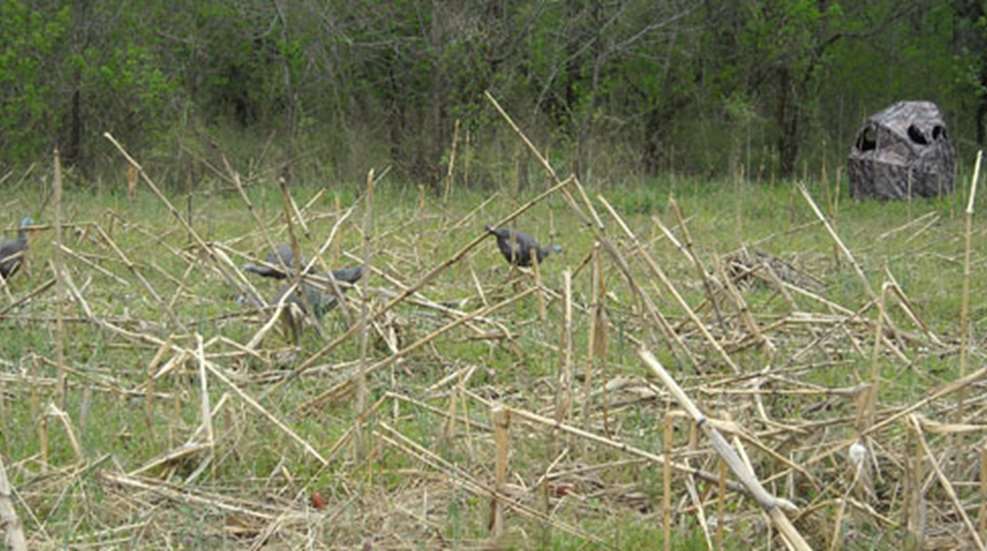
Around 10 a.m., after having no luck, we headed to a recently planted cutover near where the bird had gobbled that morning with a bag full of decoys. We spread out 12 hen decoys like a flock with a single jake decoy in the middle. Then, we placed a fan off to our right to resemble a gobbler coming in, and found a comfortable place to wait.
It was a long wait and we were dozing, only raising our heads every once in a while to send out a few yelps before going back to sleep, when we heard the bird. I actually thought I was dreaming when I got a response to my Primos box call, and had to hit it again to make sure I had really heard a bird gobbling.
That bird was already within 100 yards of us before we even knew he was coming, and within a couple of minutes was standing at 50 yards displaying for our flock. He wanted those hens, but was old enough to know that they were supposed to come to him. It took about five minutes for that bird to offer P.J. a shot, but he put on a nice show while we were waiting.
We would have never gotten that bird if we had charged straight at it, but by slowing down and letting our decoys do the work, we took an old bird off of public land, and I learned a great new approach. Since then, I have implemented a spread into my turkey tactics, and have even developed the system to be a comfortable way to introduce a young hunter to the sport, in addition to being an effective way to bag a turkey. But to really use a spread effectively, you have to be comfortable, silent, still and in the right location.
This tactic is about waiting to catch a gobbler as he progresses through his day, so scouting to learn where the birds travel is crucial. Start by looking for fields where birds come to feed. During the early season, if you find the hens, you will find the gobblers, and having a live hen or two mingling with your decoys can be a contributing factor for success. As the season progresses, you should look for smaller openings farther back in the woods to anticipate the pressure the birds are receiving from hunters, but don’t overlook larger fields, because as pressure lifts toward the end of the season, the birds head back to preferred food locations.
As far as being comfortable and unseen, a blind is the best option. I prefer the Ameristep Chair Blind, but any blind will do the job as long as it is large enough to conceal movement, offers ample vision in all directions and is comfortable enough for a long wait.
The last aspect of the turkey spread involves decoys. While the standard setup is a single hen or two hens with a jake, for a spread you need at least 10 decoys—nine hens and a jake. Movement is also important because a flock of turkeys almost never stands still. You can add movement with a motorized decoy, if legal, or by tying a pull-chord to one or two decoys but, once again, you must ensure that this is legal as some states havebanned all mechanical decoys for turkey hunting and the laws could be interpreted to include pull-chords. You should also use the most realistic decoys that you can afford, though mixing brands is just fine. Over the years, I’ve used Montana, Flambeau and Primos decoys to fill out my spread.
After setting up your blind, spread your hens out around the jake, which should be placed facing the blind at about 20 yards, keeping all the hens within range of the blind. Be sure to mix both standing and feeding hens into the spread and have them facing a variety of directions. Then, get comfortable and start calling. Remember, hens make a lot of noise, especially when feeding. I usually wait about 15 to 20 minutes to let everything calm down before making a lot of soft clucks, purrs and yelps on a variety of calls, mixing in the occasional loud yelp to get the attention of any passing gobblers. However, as described earlier, just hitting a few yelps every 10 to 15 minutes can work as well.
The spread is one of many tactics that can be successful in the turkey woods. It’s not the only one, and no hunter should limit him or herself to one style of hunting. It is, however, an excellent way to keep hunting when the birds aren’t responding to calls, when it’s raining or if you’re just not in the mood to chase those pesky birds.