Established perceptions are difficult to change, and it matters not at all if the beliefs are unsubstantiated or warranted, either. Case in point: most dedicated turkey hunters inevitably flock to the 12 gauge to pursue springtime’s boisterous birds; surely bigger is better, right? In doing so, though, these individuals are foregoing the many benefits of the ubiquitous and utilitarian 20 gauge. The typical 20-ga. shotgun is lightweight (generally a full pound or more lighter), svelte, and produces noticeably less recoil than its 12-ga. counterparts, all of which enable its use by a larger, more-diverse demographic of turkey hunters, including youth, women, elderly, and physically challenged individuals. Even veteran hunters would benefit from its increased portability and maneuverability. At practical shot distances, tom-tumbling performance isn’t sacrificed, either. Want evidence? Read on.
Traditionally viewed by many hunters as a gauge best suited for smaller upland species, such as rabbit, squirrel, grouse, and quail, and, at best, a beginner’s gobbler gun, recent technological advances in shotshell components—most notably, shot and wads—have greatly improved the 20 gauge’s effectiveness on turkeys. Let’s now examine each of these components individually, along with a glimpse into the past.
Change can be viewed positively or negatively; assuredly, among dedicated waterfowl hunters and ammunition manufacturers, the U.S. Fish & Wildlife Service’s 1991 nationwide ban—with the phase-in beginning during the 1987-1988 season—of lead shot for hunting waterfowl was seen as highly undesirable. To create regulation-compliant waterfowl loads, most manufacturers began utilizing steel shot, the characteristics of which weren’t fully understood at the time. Propelled to velocities mimicking those of traditional lead loads, the pellets were woefully underpowered for even close shots at small species of waterfowl, thereby causing frustration among hunters and companies alike. This initiated the search for “something better,” and from these endeavors emerged various blends of the following shot-making materials: bismuth, tin, tungsten, iron, copper, nickel, and polymer. Each combination differed with regard to density (and thus weight), with many exceeding that of lead and thus providing better-than-lead terminal ballistics on waterfowl. With superior performance on waterfowl, it was inevitable that the same materials (and pellets) would be offered in turkey-specific loads, which were traditionally dominated by lead shot. For diehard turkey hunters, the improved lethality offered at greater distances more than offset the incurred costs. It was these ultra-dense pellets, too, that upped the performance of the 20-ga. shotgun.
According to the American National Standards Institute (ANSI), the established bore diameter of the 20 gauge is (0.615”+0.020”), as opposed to (0.725”+0.020”) for the 12 gauge. Shell diameters are listed as 0.6850” and 0.7980”, respectively. From these numbers, it’s obvious that, in equal-length shells, a 20-ga. shotshell has notably less volume than its 12-ga. counterpart. For example, whereas 3”, 20-ga. turkey loads “top out” with a 1½-oz. payload, there are 3”, 12-ga. offerings with 2 ozs. of shot. Because of the 20 gauge’s reduced volume, to increase pattern density required the use of smaller shot sizes, such as No. 6; however, this proved problematic because small, lead-alloy (chilled or magnum) shot has insufficient weight to be effective at longer ranges. Choosing small shot in place of larger pellets increases the pattern but reduces diameter (i.e. wound channel) and penetration, the latter of which is especially important at distances 40 yds. and beyond. Today’s densest, tungsten-based pellets, such as Federal’s Heavyweight and HEVI-Shot’s HEVI-13, enable the turkey hunter to get the best of both worlds; because they’re upward of 35-percent denser than lead, the small shot weigh as much as larger lead-alloy ones, but occupy less space in the shotcup. For example, using a Hornady GS-1500 electronic scale, I discovered that Federal’s No. 7 Heavyweight pellets average 2.3 grs. each, while HEVI-13 No. 6 shot weighs 2.8 grs. In comparison, copper-plated, lead-alloy No. 6 shot averages 2.3 grs., high-antimony-lead No. 6 shot is 2.0 grs., and chilled, lead-alloy No. 7½ pellets are 1.4 grs. each. Even No. 5 copper-plated, lead-alloy shot only weighs 2.8 grs. each—the same as No. 6 HEVI-13. As you can see, the lead-free pellets offer a distinct downrange advantage. That being said, when loaded with 1¼ ozs. to 1 3/8 ozs. of lead-alloy No. 4, 5, or 6 shot, there are still ample and energy to ground a tom at practical shot distances. In the 20 gauge, lead-alloy No. 5 shot is a good compromise between the enhanced pattern density provided by No. 6s and increased pellet energy (and thus range) of No. 4s—especially approaching 40 yds.
Pellet energy and penetration are certainly critical characteristics for bringing a gobbler to bag; however, shot patterns, and thus load effectiveness, are heavily influenced by the wad design. Turkey hunting is, typically, a one-shot pursuit; seldom does a newly enlightened bird give the hunter a suitable redemption shot. Many 20-ga. turkey loads utilize traditional wads in which several petals peel rearward, or bloom, to slow its forward momentum and facilitate the release of the payload. This generally occurs quickly after exiting the muzzle; in most cases, the faster it does so the more open the pattern downrange. Newer wad designs, including the Federal FLITECONTROL and Hornady VERSATITE, which are one and the same, operate quite differently, and have finally “trickled down” from their original development in the 12 gauge. After exiting the muzzle, the lengthy gas seal of the one-piece wad flares widely, which, when combined three petals that open from the body of the shotcup, slow the wad’s advance. This design enables the shot to remain in the wad longer, which keeps the pattern denser, longer. Of course, buffering is used to protect the pellets from becoming misshapen during setback and while traversing the bore and choke tube. Non-round shot naturally migrates to the pattern’s fringe and, in a turkey load, is wholly undesirable.
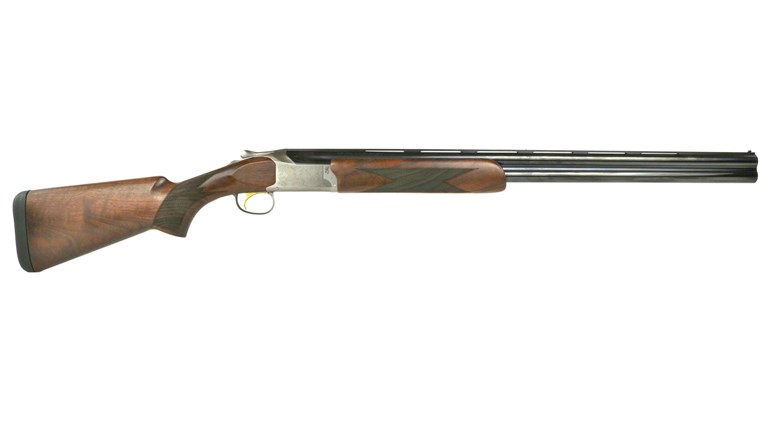
Lastly, just as with 12-ga. shotguns, 20-ga. guns will benefit from a tight-patterning, turkey-specific choke tube. Unfortunately, this is an area in which the 12 gauge has a clear advantage. Because most hunters opt for a 12-ga. shotgun for turkey hunting, most of the product development (in guns, ammunition, and choke tubes, among other things) originates with it, not the 20. Still, there is still a sufficient selection of extra- and super-full chokes—and thus differing constrictions—available in the popular thread patterns, including Beretta/Benelli, Remington, and Mossberg/Winchester/Weatherby/Savage. For the testing phase for this article, I visited a local Gander Mountain and purchased two versions suitable for a Stevens Model 555 over-under. The first was a ported, $20 Primos “TightWad” with a constriction of 0.570”, which was suitable for all shot types with the exception of steel. The second choke tube was Hunter Specialties’ non-ported “The Undertaker,” which was rated for plated- and non-plated lead only. Its constriction was rated as 0.572”. Both chokes provided excellent performance, though I preferred the versatility and patterns produced by the Primos choke.
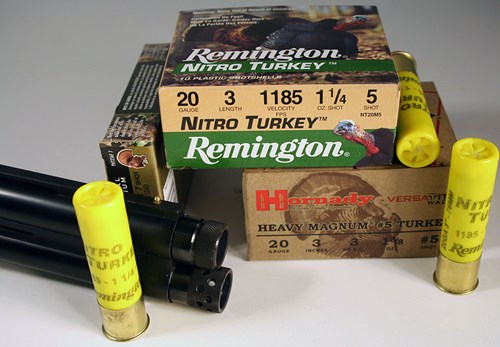
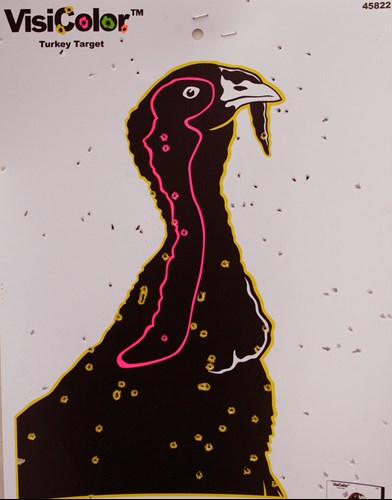
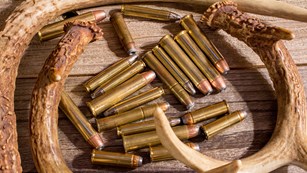
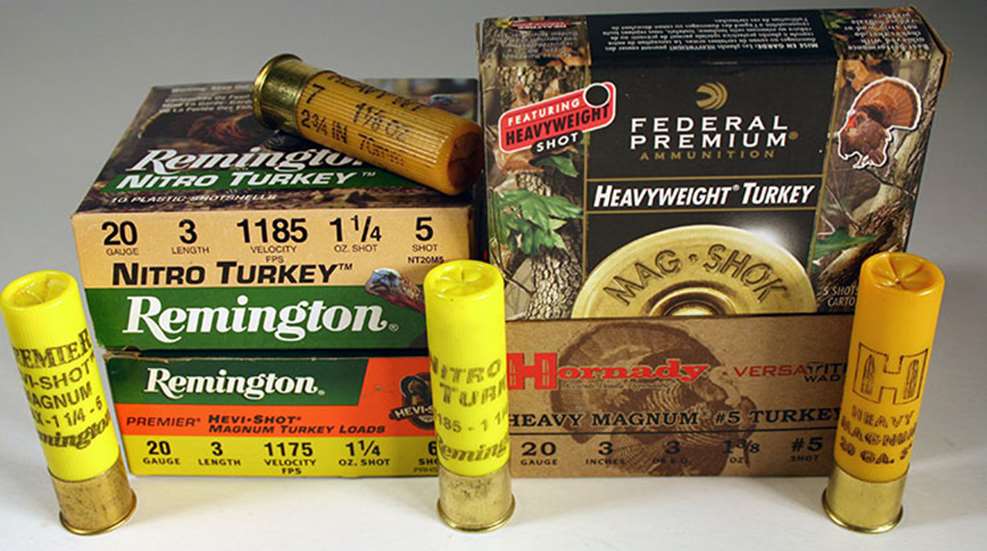
To determine the bead-sighted 20-gauge’s effectiveness, I patterned the Model 555 at 40 yds. using a combination of patterning paper (i.e. clearance Christmas wrapping paper) with Champion VisiColor Turkey Targets in the center. As for ammunition, I selected: Federal Premium Mag-Shok Heavyweight 2¾”, 1 1/8-oz., No. 7, an excellent lower-recoil option; Hornady Heavy Magnum 3”, 1 3/8”, No. 5; Remington Premier HEVI-Shot Magnum Turkey Load, 3”, 1¼-oz., No. 6; and Remington Nitro Turkey 3”, 1¼-oz. No. 5. The published velocities are 1100, 1150, 1090, and 1185 f.p.s., respectively.
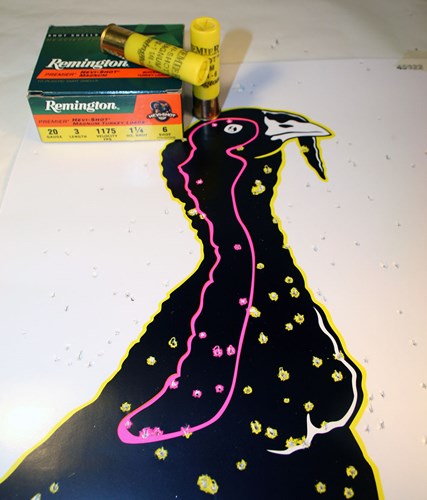
Of four loads tested, the best performing was the long-discontinued Remington Premier HEVI-Shot load when using the Primos choke, which placed 16 No. 6 HEVI-Shot pellets in outlined the turkey’s vitals and 146 in a 10” circle surrounding the point of aim. Its performance was nothing short of phenomenal. Although this load is unavailable, virtually identical ones—with regard to shot size, type, and payload—are offered by HEVI-Shot in its HEVI-13 line. I would expect very similar—if not better—performance. Using the Primos choke tube, Federal’s Heavyweight placed nine No. 7 pellets in the “kill zone” and 58 in a 10” circle. A second shot delivered five and 86, respectively. Again from the Primos choke tube, Remington’s Nitro Turkey scored six No. 5 pellets in the outlined brain and neck and 64” in the 10” circle. When fired from through The Undertaker choke tube, the numbers increased slightly; 10 pellets impacted in the “kill zone,” and 69 fell within a 10” circle surrounding the point of aim—not bad considering the load’s modest cost. Lastly, from the Primos choke tube the Hornady Heavy Magnum load delivered four No. 5 pellets in the “kill zone and 38” in a 10” circle. Based upon these results, I wouldn’t suggest shooting at a turkey beyond 35 yds. with the Hornady load. In the evaluation arm, any of these loads would ground a gobbler out to 35 yds., and several were 40-yd. loads. It just goes to show that you that, with the right load and choke, the 20 gauge is plenty of gun for tackling turkeys at practical shooting distances.
As evidenced above, thanks to technological improvements in ammunition and choke tubes, at all practical distances a 20 gauge is easily just as capable of tagging a tom as is a 12 gauge. Best of all, there’s less recoil and the guns’ light weight, such as the aforementioned 5½-lb. Stevens Model 555, are a joy to carry and easy to maneuver. This begs the question: Is there a reason to carry a 12-ga. shotgun turkey hunting? You decide.