Whitetail deer: they are a staple of our hunting world. No matter how many extravagant hunts we head out on, no matter how exotic the species may be that fuels our dreams, the whitetail deer is always there for us—season after season, decade after decade. While it may be argued that the wild pigs may be a more popular game species worldwide, it’s pretty safe to say that the whitetail is North America’s most popular big game animal.
What, then, is the greatest cartridge ever designed to take a whitetail? That’s about as easy as naming the greatest guitarist of all time; it’s both subjective and easily debatable. Nevertheless, it’s been assigned to me to try and figure out—among the myriad of cartridges that we have on our menu—what exactly is the best cartridge designed for the whitetail deer, and only for whitetail deer.
Assuming that no other species were to be pursued with this cartridge, and that we’d pursue the whitetail in any and all of its habitat—from Sonora to Saskatchewan—there will be certain requirements that must be met. Now, I’m well aware that any and all sort of firearm ever invented has been used to (successfully) take a deer, and I’m not about to denigrate or shame anyone’s choice; I’ve been asked to tackle the assignment of choosing the best cartridge for whitetail, continent-wide.
Let’s, for a minute, take into consideration what we’re talking about here. I’ve hunted deer in the pine-forests and scrub-brush of Texas, where the body size may not exceed 100 lbs., and I’ve also hunted them in the arboreal forests of the Adirondacks and Minnesota, where a 250 pounder may not be out of the question. While I know people who have (on both sides of legal methods) used .17 caliber centerfires and the .22 Long Rifle to take a deer, as well as those who favor the .45-70 Government or maybe even one of the Nitro Express cartridges for their deer rifle, I’d say that the all-around rifle cartridge lies somewhere in the middle; a cartridge that will equally handle the largest Canadian bruiser, as well as shoot flat enough to reach any deer within sane hunting distances.
So, where do we settle in the middle? Personally, I've used bullets from 6mm in diameter, up to and including .375 bores. What I envision—what I’d build were my mission to build the ultimate whitetail rifle—is to find a cartridge that will provide a level of recoil that is comfortable enough to be accurate under all conditions, has a muzzle velocity capable of producing a trajectory curve that will make hits out to 400 or 450 yards feasible, and enough striking energy to dispatch a deer out to those same distances. Additionally, the wind-deflection numbers should be on the favorable side, so that a day on the Wyoming prairie doesn’t make life difficult.
These demands will rule out the 6mms; the wind is simply just too much for the bullet weights in 6mm. While I took my best whitetail in Texas with a .243 Winchester, it was dead-calm, and at 125 yards, it didn’t require a whole lot of ballistic over-thought. Same can be said for the .35 caliber deer-guns: a low muzzle velocity combined with a low Ballistic Coefficient sort of handicap these cartridges out past 300 yards. While they certainly have worked in the past, and will again in the future, I don’t feel that either of them comprises the “ultimate deer cartridge.”
It sort-of boils down to a cartridge between 6.5mm and .30 caliber in diameter, delivering a bullet of somewhere between 140 and 180-grains, and at a respectable muzzle velocity. While my gut wants me to write that the 6.5-284 Norma and/or .270 Winchester should be crowned, I know that the true northern giants of Canada might demand something with a bigger bore diameter, especially with a marginal shot. Looking at a variety of factors, like wind drift, bullet choice, ammunition availability, and the chance of a marginal hit on a bruiser, my brain is over-riding my gut and telling me one of the .30 caliber cartridges would make for a perfect all-around choice. But, which one?
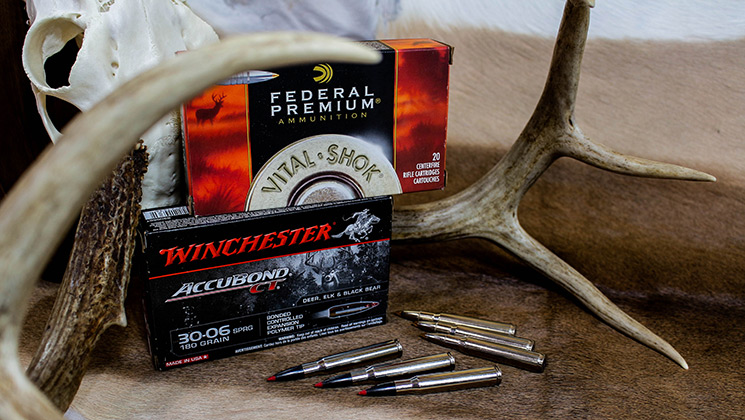
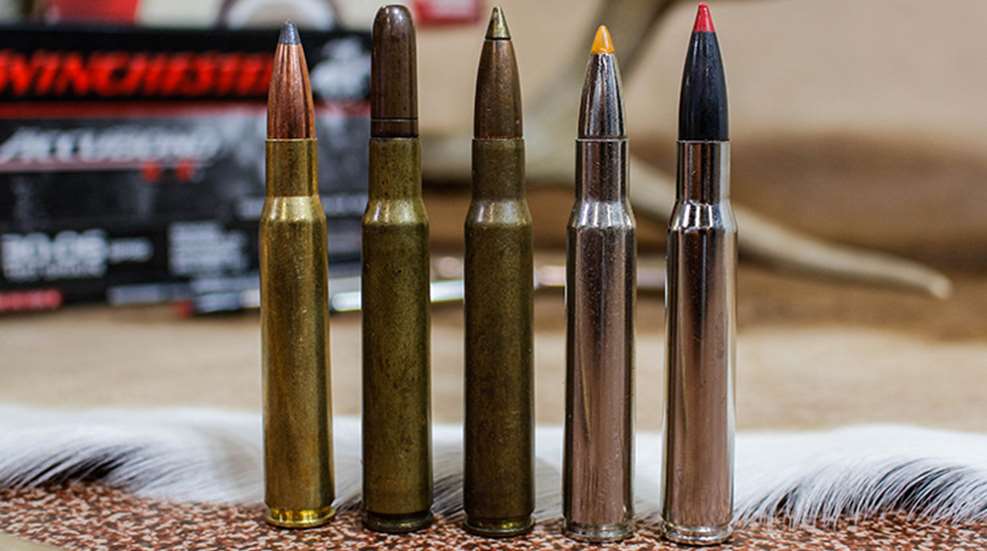
There is no shortage of .30 caliber cartridges to choose from—from the classic .300 Savage and .308 Winchester, up to and including the plethora of .300 Magnum-class cartridges. There’s something about .30 caliber bullets; between 150 and 180-grains you can just about perfectly outfit yourself for any situation from long-range to up-close horsepower. Most of my time in the deer woods has been spent with one of two .30s: either the .308 Winchester or the .300 Winchester Magnum; both have worked perfectly, and I wouldn’t hesitate to use either again. But, were I forced to hunt nothing but whitetails with this hypothetical rifle, I feel that we had the answer in 1906: the .30-’06 Springfield.
Taking a long, hard look at all the possible hunting scenarios; from a Texas Sendero where the shots may range out to 450 yards, to the 100 yard shots in the Canadian wilderness; the ought-six can do it all, and do it well. Firstly, the recoil generated by a .30-’06 is low enough that just about any shooter can handle it. Secondly, it will handle a whitetail at just about any ethical shooting distance, and I’m purposely excluding the extreme long-range shots that have become all-the-rage these days. Thirdly, it is so popular that in a pinch, a box of ammunition will be available in just about any general store that sells ammunition, throughout the entire range that whitetails are hunted.
It has a steep enough shoulder for good headspacing, and enough case capacity for respectable, if not magnum, velocities. The wide variety of .30 caliber bullets is certainly a benefit, as is the fact that the ’06 can be chambered in just about any type of rifle produced. Sometimes, the designers get things right the first time around, and I feel that is the case with the .30-’06 and deer hunting; though it was bred for combat, it makes just about the perfect choice.
So, there it is. I didn’t make this decision lightly, I actually consulted with a number of highly experienced whitetail hunters and guides, and they all recommended cartridges between .280 Remington/7mm Remington Magnum to ’06/.300 Winchester Magnum. While I see the wisdom of a lighter bore and a premium bullet, there is no denying that a .30-’06 Springfield—with a premium 150-grain polymer-tipped boat tail or a 180-grain Partition—has, will, and shall continue to do all that is asked of it, especially where deer are concerned.