Ode to the .30-’06 Springfield
Way down in Cuba, upon San Juan Hill
Col. Roosevelt realized the Krag’s little pill
Just wouldn’t suffice
So he had to charge twice
And make up the difference with courage and skill.
The Army designed a new cartridge divine,
With velocities higher than those of their time,
At Springfield they saw,
A design without flaw
That would give generations a chance to opine.
Whether mated with telescope, or bayonet fixed,
American soldiers, they got in their licks,
And they fought ‘til the end,
So sit down my friend
And hear now, my Ode to the .30-‘06
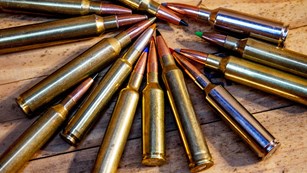
Roosevelt, Hemingway, Ruark, Fitz: All are famous hunters, and all are famous hunters who fully embraced the .30-’06 Sprg. as a hunting cartridge. While the military history of the ought-six is undeniable, its hunting history is equally stellar. In the 21st century, we have a near-silly amount of cartridges that will launch .30 caliber bullets to useable hunting velocities, yet the design from 1906 stands proud and tall, still leading the parade. Like its elder cousin, the .30-30 WCF, it still makes the top 10 in the ammo sales lists, and the .30-’06 has been offered in just about every type of rifle conceivable. Not to mention the fact that the case has spawned some of the coolest cartridges ever, such as the .270 Winchester, the .25-06 Remington, the .338-06 A-Square and the .35 Whelen. What is it about the Cartridge, Caliber .30, Ball, M2 of the Second World War that translates so well into a hunting cartridge?
 In my opinion, the ’06 represents one of the best balances of accuracy, velocity and manageable recoil in the history of firearms. While the .30-30 holds the mythical claim to fame of having killed more whitetails than any other cartridge, I think the .30-’06 has killed more game across the globe than any other, save maybe the .375 H&H Mag. It is equally at home in the forests of Bavaria, the jesse-bush of the Zambezi Valley, the hemlock thickets of the Adirondacks or the sagebrush of Wyoming. It is shooter-friendly, in that most hunters can handle the recoil of the ’06 while still placing shots accurately, and there are such a wonderfully wide selection of bullet weights and constructions that it can effectively take game of many different sizes. As a matter of fact, if you were to pair it with a good .375 H&H or one of the .416s for the true heavyweights like Cape buffalo, grizzly and elephant, you’d easily hunt the whole world with a two-rifle battery. Whether you’re after Texas whitetails with a good 150-grain bullet, eland in the miombo with a stout 220-grain round nose, or elk in the Rockies with a 180-grain spitzer boat tail, the same rifle will handle them all.
The ’06 generates enough velocity to enjoy the benefits of the premium bullets, yet doesn’t cross that threshold where traditional cup-and-core bullets will blow up on impact. Being .30 caliber, the bullet weights will range from 100 grains all the way up to 250 grains (in the Barnes Original) and the ought-six handles them all well. Having a 1:10” twist rate, it will easily stabilize the longest bullets, and the case capacity will avoid heavily compressed charges. My dad and I shoot a ton of .308 Winchester (Ol’ Grumpy Pants was made a believer at Ft. Leonard Wood in the late 1960s, with an M14 in hand) and he always told me that anything the ’06 could do, the .308 could do equally well. I’m not going to argue with him anymore, but there is a difference—although negligible. The .308 lacks the case capacity to push the heavier bullets well, and the early .308s came with a 1:12 twist rate, so the longer bullets wouldn’t stabilize well. With 200 and 200-grain bullets, the .30-06 shows its advantage over its shorter brother. I am also a huge fan of the .300 Win. Mag., having carried one all over America, Canada and South Africa. While I like the additional velocity and horsepower, I can honestly say that I have never made a shot with a .300 Winnie that I couldn’t have made with an ought-six.
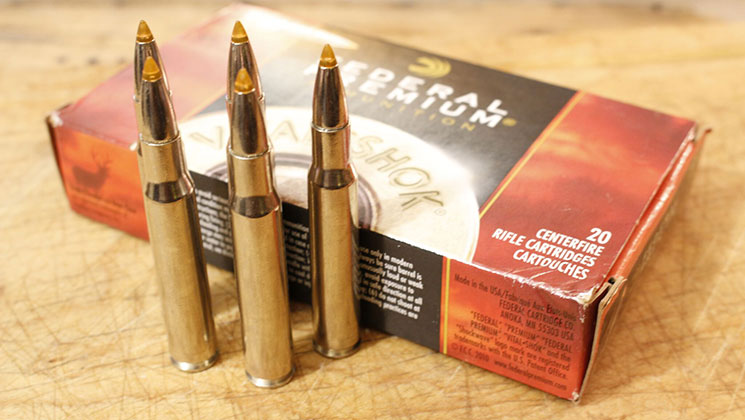
The serious hunting loads usually use bullets between 150 and 220 grains, and they will suffice for 90 percent of the world’s game. With a 150-grain bonded-core bullet like the Swift Scirocco II, and a muzzle velocity of 2,900 fps, you have a stout, flat-shooting load that will handle any deer or antelope that God ever put on earth. Bump up to the 180-grain Trophy Bonded Tipped from Federal, and that bullet is still leaving the muzzle at a respectable 2,700 fps, for just 3,000 ft.-lbs. of energy, perfect for elk, moose and black bear. If you want to use your Springfield for some of the true heavyweights, like bison, grizzly and eland, I’d recommend the classic load of a 220-grain bullet—like the Hornady Interlock—at a muzzle velocity of 2,400 fps for 2,800 ft.-lbs. of muzzle energy, and all sorts of penetration.
The magic formula that is the .30-’06 has often been tinkered with, and they have tried for 110 years to improve upon it, but the bottom line is this: when you stumble upon a design as cool as the chocolate-chip cookie—which the .30-06 is—there’s really no need to mess with it.
Most Popular