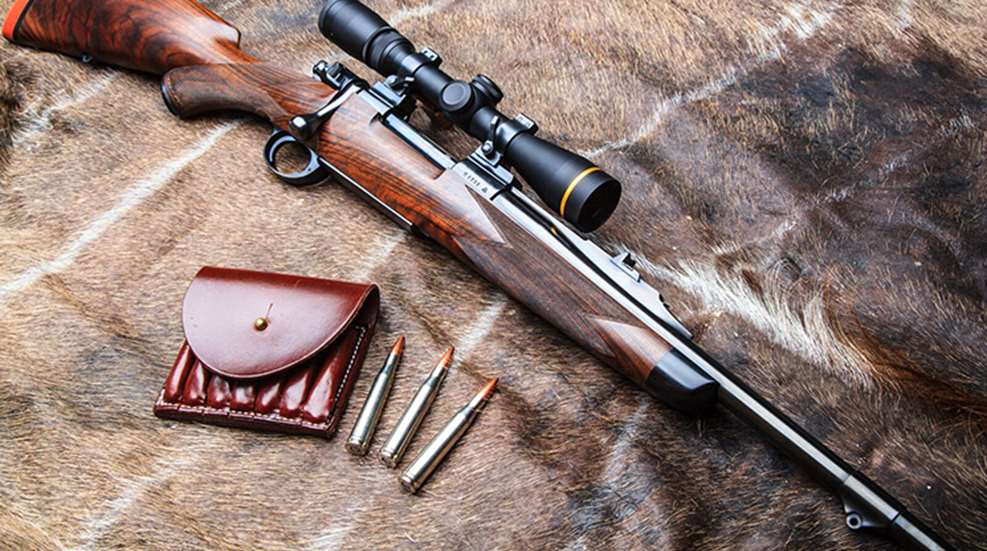
At first glance, declaring a rifle “the greatest ever” was to be a daunting task. The rifle, as we know it, has been around for hundreds of years and many examples have come as close to perfection as imagination and technology allowed. Rifles have been made to shoot tiny groups at ungodly ranges and have been crafted with almost unimaginable beauty. After much reflection, though, the choice was relatively simple. The same contender kept showing up on every list. No, it's not a rifle that's known for especially great accuracy, or because it features hundreds of hours of masterful engraving. Its genius is in its fundamental design—function personified. The winner, in my book, must be the 1898 Mauser.
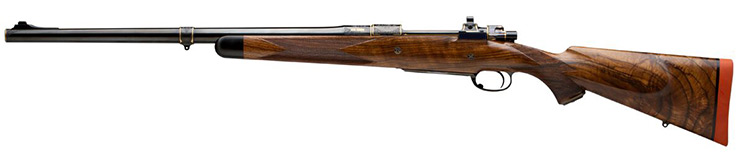
Oh, you disagree? Fine—but name for me a bolt-action design introduced since the Mauser that isn’t an evolution or an all-out plagiarization of the German masterpiece. Your list probably won’t require all of your fingers. The 1903 Springfield? A Mauser copy that required the payment of royalties. The Winchester Model 70? Clearly an evolution of the Mauser ‘98. Maybe a Kimber? They used the extractor. Ruger M77 Mk II? Yep. CZ 550? Aye. Are you sensing a trend here? Military- and police-issue Mausers were adopted by so many nations around the world that it’s nearly impossible to keep track. There are Czech Mausers, Turkish Mausers, Argentines, Chileans, Bolivians, Columbians, Mexicans, Siamese, Persians—you get the idea. In terms of being prolific as a battle rifle, one could say that the Mauser was the AKM of the first half of the 20th Century. There are so many factory variations of the basic 1898 design that entire books have failed to catalog them all. Mauser sporting rifles, whether factory, custom, or home-built, can be found anywhere that hunters roam.
The ’98 wasn’t the Mauser brothers’ first stab at a turn-bolt action, but it was certainly their most successful. The Mauser was designed as a military rifle and was state-of-the-art technology at its inception. War is, and was then, a dirty exercise prone to breaking out in inhospitable corners of the globe. Every element of the rifle was engineered to be reliable and durable in any conceivable environment. Enthusiasts often point to the 98’s massive, non-rotating claw extractor as the key to its reliability. While remarkable, it is but a single piece in the puzzle. Surplus military Mausers made a century ago feed, fire, extract and eject with reliability that many of today’s rifles could only dream about. The massive cocking piece doesn’t have the lock time of a target rifle, but it ensures that the primer goes bang every time. The gaping receiver may compromise rigidity, but its fast to load and has plenty of ejection clearance—factors that could become lifesavers during a dangerous game encounter.
Everything from the Mauser’s cock-on-opening operation to the fixed ejector was built to minimize and mitigate failure. If a catastrophic ammunition-related failure did occur, the 98’s gas-handling features and third bolt lug protected the shooter’s eyes and face from nasty wounds. Gas handling is a big deal that you’ll likely never concern yourself with until a case fails, at which point, it may be too late to consider. Paul Mauser himself lost an eye from a rifle firing out of battery, so his obsession with safety is understandable. Mauser’s August, 1895 patent application goes into specific detail regarding how his action design protects the shooter from gases that “forms not only a danger to the person using the arm but also causes more or less damage to the weapon”. Hunters afield are at no less risk of a case failure than soldiers were in the trenches of Verdun, and the Mauser protects each equally.
When Mauser began making sporting rifles, it did not delete the features that made its rifles so reliable on the battlefield. Rather, it embraced them. Likewise, when Mauser actions were exported to England to be made into Rigbys, Jeffreys and Westleys, their legendary reliability was maintained. Even today, the finest sporting rifles on the planet often begin as Mauser ‘98s, or modern clones. My .300 H&H was built on a 1909 Argentine Mauser and my 7x57mm was made from a Steyr G.29/40; there’s another 1909 on my bench at the moment that will resume life as a .35 Whelen. Firms such as Prechtl and FZH are building proper Mauser actions with tight tolerances and modern steels that combine the best of modern technology and a timeless Victorian-era design. Even with modern CNC machining methods available, the Mauser action is expensive and complicated to produce; that it was mass-produced so well with belt driven manual machines is staggering.
So we have an action designed on a military budget with almost no object to cost or commercial viability. This action was designed to be as reliable and as safe as possible and is capable of sub-MOA accuracy at the hands of a good maker with a fine barrel. It is so stylistically beautiful that even the famed “Golden Age” English gunmakers did not attempt to improve upon it. It can be scaled to the tiniest of centerfires and stretched to accommodate the largest elephant stoppers. It has been copied and adapted but still, over 100 years after its design, can barely be improved-upon for a sporting repeater. It is, without debate, the greatest rifle ever made.