You don’t hunt whitetails the same in September as you do in December, so why would you stick with the same coyote strategies from the start of predator season to the end? Of course, you might if you had access to thousands of acres of prime coyote country that doesn’t receive hunting pressure, as those coyotes wouldn’t have learned that the death throes of a bunny might not be real. Those coyotes have never experienced the chase from an accelerating truck bouncing across a pasture blazing a dusty path toward them. Those coyotes have never felt their hide burn from a near miss after they’d investigated a squeaking rodent… . With the surge in popularity of predator hunting, those un-hunted spots mostly just exist in daydreams. So instead of moping around the house wishing Ted Turner would offer you access to his vast estates, here’s how to call in coyotes that have heard it all.
Several years ago I shared a predator camp with calling-legend Gerald Stewart. His Texas wit combined with his deep knowledge of predators making hunting with him one of the most enjoyable and influential weekends of my predator-hunting career. The amusing camp atmosphere was memorable, but I marveled even more at Stewart’s carefree willingness to try a variety of calls, even during the same setup. Although I still won’t use an array of calls at a whim’s notice, I have discovered that you can keep success flowing by using different calling strategies to match coyote mindsets throughout the winter.
Early Winter Coyote Strategies
If you’ve timed your hunt wisely you’ll be the first in line at a particular property and the first to test naïve coyotes with the basic coyote calls. There’s no need to dive deep into your bag of calls yet, especially if you hit the calling window just as coyote furs prime for the winter.
In most locations, coyote pelts are prime by November—the only exception is coyotes that reside in the Deep South where pelts may not be prime until December. Hunters of the high-mountain West have an advantage, since those coyotes fur-up early, often in October. Regardless, if it’s October or early December, most hunters still have other species keeping them occupied early in the traditional predator-hunting season. Whether it’s late-season deer, waterfowl or small-game seasons, few hunters have coyotes on their minds until it’s time to stash the Christmas decorations for another year.
Most yearling coyotes haven’t heard a manufactured call, so if you hit this window you can lure naïve coyotes with tried-and-true prey-in-distress calls, such as cottontail-in-distress, jackrabbit-in-agony calls and rodent squeaks or bird squawks. Youngsters, fresh from being evicted from the den, may be struggling with their hunting skills.
Each year I try and wrap up my big-game hunting by early December so I can take advantage of this high-success window. Even though I include rabbit-in-distress calls, I still try to provide confidence calls, such as howls. Why? Young coyotes have disbanded from litter mates and are investigating howls as they settle into their new territories. Regardless of how they perceive the howl—kinfolk or territorial invader—it will perk their curiosity.
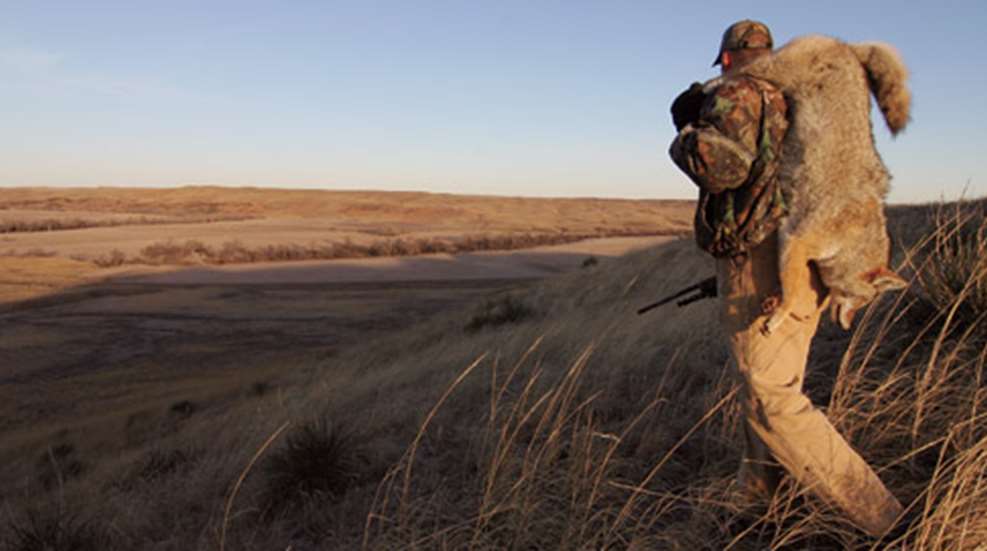
One of my most memorable early winter setups took place within sight of the skyline of my hometown. It was mid-December and I could tell by the trackless dirt at the gate that I was first in line. After a 20-minute hike I had reached a ridge looking down into a jungle of brush and eroded nooks and crannies. I kicked off the hunt with two to three long, mournful howls and waited. After five minutes I added in the bawls of a fawn in peril. A coyote appeared from a brush pocket 600 yards below and padded over to a cow trail. Instead of continuing the fawn call I sat silent and allowed the coyote to hunt me. It continued ambling my way and, when it rounded a corner at 100 yards, I barked. The coyote stopped and I added my first coyote, a young male, to my winter fur cache.
Mid-Winter Setups
The first few weeks of coyote season can be like fishing for bluegills in an un-fished city pond. Every cast results in a bite, but after the New Year’s ball falls in Times Square it’s a different story. Bored hunters have switched gears to coyote hunting. As if that isn’t enough pressure, coyote-calling contests have become very popular. Cities, sportsman’s clubs and sporting goods stores around the country host these events and thereby put novices and experts alike in the field to kill coyotes. If you’re up against weekend warriors or an entire platoon of coyote contestants, it’s time to change tactics.
Although I still use distress calls after the first of the year, I only use them in areas where I believe hunting pressure has been low to nonexistent. Tire tracks, convenience store gossip and landowners can reveal how much pressure coyotes have gotten in your neck of the woods. When uncertain, I deem coyote vocalizations to be a better option than prey-in-distress calls. Howls are simple confidence calls, yet they can lure a coyote from miles away. At a minimum, howls may entice a coyote to howl so you can move closer for another setup.
I begin most setups with simple howls. A non-aggressive howl either invites a response howl or a visual inspection. By midwinter coyotes often return the “hello,” but sometimes falter on the face-to-face greeting. To pique their curiosity further I add the sounds of fighting coyotes. It’s been surprisingly effective.
Why include fighting canines? My belief is that everyone loves a good fight. Coyotes may race to the sounds of fighting coyotes to check for territorial invaders, to see if there is a food fight or simply to have a ringside seat. When the winter is brutal, coyotes definitely respond better to the sounds of coyotes clobbering each other. In my northern hunting grounds deep snow also helps. When you combine these elements, I feel coyotes respond because they believe coyotes are fighting over the last drumstick.
Last year the snow was deep early and coyotes packed up. One morning I sat on a ridge and heard coyotes answer, but none showed. After 45 minutes I hiked to the next ridge to see if I could spot any of the culprits. Sure enough I spied not one, but seven coyotes hunting across a hillside on their way to a neighboring property. I hustled out of sight to a new setup location and immediately began a series of coyote fighting sounds with my Johnny Stewart digital caller and a mouth diaphragm call. I estimated the coyotes at nearly a mile away, but within a few minutes the entire pack was running straight at me. I’d like to say I got all seven, but two confirmed kills is good morning for me.
Killer Late-Winter Tactics
If you think midwinter coyotes can be difficult, then you’ll find that late-winter coyotes are wily. By this point most coyotes have heard it all, including a pickup in hot pursuit. Although any call may work at any time, it takes a special message to bring a coyote into rifle range for a Valentine’s Day date. Speaking of Valentine’s Day, you do have one card to play: The month of February marks the time period when coyotes court, fall in love and settle into dens.
Do I need to remind you how love can cloud your judgment? I didn’t think so. Coyotes wear the same rose-colored glasses in February as adolescent males do year-round. As the race ramps up to find a mate, coyotes wear the pads off their feet in their attempts to meet the right partner.
Simple howls work to lure coyotes into range during breeding season. That isn’t to say the coyotes haven’t been duped by hunters’ howls already and so have learned to keep a safe distance. It’s just that their hormones override their intellect; however, if you’re looking for a new sound, practice up on the love language of coyotes. Like dogs, coyotes have a range of vocalizations. Although the various howls are the most familiar, in breeding season females incorporate high-pitched yips and whines into their vocabulary to advertise their willingness to mate. I’m sure several coyote experts claim they first brought this sound into the limelight, but I first heard about it from coyote aficionado Dave Tatum, a former animal-damage-control officer who currently guides hunters in South Dakota. One February he witnessed a pair of coyotes making these high-pitched whines. It’s been his top calling strategy from mid-January through mid-March ever since.
If you want to send a love letter vocally, you need to capitalize on the coyote estrous yip, the estrous whine and the basic howl. Estrous yips are short, simple and high pitched. Three or four advertise a female is in the area. These are unmistakable to male coyotes. Follow the yip with what’s referred to as the “estrous whine.” Forget the fancy definition and imitate the whining your pooch makes when you pluck a steaming-hot bratwurst from the grill. Give it intensity and sound sultry. Wait for up to 15 minutes. If that doesn’t do the trick you can always end your setup with a howl for a long-range invite.
Last winter, before I stashed the coyote gear for the season, I decided a breeding-season hunt was in order. I knew coyotes preferred to den on a particular ridge that overlooks a creek. To give myself a late-season advantage, I slipped in as close as possible.
I first advertised my presence with a series of high-pitched estrous yips and followed them with submissive whimpers. That’s all it took. A coyote raced off the ridge and crossed the creek bottom. I lost sight of it as it coursed toward me through a steep gully, but when it reappeared I had a 75-yard shot. After the shot I checked out the coyote and to my surprise discovered it was a female, likely defending her den site, spouse or dignity.
Regardless of her reasons for responding, I ended my coyote season just like I started it with a slam-dunk setup. The only difference was in the message I sent. Without a change of dialogue the outcome would have been very different.