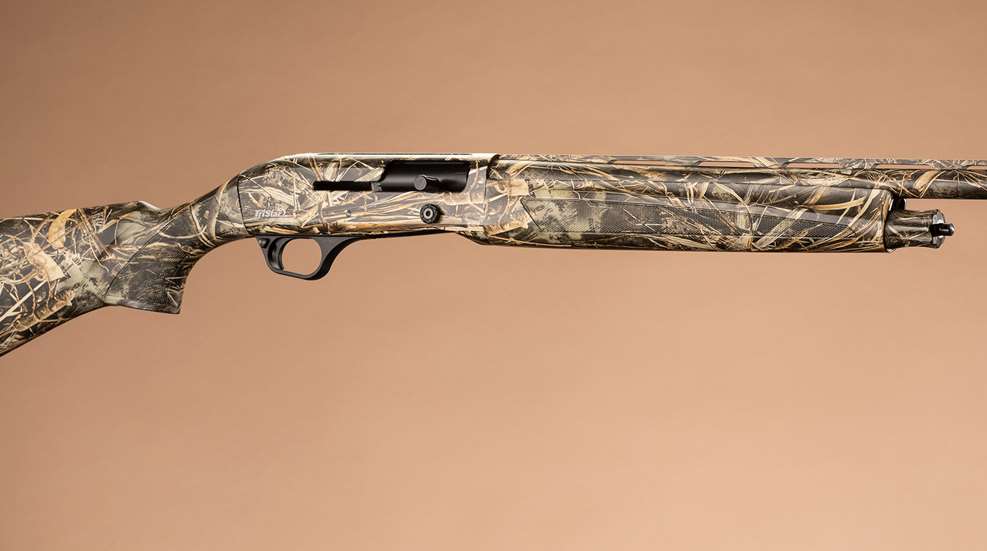
American gunmakers have been importing inexpensive semi-automatic inertia-driven shotguns from Turkey for years. However, many of the early models shipped to the U.S. were not well made, causing hunters and shooters to steer clear of Turkish autoloaders. Over the years, the gun houses in Istanbul have improved the quality of their guns, so that they function more reliably. Companies like Weatherby and Stoeger have long relied on inertia-driven Turkish imports. You can add Missouri-based TriStar to that growing list of manufacturers.
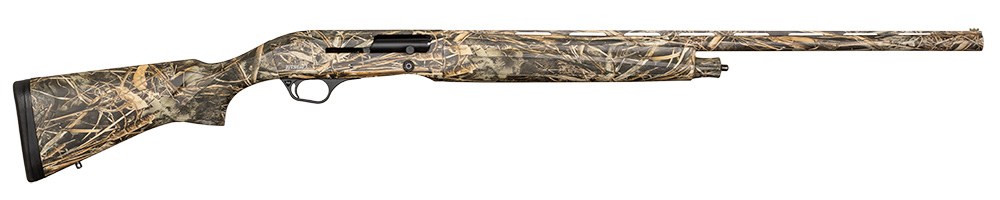
TriStar debuted its first semi-automatic inertia shotgun, the Matrix built by Khan Arms, in 2022. The company had previously sold only gas-operated autos, but decided that with the continued popularity of inertia guns, especially among duck hunters, they would enter that market as well.
“We’ve had a lot of gas guns in the past,” said TriStar VP of Marketing and Sales Ryan Bader. “With inertia guns, you don’t see as much energy loss, so there’s more knockdown ability downrange. Like many TriStar shotguns, you get an oversized bolt handle, an oversized bolt release and a bigger (magazine) well for easier loading.”
My 12-gauge test gun came in Realtree Max-7 (it’s also available in a synthetic black finish or wood and steel exterior). Like most inertia shotguns, the Matrix has trim lines, weighs only 7 pounds and has very little bulk in the fore-end. Gas-driven shotguns often have a bit more heft in this area because the piston that drives the bolt sits at the top of the magazine tube. Because the Matrix is so nimble, it’s more responsive and swings quickly to the target, especially if you’re a snap shooter and need to pull the muzzle through the bird as opposed to continuous lead where you insert the barrel in front of the target.
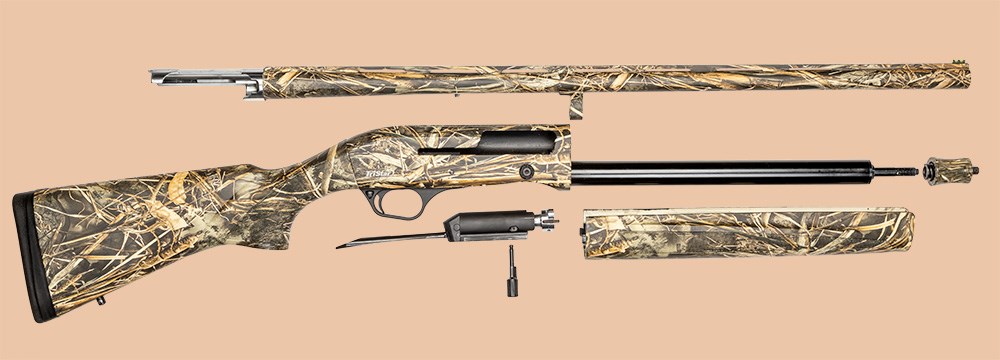
Inertia guns are much simpler to field strip than gas guns (we will tackle why this is so important for duck hunters later) because there are fewer parts. Once you unscrew the fore-end cap of the Matrix, the 28-inch vent-rib barrel and fore-end slide off together, though they are two separate parts once the barrel is removed from the action. The recoil spring is housed in the stock, not around the magazine tube, so you can move right to the bolt assembly, which can be taken out once you remove the bolt handle. There’s no need to press down on the bolt head or bolt release to pull out the handle. Just give it a tug with some force and it comes loose. Drop the trigger group by tapping out a single pin that holds it in place and you are ready to give the Matrix a deep clean.
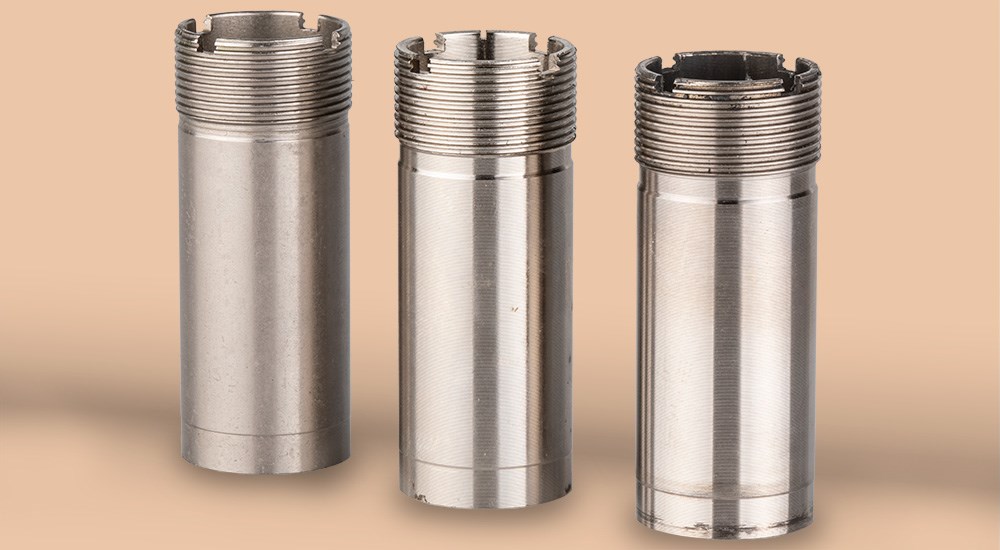
The Matrix comes with three chokes—IC, M and F—that are identified by the notches made in the muzzle end of each choke. There is nothing etched into the sides of the chokes to distinguish one from another. At the patternboard, I inserted the modified choke and shot both Winchester Bismuth (3-inch, 1⅜-ounce, 1450 fps, No. 4) and Hevi-Teal (2¾-inch, 1⅛-ounce, 1500 fps, No. 6) five times each on 35x35-inch butcher paper from 40 yards. Both loads produced an even 50/50 pattern each time I shot. I took the gun on a handful of duck hunts as well. The Matrix was a joy to shoot, mounting easily to my shoulder, and it performed flawlessly in 30- and 40-degree temperatures.
My only complaint is that the cross-bolt safety is at the rear of the trigger guard. That’s problematic for a left-handed shooter. I don’t mind having to reach under the trigger guard to click over the safety, but the recoil (which is stout when shooting 1⅜-ounce loads) produced by the first shot sometimes causes my trigger finger to push the safety back on, so I don’t get a second shot if needed. But that issue is not isolated to the Matrix. Most inertia guns have a rear safety, so southpaws have to drop the trigger group and reverse the safety if possible; if not, which is the case with the Matrix, our autoloaders sometimes become single shots.
When evaluating most duck guns, I put them through a torture test. Duck hunters are hard on gear, shotguns included. We drop them on the ground, throw them in the bottom of the boat and rely on them to paddle our boats back to the ramp when engines fail. To start, I leaned the Matrix up against the tailgate of my truck and pushed it over on a gravel driveway three times to see if the Realtree Max-7 finish held up. The Matrix suffered a few nicks, but nothing I wouldn’t expect if I dropped a gun on the rocks.
Next, I took the Matrix to the family fishing pond, submerged it underwater, and pulled it out to let it drain. My protocol is to fire 12 rounds (Winchester Bismuth in this case) in four, three-shot volleys to see if the guns cycles properly, which the Matrix did. Duck guns often go for a dip, so this is a good test to see if a repeater will run when it gets wet.
Finally, I grabbed a handful of dirt and tossed it in the open action of the Matrix. This simulates a gun that falls in the muck or a rainy/snowy field hunt where the action can get extremely dirty. I used the same 12-shot, four-volley protocol. The Matrix made it through two shotshells before jamming. This is typical of any autoloader or pump shotgun I have tested. One pump made it through three shells, but as that dry dirt turns to mud, it cakes on the walls of the receiver and makes it impossible for the bolt to operate.
To be clear, I don’t expect any shotgun to operate under such extreme stress. But shooting an inertia shotgun like the Matrix makes it much easier to get your gun up and running again if it does get this grimy. All you need to do is field strip it, wipe out the action (carrying a toothbrush or small wire brush is helpful), reassemble it and you’re back to hunting.
Technical Specifications
• Type: inertia-driven, semi-automatic shotgun
• Gauge/Chamber: 12 / 3" (tested); 20 / 3"
• Capacity: 2+1
• Barrel: 28"
• Trigger: 3.3 lbs. pull weight
• Sights: fiber-optic front pipe
• Safety: cross-bolt
• Stock: synthetic, Realtree Max-7 (also available in matte black or wood), LOP 14¼", drop at heel 1.21", drop at comb .90”
• Metal Finish: Realtree Max-7
• Overall Length: 49"
• Weight: 7.2 lbs.
• Accessories: IC, M, F chokes
• MSRP: $685; tristararms.com