How would you like to cut the stopping distance of your pickup or SUV by 7 feet in wet conditions?
How about 20,000 more miles of tread life over “stock” tires? Or 4 percent better fuel economy?
All three improvements are possible if you do some research before buying replacement tires.
Studies have shown that the average light pickup truck or SUV owner can expect to get anywhere from 30,000-40,000 miles of tread life from his tires before they need replacement. Of course, sportsmen who do a considerable amount of offroad driving will probably see less tire life since tread wear becomes even more dependent on the severity of offroad use (i.e. steep climbs, hills, sharp rocks). And using your 4WD or AWD system a lot also affects tread wear. What’s more, if you’re an outfitter or rancher, you probably have even more severe and rugged transportation requirements when compared to average hunters who use their 4x4s primarily for daily use on paved roads. As such, you’ll need a tire that can go beyond the norm.
So how do you know if your tires need replacement? First look for wear bars, the narrow bands that can appear in the grooves across the tread. Here’s a good rule of thumb: If the wear bars are even with the tread depth, and only 2⁄32 of an inch of tread remains, it’s time for replacements. Then there’s the penny trick. Place a penny in the most shallow tread groove with Lincoln’s head down. If you can see the top of his head, the tire should be replaced.
Other factors? Was the tire repaired with a plug rather than patched from the inside? Exterior plug repairs, say all tire manufacturers, are not reliable and can lead to failure. Sidewall cracks, or worse, bulging, can also lead to tire failure. And then there’s the problem of replacing only two tires, something many of us have to consider because of economic conditions. If you decide to buy only two tires, make sure they’re installed on the rear axle as they’ll offer better traction and help reduce the potential for your vehicle to fishtail or hydroplane in wet conditions.
With 25,000 miles on my Explorer tires, and with winter coming at the time, I looked for replacements. My criteria included finding tires that provided better fuel economy since my original deep-lugged tires delivered plenty of grip but were not kind at the gas pumps. I wanted good traction on snow for the few times they’re needed under those conditions. I needed them to be rugged and sure-footed to withstand an occasional offroad jaunt to retrieve a whitetail from the wooded acreage I hunt. I also wanted them to last longer than the 25,000 miles I averaged with my old set.
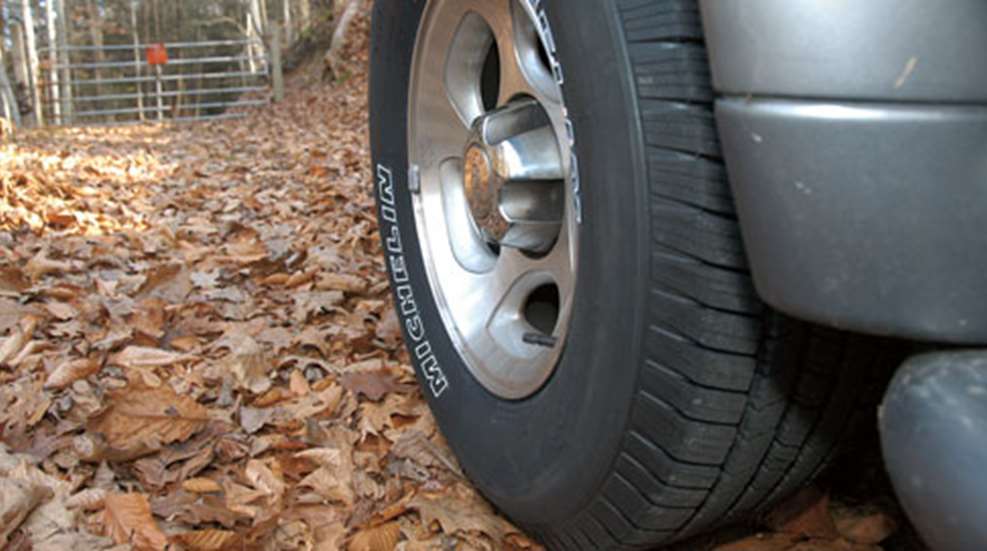
Having been to Michelin’s facility in Tennessee on a media introduction, I was partial to the company’s tires since I saw how they’re built and tested. I chose the company’s new LTX M/S2.
Michelin test driver Brandon Sturgis says the LTX M/S2 is the closest thing hunters who live in the Snow Belt will ever get to a snow tire. Although it looks like a conventional all-season tire, the LTX M/S2 uses a new, softer silica tread compound in addition to deep active sipes and 8 percent more biting edges in the tread blocks. Sipes are the tiny cuts in the tires that provide traction and stopping resistance. Michelin reps explain that their deep, active sipes lead to less bending of the tread blocks under torque for better fuel economy. The overall design, according to Michelin, allows better lateral water evacuation and a stopping distance 7 feet less than the competition. And with three steel belts in load ranges D and E, the M/S2 can handle loads up to 13,500 pounds. Added to that, the company claims the tire will last 20,000 more miles than the competitors’ and backs them with a 70,000-mile limited warranty.